

Key Takeaways
- Small Language Models (SLMs) are suitable for specialized tasks requiring low latency, efficient inference, and greater deployment control.
- Large Language Models (LLMs) offer broader knowledge, complex reasoning, and flexibility for unpredictable user requests.
- SLMs can reduce inference expenditure, but self-hosting and maintenance costs must be included in the calculation.
- On-device AI enables mobile applications to process supported tasks locally using technologies such as Apple Foundation Models and Google Gemini Nano.
- Hybrid architectures combine SLM efficiency with LLM capabilities, making them practical for applications with different levels of task complexity.
Businesses adopting artificial intelligence must balance model performance with inference costs, response times, infrastructure requirements, and data privacy. Using a large model for every application task can increase operating expenses, while smaller models may struggle with complex reasoning and unfamiliar requests.
The choice between SLM vs LLM depends on the complexity, scale, and sensitivity of the tasks an application needs to perform. Small Language Models are efficient for specialized workflows, whereas Large Language Models offer broader capabilities for complex and varied tasks. An experienced AI-powered app development company can help businesses evaluate these requirements and select an architecture that aligns with their technical and operational goals.
Understanding these differences helps business leaders choose an AI architecture that meets application requirements without unnecessary infrastructure or operating costs. This guide compares both models across performance, pricing, deployment, privacy, and industry applications.
Table of Contents
What is an LLM (Large Language Model)?
A Large Language Model (LLM) is an AI model trained on extensive datasets to understand and generate human language. Using transformer-based neural networks and billions or trillions of parameters, LLMs can interpret context, answer questions, generate content, and handle complex instructions.
Businesses typically access proprietary LLMs through cloud APIs or deploy open-weight models on dedicated infrastructure.
Common LLM capabilities include:
- Natural language understanding: Interpreting questions and conversational context.
- Content generation: Creating reports, marketing copy, and product descriptions.
- Complex reasoning: Analyzing information and solving multi-step problems.
- Code generation: Supporting coding, debugging, and technical documentation.
- Multilingual communication: Processing and generating content in multiple languages.
Examples of LLMs:
- GPT models from OpenAI
- Claude models from Anthropic
- Gemini models from Google
- Llama models from Meta
- Qwen models from Alibaba
LLMs are suitable for applications that handle varied inputs, multiple subjects, and complex instructions. Businesses planning such applications can use an LLM app development guide to understand model selection, integration, infrastructure, and deployment considerations.
What is an SLM (Small Language Model)?
A Small Language Model (SLM) is a language model designed to perform focused tasks using fewer parameters and computational resources than a general-purpose LLM. It can understand instructions, generate text, classify information, and summarize content within a more specialized capability range.
There is no universally accepted parameter threshold defining an SLM. Models containing approximately 1B–10B parameters are commonly considered small, although some classifications extend the range to 30B parameters.
SLMs can be developed or optimized using several techniques:
- Knowledge distillation: Transfers capabilities from a larger teacher model into a smaller student model.
- Pruning: Removes less important parameters or connections to reduce computational requirements.
- Quantization: Reduces numerical precision in model weights to lower memory consumption and improve inference efficiency.
- Domain-specific fine-tuning: Adapts an existing model using specialized business data to improve performance on particular tasks.
These techniques help businesses deploy language models on smaller servers, edge devices, and compatible smartphones.
Examples of SLMs:
| Model | Organization | Typical application |
| Phi-4-mini | Microsoft | Reasoning and focused business tasks |
| Gemma 3 | Text generation and multimodal applications | |
| Llama 3.2 1B/3B | Meta | Lightweight assistants and edge applications |
| Qwen3 small models | Alibaba | Instruction following and reasoning |
| Ministral models | Mistral AI | Low-latency and resource-efficient inference |
SLM vs LLM: Key Differences at a Glance
Both models use language modeling techniques, but their architecture, computational requirements, deployment options, and capabilities differ.
| Comparison factor | SLM | LLM |
| Parameters | Commonly 1B–10B | Often tens or hundreds of billions; some reach trillions |
| Training data | Often curated or distilled for focused capabilities | Large and diverse datasets |
| Hardware | Can run on consumer hardware or edge devices, depending on size | Often requires substantial GPU infrastructure |
| Deployment | On-device, edge, on-premises, or cloud | Cloud APIs, private cloud, or dedicated infrastructure |
| Latency | Generally lower for comparable workloads | Can be higher for comparable workloads |
| Inference cost | Often lower for equivalent workloads | Generally higher for larger models and workloads |
| General knowledge | More limited | Broader knowledge and capabilities |
| Domain accuracy | Can perform strongly after task-specific tuning | Strong general performance and broader reasoning |
| Context window | Varies by model | Often larger, depending on model |
| Data control | Greater potential for local processing | Depends on provider and deployment |
| Customization | Often practical for focused fine-tuning | May require more training and serving resources |
| Hallucination risk | Higher risk when handling questions outside its training domain; RAG and fine-tuning can reduce errors. | Broader general knowledge, but hallucinations remain possible; grounding is important for factual tasks. |
The important distinction: Model size does not automatically determine business performance. A larger model may understand more subjects, but a smaller model trained for a specific task can produce more accurate and economical results.
SLM vs LLM: Detailed Comparison for Business Decisions
Choosing between an SLM and an LLM requires evaluating how each model affects application performance, operating expenses, security, and scalability.
1. Performance and Accuracy
LLMs generally perform better when an application needs broad knowledge, complex reasoning, or responses to unpredictable questions. Their larger capacity helps them interpret varied instructions and maintain context across multi-step interactions.
SLMs perform well when tasks have clearly defined inputs and outputs. A fine-tuned SLM can match or outperform a general-purpose LLM on specialized classification, extraction, and text-processing tasks.
For example, a financial application that categorizes transaction descriptions does not necessarily need a model with extensive general knowledge. A smaller model trained on relevant transaction patterns may deliver sufficient accuracy with lower inference overhead.
However, the same SLM may struggle to explain complicated financial decisions or analyze unfamiliar regulatory scenarios. Businesses should evaluate both models using their own datasets, measuring accuracy, output consistency, error rates, and performance on edge cases.
2. Cost: Training, Inference, and Running Expenses
The cost difference between SLMs and LLMs depends on how businesses access and deploy them. Three common deployment approaches have different cost structures.
API-based LLM deployment
Businesses pay model providers according to their pricing structures, commonly based on input and output tokens. Additional expenses may include embeddings, retrieval infrastructure, storage, and application orchestration.
This approach avoids managing GPU infrastructure and is practical for applications with unpredictable or moderate request volumes.
Self-hosted SLM or LLM deployment
Businesses run open-weight models on their own cloud or on-premises infrastructure. Expenses include GPU instances, memory, storage, networking, monitoring, maintenance, and engineering resources.
An SLM generally requires fewer computing resources than a comparable LLM deployment. However, infrastructure still needs to be provisioned, secured, and maintained.
On-device SLM deployment
The model runs directly on a compatible smartphone, computer, or edge device. This reduces dependence on cloud inference and avoids external per-request model API charges.
However, on-device AI is not completely free. Businesses must account for integration, device compatibility, application size, testing, battery consumption, and ongoing maintenance.
Deployment cost comparison
| Cost factor | API-based LLM | Self-hosted SLM | On-device SLM |
| Initial investment | Low to moderate | Moderate to high | Moderate to high |
| Infrastructure | Provider-managed | Business-managed | Device-managed |
| Per-request cost | Token-based charges | Infrastructure and utilization | No external inference API charge |
| Scaling | Increase API usage | Provision additional resources | Depends on supported devices |
| Maintenance | Primarily provider-managed | Business-managed | Application-managed |
| Best suited for | Variable workloads | High-volume, controlled workloads | Frequent local tasks |
For a broader implementation budget, businesses should also consider model integration, data preparation, testing, and ongoing infrastructure expenses. See the AI development cost guide for a wider breakdown.
3. Speed and Latency
SLMs generally offer lower inference latency because they process fewer parameters and require less computation. This makes them suitable for applications where users expect immediate responses.
Common applications include:
- Smart replies in messaging applications.
- Real-time text classification.
- Voice-command processing.
- Product search suggestions.
- Offline content summarization.
LLMs may introduce additional network latency when requests travel between an application and a cloud provider. Processing time can also increase with longer prompts and more complex reasoning.
However, model size alone does not determine response speed. Hardware acceleration, quantization, batching, network conditions, context length, and serving infrastructure also influence latency. For real-time applications, businesses should benchmark end-to-end response times instead of relying exclusively on model specifications.
4. Data Privacy, Security, and Compliance
Data privacy can determine which AI architecture a business can deploy, particularly in healthcare, fintech, insurance, and enterprise applications.
SLMs offer greater deployment flexibility. Businesses can run them on private infrastructure or compatible devices, reducing the need to send sensitive information to external model providers.
LLMs accessed through cloud APIs require careful evaluation of data handling, retention policies, access controls, encryption, processing locations, and contractual safeguards.
Three important compliance considerations include:
- HIPAA: Healthcare applications processing protected health information must meet applicable HIPAA requirements. HIPAA compliance app development involves implementing appropriate safeguards, access controls, and business associate agreements when using cloud services. Using an SLM alone does not guarantee compliance.
- GDPR: Applications processing personal data covered by GDPR must address lawful processing, transparency, data minimization, security, and applicable international transfer requirements.
- Data residency: Organizations may need to control where information is stored and processed to satisfy contractual, regulatory, or internal governance requirements.
On-device processing can reduce exposure by keeping prompts and personal information on the user’s device. However, it does not automatically guarantee compliance. Data synchronization, backups, application logs, analytics, and connected services must also be considered.
Recommendation: Evaluate the complete data flow, not just the model. A privately hosted LLM may provide better governance than an inadequately configured SLM deployment.
5. Customization and Fine-Tuning
Businesses can customize both models, but the resources and techniques required differ.
| Approach | How it works | Best suited for |
| Prompt engineering | Uses instructions and examples to guide responses | Quick customization without changing model weights |
| Retrieval-Augmented Generation (RAG) | Retrieves relevant business information before generating an answer | Knowledge-based assistants using current or private information |
| Fine-tuning | Updates model weights using task-specific training examples | Specialized language, consistent behavior, and repetitive workflows |
SLMs are often practical candidates for parameter-efficient fine-tuning techniques such as LoRA (Low-Rank Adaptation). LoRA updates a smaller set of trainable parameters instead of requiring full-model fine-tuning.
LLMs can also benefit from fine-tuning, but training and serving costs may be higher. For example, a logistics business could use RAG to retrieve current shipment information and an SLM fine-tuned to classify delivery exceptions. An LLM could handle more complicated customer questions requiring broader reasoning.
6. Scalability and Infrastructure
LLMs typically need substantial computing resources, particularly when handling high concurrency, long context windows, and complex generation tasks.
Businesses accessing LLMs through managed APIs can scale without directly managing model infrastructure. However, they remain dependent on provider capacity, pricing, rate limits, and service availability.
SLMs provide more deployment flexibility. Depending on their size, they can run on:
- Private cloud and on-premises GPU servers.
- Edge computing infrastructure.
- Smartphones with suitable hardware.
- Devices equipped with GPUs or Neural Processing Units (NPUs).
This flexibility can reduce infrastructure requirements for focused workloads. Businesses must still plan for model updates, monitoring, hardware compatibility, and peak-demand performance.
When Should Your Business Choose an SLM?
An SLM is a strong choice when an application needs fast, consistent responses to repetitive tasks without requiring broad reasoning capabilities.
Consider an SLM when:
- The application performs a limited set of well-defined tasks.
- Response speed and low inference costs are important.
- Data needs to remain on private infrastructure or user devices.
- The application must work with limited or intermittent internet connectivity.
- The business handles a high volume of predictable requests.
Common business applications include:
1. Customer Support Triage and FAQ Bots
SLMs can categorize incoming queries, identify customer intent, and provide answers using approved knowledge sources.
For example, an eCommerce application can use an SLM to classify refund, delivery, and payment queries before routing complex complaints to a human representative.
2. Document Classification and Data Extraction
Businesses processing large volumes of documents can use SLMs to extract predefined information, classify records, and identify relevant fields.
For example, an insurance application can categorize claim documents and extract policy numbers, dates, and claim references.
3. On-Device and Offline Application Features
SLMs can support features that need immediate responses without sending every request to a cloud server.
Examples include smart replies, note summarization, semantic search, and text rewriting in mobile applications.
4. Industry-Specific Assistants
A smaller model fine-tuned on specialized information can support focused industry workflows. For example, a healthcare application can organize consultation notes, while a logistics platform can classify shipment exceptions and generate delivery updates.
Businesses investing in healthcare app development services can also use specialized models to streamline administrative tasks, summarize patient information, and support clinical workflows without replacing professional judgment.
These applications still require appropriate validation and human oversight where outputs influence important decisions.
5. High-Volume Repetitive Workflows
SLMs can automate predictable tasks such as email routing, ticket categorization, product tagging, and transaction classification.
Their lower computational requirements can make them economical when processing large numbers of similar requests.
When Should Your Business Choose an LLM?
An LLM is more appropriate when applications require broad knowledge, complex reasoning, flexible conversations, and the ability to handle unpredictable user requests.
Consider an LLM when:
- The application handles diverse questions across multiple subjects.
- Tasks require multi-step reasoning and contextual understanding.
- Users need detailed explanations or personalized responses.
- The system processes long documents or multiple information sources.
- AI agents must coordinate tools and execute complex workflows.
Common applications include:
1. Open-Ended Customer Conversations
LLMs can interpret complex questions, maintain conversational context, and generate detailed responses.
For example, a banking application can use an LLM-powered assistant to explain account services and guide customers through complicated service requests.
2. Content Creation and Marketing
LLMs can generate product descriptions, marketing campaigns, newsletters, social media content, and business reports.
They are particularly useful when businesses need varied content rather than outputs restricted to predefined templates.
3. Research and Long-Document Analysis
LLMs can summarize lengthy documents, compare information, identify relationships, and explain findings.
For example, an enterprise application can help management teams analyze market reports, internal policies, and business proposals.
4. Code Generation and Technical Assistance
LLMs can generate code, explain programming concepts, identify potential errors, and support software development workflows.
They are useful for building developer copilots and automating technical documentation.
5. Multi-Step Agentic Workflows
Agentic AI systems use models to interpret goals, select tools, coordinate tasks, and execute actions.
LLMs are suitable for workflows requiring broad reasoning, such as researching suppliers, comparing proposals, and preparing recommendations using multiple information sources.
Small Language Models vs Large Language Models in Mobile Apps: The Rise of On-Device AI
Mobile applications increasingly use AI for personalization, search, summarization, and conversational experiences. Understanding LLM vs SLM helps businesses decide which tasks should run locally and which require cloud-based processing. Sending every interaction to a cloud LLM can increase latency, API expenditure, and data exposure.
On-device AI provides another approach by running language models directly on compatible smartphones. Two important platforms are Apple’s Foundation Models framework and Google’s Gemini Nano.
1. Apple Foundation Models
Apple’s Foundation Models framework provides developers with access to on-device language models through native Swift APIs. It supports summarization, entity extraction, text generation, structured output, and tool calling.
The framework is available on devices supporting Apple Intelligence. Developers can check model availability at runtime rather than assume every iPhone supports the same capabilities.
For more demanding tasks, Apple also supports Private Cloud Compute (PCC), allowing applications to move processing from on-device models to Apple’s cloud infrastructure. At WWDC 2026, Apple expanded developer access to PCC with no cloud API costs for eligible developers enrolled in the App Store Small Business Program, provided they have fewer than 2 million first-time App Store downloads and the required entitlement.
The framework also supports server-side model integration, allowing developers to connect third-party models such as Claude and Gemini through a common Swift API. This creates a practical hybrid architecture in which applications can use on-device SLM capabilities for routine tasks and cloud models for more complex requests.
2. Google Gemini Nano
Google Gemini Nano enables on-device generative AI through Android’s AICore system service and ML Kit GenAI APIs. Businesses exploring generative AI development services can use this capability to build mobile experiences that process supported tasks locally.
Depending on device and API availability, applications can implement summarization, proofreading, rewriting, and image description. Custom generation is also available on supported devices through Google’s Prompt API.
An important consideration is device compatibility. Gemini Nano availability varies by device, model version, memory configuration, and AICore updates. Applications should check runtime availability and provide alternatives when local inference is unavailable.
Practical Mobile Application Examples
| Application | On-device AI feature | When cloud AI helps |
| Fitness app | Summarize activity and exercise notes | Analyze extensive historical patterns |
| Journaling app | Summarize entries and suggest tags | Analyze themes across longer periods |
| Shopping app | Improve search queries | Compare products across large catalogs |
| Education app | Summarize learning notes | Explain complex subjects and create learning plans |
For example, a fitness application could summarize daily activity locally and send a user’s more complex question to a cloud LLM when additional reasoning is required.
A practical mobile AI architecture should include:
- A device capability check before using an on-device model.
- Local processing for supported, low-complexity tasks.
- A cloud fallback for complex requests or unsupported devices.
- Appropriate consent, encryption, and data-handling controls.
- Output validation and graceful handling of model failures.
On-device AI also introduces trade-offs involving application size, memory, battery usage, model availability, and device fragmentation. Businesses planning these capabilities should consider their AI app development cost and mobile architecture together.
The Hybrid Approach: Using SLMs and LLMs Together
Businesses do not always need to select one model for their entire application. A hybrid AI architecture combines SLMs and LLMs, assigning tasks according to their capabilities.
An SLM can handle routine requests, while an LLM processes queries requiring broader knowledge or complex reasoning.
This architecture offers three advantages:
- Lower operating costs: Routine requests use smaller models instead of consuming expensive LLM tokens.
- Better response times: Simple tasks avoid unnecessary cloud processing.
- Flexible capabilities: Complex requests retain access to more capable models.
NVIDIA Research’s paper, Small Language Models are the Future of Agentic AI, advocates using specialized models for repetitive agent tasks and combining different models when broader reasoning is necessary.
The key is to design model routing around measurable task complexity, not simply send every request through an SLM first.
How to Choose Between SLM and LLM: A Six-Step Framework
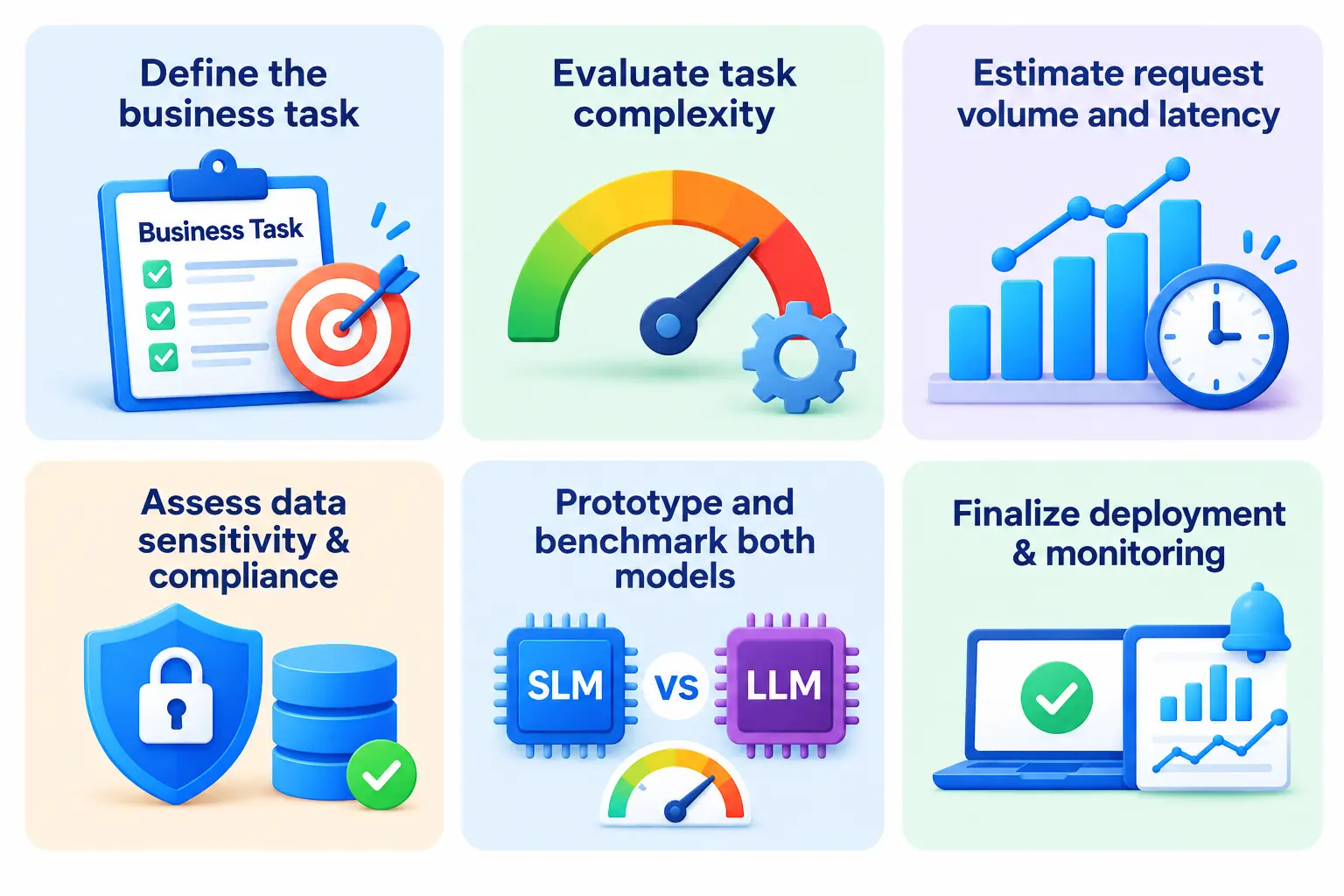
Selecting an AI model should begin with business requirements rather than model popularity.
Step 1: Define the business task
Identify whether the AI feature needs to classify information, answer questions, generate content, summarize documents, or coordinate actions.
Step 2: Evaluate task complexity
Determine whether the task requires predefined outputs and specialized knowledge or broader reasoning across different subjects.
Step 3: Estimate request volume and latency
Calculate expected daily requests, average input and output tokens, concurrency, and acceptable response times. Use these estimates to compare API, self-hosted, and on-device deployment.
Step 4: Assess data sensitivity and compliance
Identify whether the application processes personal information, financial records, healthcare information, or confidential business documents. Establish applicable security and data residency requirements.
Step 5: Prototype and benchmark both models
Start with an LLM to establish a performance baseline. Then test whether an SLM can achieve comparable results using representative business examples.
Compare accuracy, latency, cost, consistency, and failure rates to determine whether a smaller model can meet the application’s requirements without compromising performance.
Step 6: Finalize deployment and monitoring
Choose managed APIs, private cloud, on-premises infrastructure, on-device inference, or a hybrid architecture. Plan for model updates, output validation, performance monitoring, and fallback mechanisms.
Model Selection Decision Table
| Business requirement | Recommended approach |
| Basic text classification | SLM |
| High-volume FAQ processing | SLM with RAG |
| Complex conversational assistant | LLM |
| Offline mobile AI features | On-device model |
| Sensitive enterprise workflows | Privately deployed SLM or LLM |
| Long-document reasoning | LLM with RAG |
| Multi-step AI agents | Hybrid SLM and LLM |
| Repetitive business automation | Fine-tuned SLM |
SLM vs LLM by Industry
Different industries have different AI requirements. The right model depends on task complexity, information sensitivity, and the consequences of incorrect outputs.
| Industry | Typical AI feature | Recommended model | Business application |
| Healthcare | Clinical note organization | Hybrid | Structure consultation notes and support patient-facing information |
| Fintech/BFSI | Transaction classification and compliance assistance | Hybrid | Categorize records and analyze complex queries |
| Retail/eCommerce | Product tagging and conversational shopping | SLM or hybrid | Automate catalog operations and assist product discovery |
| Logistics | Shipment updates and document extraction | SLM | Classify delivery exceptions and process shipment records |
| EdTech | Learning summaries and tutoring | Hybrid | Summarize lessons and explain complex concepts |
| On-demand apps | Customer support and order assistance | Hybrid | Automate routine queries and escalate complaints |
RipenApps has experience developing AI-powered applications across fintech, logistics, and education. These projects also illustrate where SLM and LLM capabilities could support additional business workflows.
- Fintech: The Al Muzaini remittance application includes AI-powered KYC verification and three-factor biometric authentication. With 100K+ downloads, 50K+ active users, and recognition as Kuwait’s #1 Fintech App. An LLM with RAG could support more complex customer questions about remittance rules.
- Logistics: MVLoad features an AI-powered pricing engine that supports logistics operations. An SLM could extend similar workflows by extracting shipment information and generating delivery updates, while an LLM could explain complex pricing decisions and shipment exceptions. The platform reports 50K+ active users, 1M+ shipments, and a 30% cost reduction. Its AI-powered price comparison engine evaluates shipping rates based on distance, weight, and urgency.
- EdTech: ByteEdge combines reels-based microlearning, AI-driven course recommendations, and multilingual support for a global audience across 75+ languages. SLMs could support lesson summaries and routine translation, while LLMs could power conversational tutoring and explanations of complex subjects.
The Future of SLMs and LLMs in Business
The AI market is moving beyond the assumption that one general-purpose model should handle every application requirement.
Gartner predicts that by 2027, organizations will use small, task-specific models at least three times more than general-purpose LLMs. It also forecasts that more than 50% of enterprise GenAI models will be specific to an industry or business function, compared with approximately 1% in 2023.
Several developments are driving this shift:
- More capable small models: Improvements in distillation, training, and quantization are expanding specialized model capabilities.
- On-device AI adoption: Smartphone NPUs and edge hardware are making local inference more practical.
- Agentic AI architectures: Applications increasingly combine specialized models and tools to complete business workflows.
- Open-weight model adoption: Organizations can customize and deploy suitable models with greater infrastructure control, subject to licensing conditions.
- Industry-specific AI: Businesses are investing in models tailored to healthcare, finance, retail, and other specialized domains.
These developments do not make LLMs less relevant. Instead, they encourage businesses to select models based on individual tasks and combine them when necessary.
How RipenApps Helps You Build With the Right AI Model
Choosing between an SLM and an LLM requires understanding application requirements, infrastructure limitations, security expectations, and long-term operating costs.
RipenApps helps businesses evaluate these factors when planning AI-powered digital products. Our AI app development capabilities can support model selection, AI integration, application architecture, and deployment planning.
Depending on project requirements, businesses can explore LLM-powered features, smaller-model customization, Retrieval-Augmented Generation, and on-device AI capabilities for iOS and Android applications.
For applications with varying task complexity, a hybrid architecture can combine SLM efficiency with LLM reasoning capabilities. The objective is to deliver reliable AI functionality without introducing unnecessary infrastructure or operating expenses.
Conclusion
The choice between SLM and LLM should depend on what an application needs to accomplish, not simply which model offers more parameters. SLMs provide efficiency for specialized tasks, while LLMs offer broader reasoning and language capabilities. The right AI feature integration strategy ensures the selected model aligns with application requirements, performance expectations, and business goals.
For many business applications, a hybrid architecture provides a practical balance by assigning routine workloads to smaller models and complex requests to larger ones. Businesses can work with RipenApps to evaluate their AI requirements and plan an architecture that balances performance, privacy, and long-term operating costs. Benchmarking both options against real workloads helps inform the final decision.
Frequently Asked Questions
1. What is the difference between SLM and LLM?
An SLM is a smaller language model designed for focused tasks with lower computational requirements. An LLM has broader capabilities and is better suited to complex reasoning, open-ended conversations, and content generation. Both models can be customized for specific business applications.
2. Is an SLM better than an LLM?
Neither model is universally better. SLMs are more suitable for repetitive, specialized tasks that prioritize speed, cost, or local processing. LLMs are better suited to complex reasoning and varied requests. Businesses should select models based on application requirements and measured performance.
3. Are small language models cheaper to run?
Generally, yes. SLMs require fewer computational resources and can reduce inference expenses. However, actual costs depend on hardware, request volume, hosting, and maintenance. An API-based LLM may be more economical for low-volume applications than maintaining dedicated SLM infrastructure.
4. Can SLMs run on mobile devices?
Yes. Compatible SLMs can run directly on smartphones and other edge devices, depending on memory and hardware capabilities. Apple’s Foundation Models framework and Google’s Gemini Nano provide on-device AI capabilities for supported devices, enabling features such as summarization, text rewriting, and smart replies.
5. Do SLMs hallucinate less than LLMs?
Not necessarily. Smaller models can produce incorrect or fabricated information, particularly when handling unfamiliar questions. Domain-specific fine-tuning, RAG, structured outputs, and validation can reduce errors. Businesses should evaluate hallucination rates using real application data rather than model size alone.
6. Can I use both an SLM and an LLM in one application?
Yes. A hybrid architecture can use an SLM for routine requests and route complex questions to an LLM. This approach helps balance response speed, operating costs, and model capabilities. It is particularly useful for customer support, enterprise automation, and AI-powered mobile applications.
7. What are examples of small language models?
Examples include Microsoft’s Phi-4-mini, Google’s Gemma 3, Meta’s Llama 3.2 1B and 3B, Alibaba’s Qwen3 small models, and Mistral’s Ministral family. Their capabilities, hardware requirements, and licensing conditions vary by model and version.
8. Which is better for a startup MVP: SLM or LLM?
An API-based LLM is often a practical starting point for an MVP because it provides broad capabilities without requiring dedicated model infrastructure. Startups building compatible Apple applications can also explore Foundation Models and eligible Private Cloud Compute access, which Apple offers without cloud API costs to qualifying apps that meet its first-time-download threshold. As usage patterns become clearer, businesses can evaluate smaller models for routine tasks and retain cloud-based LLMs for complex requests. This hybrid approach helps balance development costs, inference expenses, and application performance.
Discuss your project and request for proposal
SHARE
WRITTEN BY

Prankur Haldiya
Chief Technical Officer
A tech innovator and engineering leader, Prankur Haldiya drives RipenApps’ product development strategy and oversees cutting-edge solutions in mobility, AI, and cloud ecosystems. He is passionate about building high-performance teams and helping brands launch secure, scalable, and user-centric digital products.
View All Articles