


Key Takeaways
- Enterprise MVP development helps businesses validate product ideas before committing to large-scale investments.
- An MVP-first strategy reduces development risks, accelerates time to market, and improves resource allocation.
- Enterprise MVPs focus on essential features that solve specific business problems and deliver measurable value.
- A structured development process includes product discovery, idea validation, feature prioritization, UI/UX design, development, and continuous improvement.
- Security, scalability, system integrations, and compliance should be considered from the initial development stage.
- Enterprises should measure MVP success through user adoption, operational efficiency, customer satisfaction, and business impact.
- Enterprise MVP development typically costs $50,000–$200,000, while complex projects could exceed $350,000.
- Choosing an experienced development partner helps businesses turn validated ideas into scalable digital products.
Enterprise innovation often starts with a promising idea. It could be a new customer-facing application, an AI-powered business tool, a digital platform for partners, or an upgrade to an existing product. However, turning that idea into a full-scale solution without testing its value first creates business and technology risks.
Large organizations face additional challenges. They need to align multiple stakeholders, work with existing systems, protect sensitive information, and maintain operational continuity. A full product launch also demands significant investment before teams know how users will respond. This is where a minimum viable product (MVP) offers a more controlled path. It helps businesses release a focused version of a product, test its core value, and use real feedback to guide future investment.
For established businesses, MVP development for enterprises creates a structured way to validate innovation without committing to a complete product from the beginning. It connects business priorities with user needs, technical feasibility, and measurable outcomes. With the right enterprise application development services, organizations can test new opportunities while keeping scalability, security, and long-term product goals in view.
Table of Contents
What is Enterprise MVP Development?
An enterprise minimum viable product is an early, functional version of a digital product that includes only the capabilities required to solve a clearly defined business problem and validate a key assumption. It is designed for a specific group of users, such as employees, customers, suppliers, or business partners.
Unlike a simple demo, an enterprise MVP needs to deliver practical value in a real or controlled business environment. It might help employees automate one workflow, allow customers to complete a key transaction, or give managers better visibility into operational data. The product is intentionally focused, but it still needs to meet the organization’s essential requirements for reliability, access, and data protection.
The objective is not to launch an incomplete enterprise system. It is to build a usable product that helps decision-makers learn what works before expanding its capabilities. This makes MVP development for enterprises a product strategy that connects experimentation with business accountability.
How Enterprise MVP Development Differs from Startup MVP Development?
Both startups and established organizations use MVPs to test product assumptions. However, their operating environments and priorities often differ.
| Area | Startup MVP | Enterprise MVP |
| Primary objective | Validate a new business idea | Validate innovation or business transformation |
| Target users | Early adopters and initial customers | Employees, customers, partners, or selected business units |
| Decision-making | Usually involves founders and a small team | Often involves product, IT, security, compliance, and business teams |
| Technology | Focuses on essential functionality and future flexibility | Must consider existing systems, integrations, and enterprise architecture |
| Governance | Usually lightweight | Requires defined approvals, access controls, and risk management |
| Success measures | User interest, adoption, retention, and revenue potential | Adoption, operational efficiency, business value, risk reduction, and user experience |
| Scaling | Based on early market traction | Based on validated business impact and organizational readiness |
An enterprise MVP requires a balance between speed and organizational readiness. Teams need enough flexibility to experiment while maintaining the controls expected in a larger business environment. This is why enterprise MVP development should begin with a defined business outcome rather than a long list of requested features.
Why Enterprises Should Adopt an MVP-First Product Strategy?
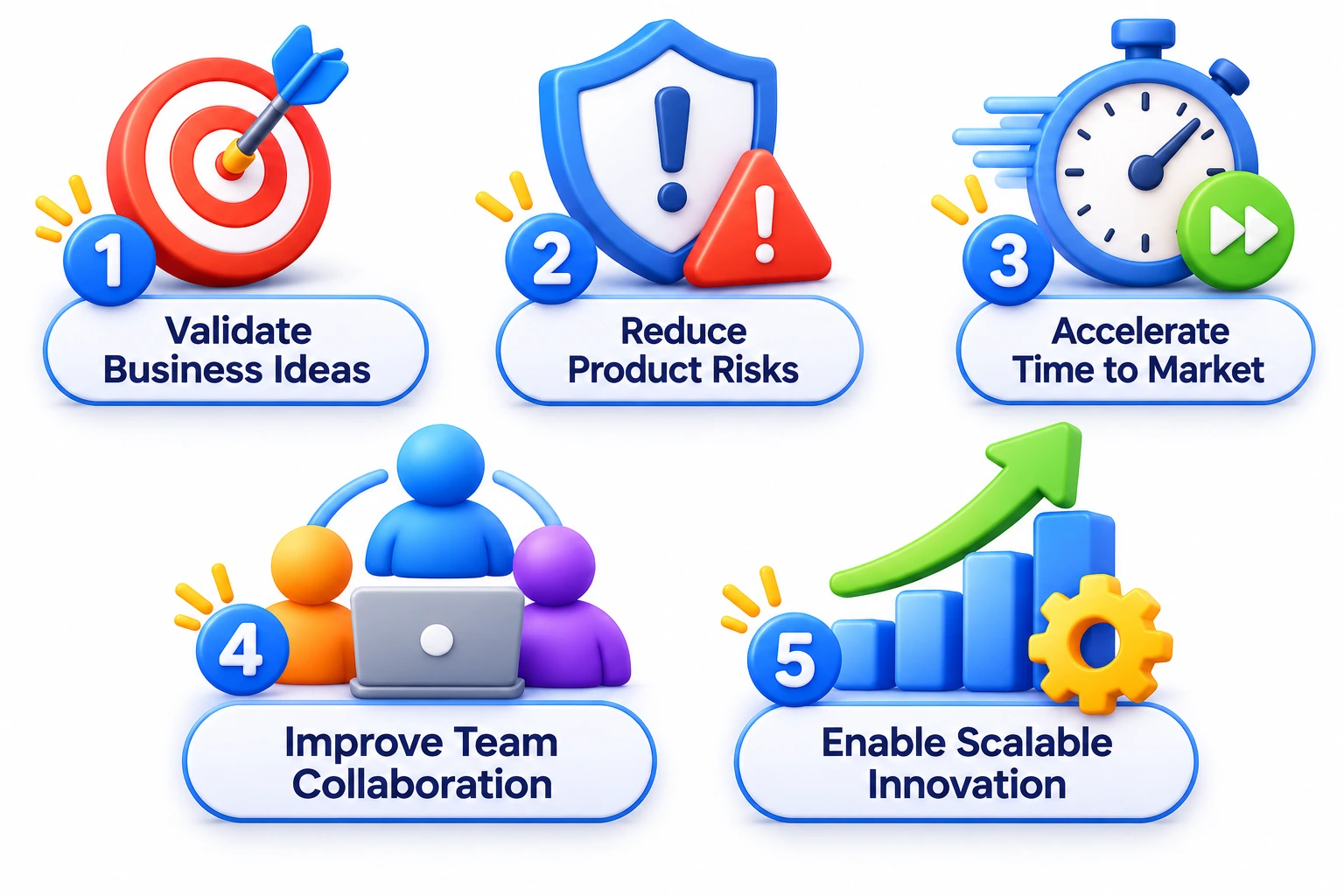
Large organizations often have the resources to build extensive digital products. However, available resources do not guarantee that every product idea deserves a full-scale investment. An MVP-first strategy helps teams test assumptions and make informed decisions before committing to broader development.
1. Validate Business Ideas Before Large Investments
A product concept might look promising during internal discussions, but its actual value depends on how users interact with it. An MVP gives teams a practical way to test demand, usability, and business relevance.
For example, a retail enterprise planning a new customer loyalty platform could first launch essential account, reward tracking, and redemption features for a selected customer group. Feedback from this release would help the business decide which capabilities deserve further investment.
This approach also supports better resource allocation. Teams can identify weak assumptions early and avoid spending on features that do not contribute to the intended outcome.
2. Reduce Product Development and Market Risks
A large product launch involves financial, technical, operational, and adoption risks. Developing every planned feature before testing the core concept increases the impact of incorrect assumptions.
A focused MVP reduces this exposure by limiting the initial scope. Teams can test technical feasibility, review user responses, and identify operational gaps before expanding the product. This creates more opportunities to correct direction while the investment remains controlled.
3. Accelerate Time to Market
Traditional enterprise projects often involve extensive planning and multiple approval stages. While governance is important, a long delivery cycle can delay innovation and allow business opportunities to change.
An MVP breaks the product roadmap into smaller releases. Teams prioritize the most important capabilities, work in focused development cycles, and release a usable product earlier. The organization can then improve the solution through continuous feedback rather than waiting for every planned feature.
For a practical perspective on delivery speed, explore how businesses build MVPs faster through focused planning, feature prioritization, and iterative development.
4. Improve Cross-Functional Collaboration
Enterprise products affect multiple departments. A new workflow application, for example, might involve operations, finance, IT, compliance, and customer support.
An MVP gives these teams a shared product to evaluate. Instead of debating assumptions through documents and presentations, stakeholders can review working functionality and provide specific feedback. This improves communication and helps teams resolve conflicting requirements earlier.
5. Create a Foundation for Scalable Innovation
An MVP is an early product release, not the final destination. Its architecture and product roadmap should support future improvements without requiring an unnecessary rebuild.
For enterprises, this means planning for modular components, integration requirements, data management, and performance expectations from the beginning. The initial release remains focused, while the technical foundation supports the next stages of product growth.
High-Value Use Cases of MVP Development for Enterprises
An enterprise MVP is useful when a business needs to test a new digital capability, improve an existing process, or introduce a product to a defined user group. The best use cases have a clear problem, an identifiable audience, and measurable outcomes.
1. Internal Workflow Automation
Organizations often rely on manual approvals, spreadsheets, emails, and disconnected tools to manage daily operations. An internal workflow MVP can test whether a centralized application improves one specific process.
For instance, a business could launch an approval management MVP for purchase requests. The first version might include request submission, approval routing, status tracking, and notifications. If the pilot reduces processing delays, the organization can extend the solution to other departments.
2. Customer-Facing Digital Platforms
Enterprises planning new customer portals, mobile applications, or self-service platforms can use an MVP to test essential user journeys before investing in a complete experience.
A financial services company, for example, might begin with account registration, document submission, and application tracking. User feedback can reveal where customers face friction and which additional services should be prioritized.
3. AI-Powered Business Applications
AI initiatives often begin with broad expectations. However, businesses need to identify where AI creates measurable value before expanding its use across operations. AI in MVP development helps enterprises test intelligent features within a focused product scope and assess their practical value before wider implementation.
An MVP could include an AI-powered support assistant, document classification tool, or internal knowledge search feature for a limited user group. Teams can evaluate response quality, accuracy, user adoption, and the need for human review. This allows businesses to refine AI capabilities based on real usage while keeping the initial investment controlled.
4. Partner and Supplier Portals
Businesses working with distributors, suppliers, or service partners often manage communication through multiple channels. A partner portal MVP could bring one essential workflow into a centralized platform.
The first release might support partner registration, document sharing, order status, and basic communication. The enterprise can measure partner adoption and process efficiency before adding advanced reporting or automated workflows.
5. New Business Models and Digital Services
An established company entering a new market or launching a digital service needs evidence that its proposed offering addresses a real need. An MVP helps test the service with a limited audience before a wider launch.
For example, a logistics company exploring a subscription-based tracking service could initially offer shipment visibility, delivery alerts, and basic account management. Customer engagement and willingness to pay would help validate the commercial opportunity.
Enterprise MVP Development Process: From Business Idea to Product Launch
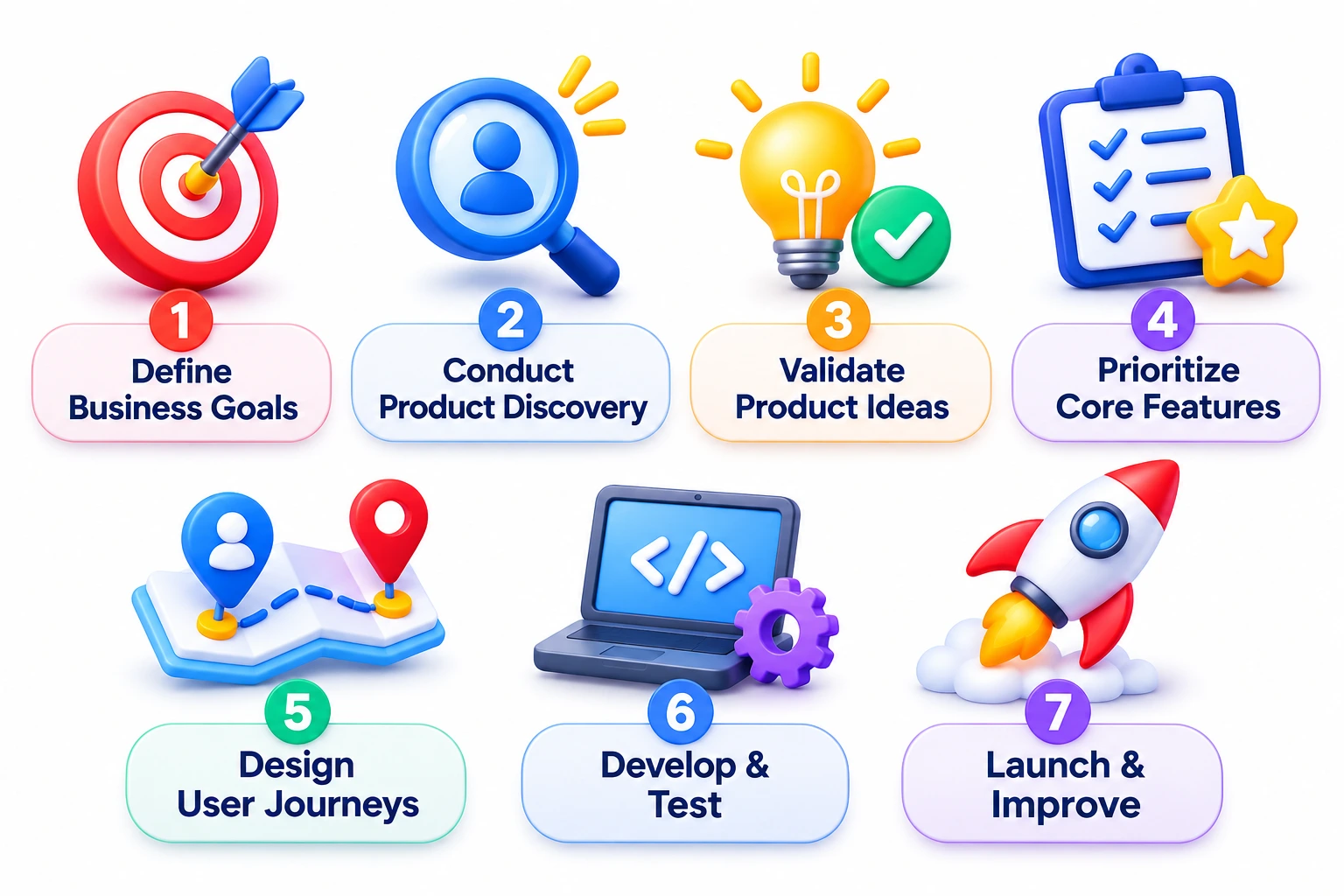
A successful MVP requires more than fast development. It needs a structured process that connects business objectives, user research, technical planning, and post-launch learning. A practical seven-stage framework:
Step 1. Identify the Business Problem and Define Goals
Start by identifying the problem the product needs to solve. Avoid beginning with a feature list or a preferred technology stack.
Work with business stakeholders to define the current challenge, affected users, and expected outcome. For example, if customer onboarding takes too long, the MVP objective could be to reduce manual steps and improve application completion.
Set measurable goals before development begins. These could include:
- Reducing task completion time.
- Improving user adoption.
- Lowering manual processing effort.
- Increasing successful transactions.
- Improving customer satisfaction.
Clear objectives give the team a basis for prioritizing features and evaluating the product after launch.
Step 2. Conduct Product Discovery and Stakeholder Research
Product discovery helps enterprises understand user expectations, operational requirements, and technical constraints before committing to development.
Interview employees, customers, business leaders, and other relevant stakeholders. Review existing workflows, identify recurring pain points, and examine the systems involved in the target process. This step also helps uncover conflicting expectations between departments.
A structured product discovery phase helps translate broad business ideas into clear product requirements and validation priorities.
Step 3. Validate the Product Idea Before Building
Not every product assumption needs a working application to be tested. Enterprises should first determine what kind of validation is appropriate.
A concept review, clickable prototype, proof of concept, and MVP serve different purposes. A prototype helps assess user flows and interface concepts. A proof of concept tests whether a technical idea is feasible. An MVP validates a usable product with its intended users.
Understanding the POC vs MVP vs prototype helps teams select the right approach based on the question they need to answer.
Step 4. Prioritize Features for the First Release
Once the problem and validation goals are clear, define the smallest feature set that delivers meaningful value.
Separate essential capabilities from enhancements that can follow after launch. A feature prioritization framework such as MoSCoW can help teams classify requirements as Must Have, Should Have, Could Have, and Won’t Have for the initial release.
For example, a customer service portal MVP might require:
- Secure user registration and login.
- Support request submission.
- Ticket status tracking.
- Basic notifications.
- An administrative dashboard.
Advanced analytics, multilingual support, AI recommendations, and complex automation could follow once the core experience is validated.
The purpose of MVP development for enterprises is to keep the first release focused on the most important user and business outcomes, rather than trying to replicate the complete product roadmap.
Step 5. Design User Journeys and the Product Experience
Enterprise applications often serve users with different roles, responsibilities, and levels of technical familiarity. The product experience should make essential tasks easy to complete.
Map the primary user journeys and define how users will move through the application. Create wireframes to review navigation, screen structure, and workflow logic before moving into detailed interface design.
A skilled ux design agency helps align user experience with business workflows, accessibility needs, and product usability. For design decisions, teams can compare low-fidelity vs. high-fidelity prototypes to determine how much detail is needed before development.
Step 6. Develop, Integrate, and Test the MVP
After finalizing the scope and design, the development team builds the core application. This stage includes frontend and backend development, database planning, API integration, quality assurance, and deployment preparation.
Enterprise products also need to work with the organization’s existing technology environment. Depending on the use case, the MVP might need to connect with CRM, ERP, identity management, payment, analytics, or internal data systems.
Testing should cover functionality, usability, integration behavior, performance, and security. The goal is to ensure the MVP is stable enough for its intended pilot audience and business environment.
Step 7. Launch, Measure, and Improve
Release the MVP to a controlled group of users or a selected business unit. Monitor how people use the product and whether it achieves the objectives defined during discovery.
Collect quantitative and qualitative feedback. Usage analytics show what users do, while interviews and surveys help explain why they behave in a particular way.
Use these findings to refine the product backlog. Teams can improve confusing workflows, fix adoption barriers, and prioritize the next set of features based on evidence.
This process makes MVP development for enterprises an ongoing learning cycle. Each release should provide a clearer understanding of user needs and the product’s business value.
Read Also: The Complete Guide to Minimum Viable Product (MVP): Process, Benefits, and Examples
Key Technical Considerations for an Enterprise MVP
An enterprise MVP needs a technical foundation that supports its immediate purpose and allows the product to evolve. The objective is to avoid overengineering the first release while addressing the risks that could affect adoption, security, and future development.
1. Scalable and Modular Architecture
Build the MVP around clearly separated components so teams can improve individual capabilities without disrupting the entire application. A modular architecture also makes it easier to introduce new features, support additional users, and connect other systems as requirements grow.
The initial architecture should reflect realistic growth expectations. It does not need the infrastructure of a fully mature enterprise platform from day one, but it should avoid design decisions that make future expansion unnecessarily difficult.
2. Integration with Existing Enterprise Systems
Most established organizations already use multiple business applications. A new MVP should fit into this environment instead of creating another disconnected source of information.
Identify the systems that the MVP must communicate with and define the required data flows. Common integration points include:
- CRM and ERP platforms.
- HR and workforce management systems.
- Payment gateways and financial applications.
- Identity and access management tools.
- Business intelligence and analytics platforms.
- Internal databases and third-party APIs.
Start with integrations that are essential to the MVP’s core workflow. Additional connections can be introduced as the product’s scope expands.
3. Security, Privacy, and Compliance
Security should be part of the initial product requirements, especially when the MVP handles customer information, financial records, employee data, or confidential business documents.
Define role-based access, authentication, data encryption, secure API communication, and appropriate data retention practices. Identify the regulatory requirements relevant to the business and industry before choosing the product’s deployment and data management approach.
Microsoft’s guidance on development security highlights the need to balance business functionality, security, and operational readiness when defining an MVP. The Minimum Viable Secure Product framework also outlines essential security controls for enterprise-ready products.
4. Cloud Infrastructure and Deployment Readiness
Cloud infrastructure gives teams flexibility when deploying and updating an MVP. However, the deployment model should reflect the organization’s security policies, data residency requirements, existing infrastructure, and operational capabilities.
Evaluate cloud hosting, monitoring, backup, disaster recovery, and environment management requirements. Set up separate development, testing, and production environments to reduce deployment risks.
5. Performance and Reliability
Even a limited MVP needs to perform reliably for its intended users. Identify expected traffic, transaction volume, response times, and critical workflows before launch.
Test the product under realistic usage conditions. Monitor application errors, API performance, database response, and infrastructure health during the pilot. These measures help teams identify technical bottlenecks before expanding access.
How to Measure the Success of an Enterprise MVP?
An MVP should be evaluated against the business problem it was designed to solve. Downloads, registrations, and page views alone do not establish whether a product creates meaningful value.
Choose a small set of metrics that connect user behavior with business outcomes. The right indicators depend on the product’s purpose and target audience.
| Success area | Metrics to track | What they reveal |
| User adoption | Active users, activation rate, onboarding completion | Whether the intended audience is adopting the product |
| Engagement | Feature usage, repeat usage, session frequency | Whether users find the product useful |
| Operational efficiency | Task completion time, processing time, manual effort | Whether the product improves existing workflows |
| Customer experience | Satisfaction scores, support requests, task success rate | Whether the product addresses user pain points |
| Technical performance | Error rate, uptime, response time | Whether the MVP is stable and reliable |
| Business value | Cost savings, conversion rate, revenue contribution | Whether the product supports business objectives |
Set Baselines Before the MVP Launch
A metric becomes more useful when the organization knows its starting point. If the goal is to reduce invoice approval time, record the current average processing time before introducing the MVP.
After launch, compare the results with the baseline. This helps teams determine whether the product created measurable improvement instead of relying on assumptions.
Combine Analytics with Direct User Feedback
Product analytics reveal how users interact with the application, but they do not explain every behavior. A low feature adoption rate, for example, could indicate poor usability, limited awareness, or a feature that does not solve an important problem.
Combine usage data with interviews, surveys, feedback sessions, and support requests. This gives product teams a more complete understanding of what to improve.
Define Clear Decision Points
Before launching, decide what results will lead to further investment. The team might expand the MVP if adoption and operational results meet agreed targets. It might revise the product if users show interest but struggle with specific workflows. If the core assumption proves incorrect, the business might change direction or stop the initiative.
These decision points keep MVP development for enterprises connected to business evidence. They also help leadership assess product progress through measurable outcomes rather than development activity alone.
Common Challenges in Enterprise MVP Development and How to Overcome Them
Enterprise MVP projects involve multiple stakeholders, existing technology environments, and business expectations. Without a clear strategy, these factors can make a supposedly focused product as complex as a full-scale application.
1. Too Many Features in the Initial Scope
Challenge: Different departments often request features based on their individual requirements. This increases scope and delays the first release.
Solution: Establish one primary business objective and prioritize features according to their contribution to that objective. Move secondary requirements into a post-launch roadmap.
2. Conflicting Stakeholder Expectations
Challenge: Business leaders, IT teams, operations, and end users might define product success differently. This can lead to unclear requirements and repeated revisions.
Solution: Assign a product owner or decision-making group. Document agreed goals, user priorities, responsibilities, and approval processes before development starts.
3. Complex Legacy System Integrations
Challenge: Existing enterprise systems might use outdated interfaces, inconsistent data formats, or restricted access policies. Integration work can become a major source of delays.
Solution: Assess integration dependencies during discovery. Start with the systems essential to the MVP and use well-defined APIs or approved integration methods wherever possible.
4. Security and Compliance Requirements
Challenge: Teams might underestimate security reviews, privacy requirements, or internal approval processes while planning a quick release.
Solution: Involve security, compliance, and IT stakeholders early. Define the minimum controls required for the pilot and include security testing in the development process.
5. Low User Adoption
Challenge: Employees or customers might avoid using the new product if it does not fit their existing workflows or if they do not understand its value.
Solution: Involve representative users during discovery and testing. Provide onboarding support, gather feedback, and improve the experience based on real usage.
6. Difficulty Measuring Business Impact
Challenge: Teams might focus on delivery milestones without establishing whether the product improves the intended business process.
Solution: Define baseline metrics and success criteria before development. Review adoption, performance, and business outcomes after launch.
7. Pressure to Scale Too Early
Challenge: Leadership might push for additional features or a company-wide rollout before the MVP has been properly validated.
Solution: Use pilot results to determine product readiness. Expand gradually after the team confirms usability, reliability, security, and business value.
Enterprise MVP vs. Rapid Prototyping: Which Approach Should You Choose?
Rapid prototyping and MVP development both help teams reduce uncertainty before investing in a complete product. However, they answer different questions.
A prototype demonstrates how a product might look or behave. It helps stakeholders evaluate navigation, screen layouts, user journeys, and interaction concepts. It does not always include production-ready functionality or real business integrations.
An MVP is a working product with enough functionality to deliver value to its intended users. It allows teams to test actual usage, operational performance, and business assumptions in a real or controlled environment.
The difference between rapid prototyping and MVP for enterprise projects comes down to the type of validation required.
| Evaluation factor | Rapid prototyping | Enterprise MVP |
| Main purpose | Test concepts and user flows | Validate a working product and business assumptions |
| Functionality | Simulated or limited interactions | Core functional capabilities |
| User involvement | Design reviews and usability testing | Real usage by a selected audience |
| Integrations | Usually limited or simulated | Required integrations for core workflows |
| Business validation | Tests usability and concept clarity | Tests adoption, operational value, and product viability |
| Output | A prototype for evaluation | A usable product for pilot release |
Choose rapid prototyping when the team needs to validate an interface, workflow, or concept. Choose an MVP when the organization needs evidence from actual product usage.
For early-stage concept testing, product idea validation can help teams identify user expectations before committing to a functional release.
Read More: How Enterprises Use Rapid Prototyping for Digital Transformation
How Much Does Enterprise MVP Development Cost?
The MVP development cost for enterprise typically ranges from $50,000 to $200,000, depending on the product’s scope, complexity, technology requirements, integrations, security expectations, and delivery model. A focused internal workflow application generally requires a lower investment, while a customer-facing platform with multiple enterprise integrations, advanced functionality, or strict compliance requirements could cost $200,000–$350,000 or more. These figures are indicative estimates, and the actual budget depends on the project’s specific requirements.
The main cost factors include:
- Product discovery and planning: Business analysis, stakeholder workshops, user research, and requirement definition.
- UI/UX design: User journeys, wireframes, interface design, and usability testing.
- Frontend and backend development: Application interfaces, business logic, databases, and APIs.
- System integrations: Connections with CRM, ERP, identity management, payment, and other platforms.
- Security and compliance: Authentication, access controls, encryption, security reviews, and compliance requirements.
- Testing and deployment: Functional testing, integration testing, performance checks, infrastructure setup, and launch support.
- Post-launch improvements: Monitoring, feedback analysis, bug fixes, and feature updates.
What Influences the Final Budget?
The number of platforms and user roles affects the development effort. So do complex workflows, custom business rules, third-party integrations, and industry-specific requirements.
Enterprises should also account for internal coordination, security approvals, infrastructure, and ongoing maintenance. These expenses might sit outside the initial development estimate, but they influence the total investment required to operate the product.
How to Keep Enterprise MVP Costs Under Control
Start with a clearly defined validation objective. Prioritize the features required to test it and avoid adding advanced capabilities without a strong business reason.
Use existing enterprise infrastructure where appropriate, identify integration dependencies early, and release the product in phases. A focused scope and regular reviews help reduce rework while keeping the project aligned with business priorities.
A reliable custom application development company can also help assess technical complexity, select a suitable architecture, and plan the first release around business requirements rather than unnecessary features.

How to Choose the Right Enterprise MVP Development Partner?
The development partner plays an important role in translating business objectives into a functional product. Enterprises need a team that understands product strategy, user experience, technology, and the operational requirements of a larger organization.
When comparing the best enterprise MVP development agencies, look beyond development speed or portfolio size. Evaluate their ability to manage product discovery, stakeholder collaboration, integration planning, security, and post-launch improvements.
1. Assess Enterprise Product Experience
Review the partner’s experience with business applications, complex workflows, customer platforms, and integration-heavy products. Ask how the team has handled similar requirements and what role it played across discovery, development, and launch.
2. Review Product Discovery and MVP Planning Capabilities
A capable partner should help define the problem, identify assumptions, prioritize features, and establish measurable success criteria. This is particularly important when business requirements are broad or multiple departments are involved.
3. Evaluate UX and Technical Expertise
The team should understand how to design for different user roles and build applications that work within existing enterprise environments. Review its capabilities across UI/UX, frontend and backend development, API integration, cloud infrastructure, and quality assurance.
4. Check Its Approach to Security and Scalability
Ask how the partner handles authentication, data protection, access control, testing, and deployment. Also discuss how the architecture will support future product improvements and higher usage.
5. Understand Communication and Delivery Practices
Enterprise MVP projects need clear ownership and regular communication. Review the team’s sprint process, reporting structure, feedback cycles, documentation, and approach to handling scope changes.
A reliable startup app development company with strong MVP experience might offer useful expertise in rapid validation and focused product delivery. However, enterprise projects also require an understanding of organizational governance, integrations, and operational readiness. Choose a partner whose experience matches the complexity of your product.
6. Look for a Long-Term Product Development Approach
The MVP partner should be able to support the product beyond its first release. Discuss how the team will use feedback to plan improvements, address technical debt, introduce new features, and prepare the application for broader adoption.
The right partner helps turn MVP development for enterprises into a repeatable innovation process, with clear decisions at every stage and a roadmap for future growth.
How an Enterprise MVP Fits into the Product Development Lifecycle
An MVP is one stage in a broader product journey. It connects early discovery with product development, launch, validation, and continuous improvement. Understanding this relationship helps enterprises plan what happens after the first release.
The Product Development Life Cycle (PDLC) focuses on the complete journey of a product, from identifying an opportunity to improving and eventually retiring it. The Software Development Life Cycle (SDLC) focuses on the processes involved in building, testing, deploying, and maintaining software.
An MVP typically emerges from the early stages of product planning and moves into the development and validation stages. Once the product is released, feedback helps teams refine the roadmap and plan subsequent development cycles.
Understanding PDLC vs SDLC helps business and technology teams align product decisions with software delivery activities.
From MVP Launch to Full-Scale Product
The transition from an MVP to a mature product should depend on validation results rather than a predetermined feature list.
A practical growth roadmap includes:
- Initial MVP release: Launch essential features to a selected audience.
- Feedback and validation: Review user behavior, business outcomes, and technical performance.
- Feature enhancement: Improve existing workflows and introduce validated capabilities.
- Controlled expansion: Extend access to more users, departments, or markets.
- Product optimization: Improve performance, security, integrations, and user experience.
- Continuous innovation: Introduce new capabilities based on changing business needs.
This progression supports digital enterprise design approaches, including MVP, where product decisions evolve through continuous learning instead of relying entirely on upfront assumptions.
Real-World MVP Lessons for Enterprise Product Teams
Successful products often begin with a focused solution to a specific user problem. Their early versions demonstrate why testing the core value proposition matters before expanding the product.
For instance, minimum viable product examples show how companies have used limited initial functionality to test demand, learn from users, and shape their future offerings.
Enterprise teams can apply the same principle while accounting for larger organizational requirements. A company introducing a new employee platform might begin with one high-priority workflow. A financial services business could test a focused customer onboarding journey. A manufacturing organization might pilot a production monitoring dashboard at one facility.
In each case, the first release should answer a specific business question. Did the product improve the process? Did users adopt it? Did the technology perform reliably? Did the expected value justify further investment?
These lessons reinforce the role of MVP development for enterprises as a controlled way to test new digital opportunities before committing to broader implementation.
Why RipenApps for Enterprise MVP Development?
Building an enterprise MVP requires a clear understanding of business objectives, user expectations, and technology requirements. The development partner should help connect these areas through a structured process that covers discovery, design, development, testing, and product improvement.
RipenApps works with startups and established businesses to turn product ideas into functional digital solutions. Its MVP development approach focuses on validating core product assumptions, prioritizing essential features, and creating scalable foundations for future growth.
The team supports product planning, UI/UX design, application development, API integrations, testing, and post-launch improvements. This helps businesses move from an initial concept to a usable product while keeping the next stages of development in view.
For organizations evaluating MVP development services for enterprise clients, the right engagement should include clear scope definition, stakeholder alignment, technical planning, and measurable validation goals. RipenApps brings this structured approach to MVP development services for startups and enterprises, helping businesses turn product ideas into functional solutions that align with their goals and growth plans.
Conclusion
Enterprise innovation becomes more manageable when businesses validate ideas before making large product investments. An MVP provides a practical way to test new capabilities, gather user feedback, assess technical feasibility, and measure business outcomes. With focused planning, the right architecture, and continuous improvement, organizations can reduce uncertainty and build products that respond to real operational and customer needs.
Choosing an experienced development partner makes this process more structured. RipenApps helps businesses plan, design, and build scalable digital products through its expert MVP development services in USA, supporting the journey from initial validation to long-term product growth. Start with a focused MVP, learn from real users, and build your next product release around proven business value.

FAQs
Q1. What is MVP development for enterprises?
MVP development for enterprises is the process of building a functional first version of a digital product with only its essential features. It helps established businesses validate product ideas, test user needs, and measure business value before investing in a complete solution.
Q2. How is an enterprise MVP different from a startup MVP?
A startup MVP generally focuses on validating a new business idea and attracting early users. An enterprise MVP must also consider existing systems, multiple stakeholders, security requirements, compliance, and operational workflows.
Q3. How long does it take to build an enterprise MVP?
The timeline depends on product complexity, feature scope, integrations, and security requirements. A focused MVP with limited integrations might take a few weeks to a few months, while complex enterprise products require a longer discovery, development, and testing cycle.
Q4. What features should an enterprise MVP include?
An enterprise MVP should include the features required to solve its primary business problem. These might include user authentication, role-based access, core workflows, essential integrations, notifications, and basic reporting. Advanced capabilities should follow when user feedback and business results justify them.
Q5. How much does enterprise MVP development cost?
Enterprise MVP development typically costs $50,000–$200,000, depending on the product’s complexity, platforms, integrations, design requirements, and security controls. Projects involving legacy system integrations, AI capabilities, or strict compliance requirements can reach $200,000–$350,000 or more. These are indicative development estimates, not fixed prices. A detailed quote should follow requirement discovery and scope definition.
Q6. Can an enterprise MVP scale into a full product?
Yes. An MVP can evolve into a full product when its architecture supports future improvements and the initial release validates the core business assumptions. Teams can add features, integrations, user groups, and infrastructure capacity in planned stages.
Discuss your project and request for proposal
SHARE
WRITTEN BY

Ishan Gupta
CEO & Founder
Ishan Gupta is a seasoned entrepreneur and CEO with extensive 10+ years of experience in business and mobile app development landscape. He believes that the right digital product allows companies to focus on what they do best, while technology handles the rest. With deep exposure to global markets, he understands what makes an app succeed. His approach translates business needs into clear product strategies, ensuring that every feature contributes to measurable ROI.
View All Articles