
Key Takeaways
- Software costs vary by complexity. Basic solutions may cost $10,000–$25,000, while enterprise platforms can exceed $150,000.
- Scope drives the budget. Features, integrations, security, data migration, and scalability affect the total investment.
- Every development stage matters. Include discovery, UI/UX design, development, testing, deployment, and project management in your estimate.
- Plan for ongoing expenses. Hosting, licences, maintenance, security updates, and support add to the initial development cost.
- Define requirements early. Clear project scope and priorities help reduce rework and unexpected expenses.
- Compare proposals carefully. Review deliverables, exclusions, timelines, and support instead of choosing a provider based on price alone.
- Use phased development where appropriate. An MVP can help validate demand and prioritise future investment before a full-scale launch.
Building custom software involves more than paying developers to write code. Your budget also needs to account for planning, design, testing, infrastructure, integrations, deployment, and ongoing maintenance. The total investment depends on what you want the software to do, how complex its workflows are, and how reliably it needs to perform as your business grows.
A simple internal tool with a few workflows costs considerably less than an enterprise platform connecting multiple departments, third-party systems, and large volumes of data. That is why generic price estimates can be misleading. Two businesses building software for similar purposes might need different budgets because their requirements, security needs, integrations, and scalability goals differ.
Understanding the software development cost before committing to a project helps you prioritise essential features, compare development proposals, and avoid unexpected expenses. A well-planned estimate also gives your team a clearer view of the investment required at launch and after deployment.
Whether you are validating an idea or upgrading an established business system, the right custom software development services can help you define the project scope, evaluate technical requirements, and plan a budget that supports your business objectives.
Table of Contents
How Much Does Custom Software Development Cost?
The cost of custom software varies according to its scope, complexity, and delivery requirements. The following ranges provide an initial budgeting reference for projects developed by a professional software development team. They are illustrative estimates in USD, not fixed quotes.
| Software complexity | Estimated development cost | Typical scope |
| Basic software | $10,000–$25,000 | Simple workflows, limited user roles, basic reporting, and essential integrations |
| Mid-complexity software | $25,000–$60,000 | Multiple workflows, user permissions, dashboards, APIs, and more extensive testing |
| Advanced software | $60,000–$150,000+ | Complex business logic, multiple integrations, advanced security, automation, or sophisticated data processing |
| Enterprise-grade platforms | $150,000–$500,000+ | Multi-department workflows, extensive integrations, compliance requirements, high availability, and large-scale architecture |
These ranges cover typical initial development work and can vary significantly by region, team composition, technology, and project requirements. They do not automatically include taxes, third-party licence fees, major infrastructure expenses, or long-term maintenance.
For example, a basic business application with a defined user flow and limited integrations might fit within the first range. A platform connecting finance, inventory, customer data, and multiple external systems is likely to require a larger investment.
The software development cost is best estimated after the team understands what the product needs to achieve, which features are essential, and what technical constraints the project must meet.
What Factors Affect Software Development Cost?
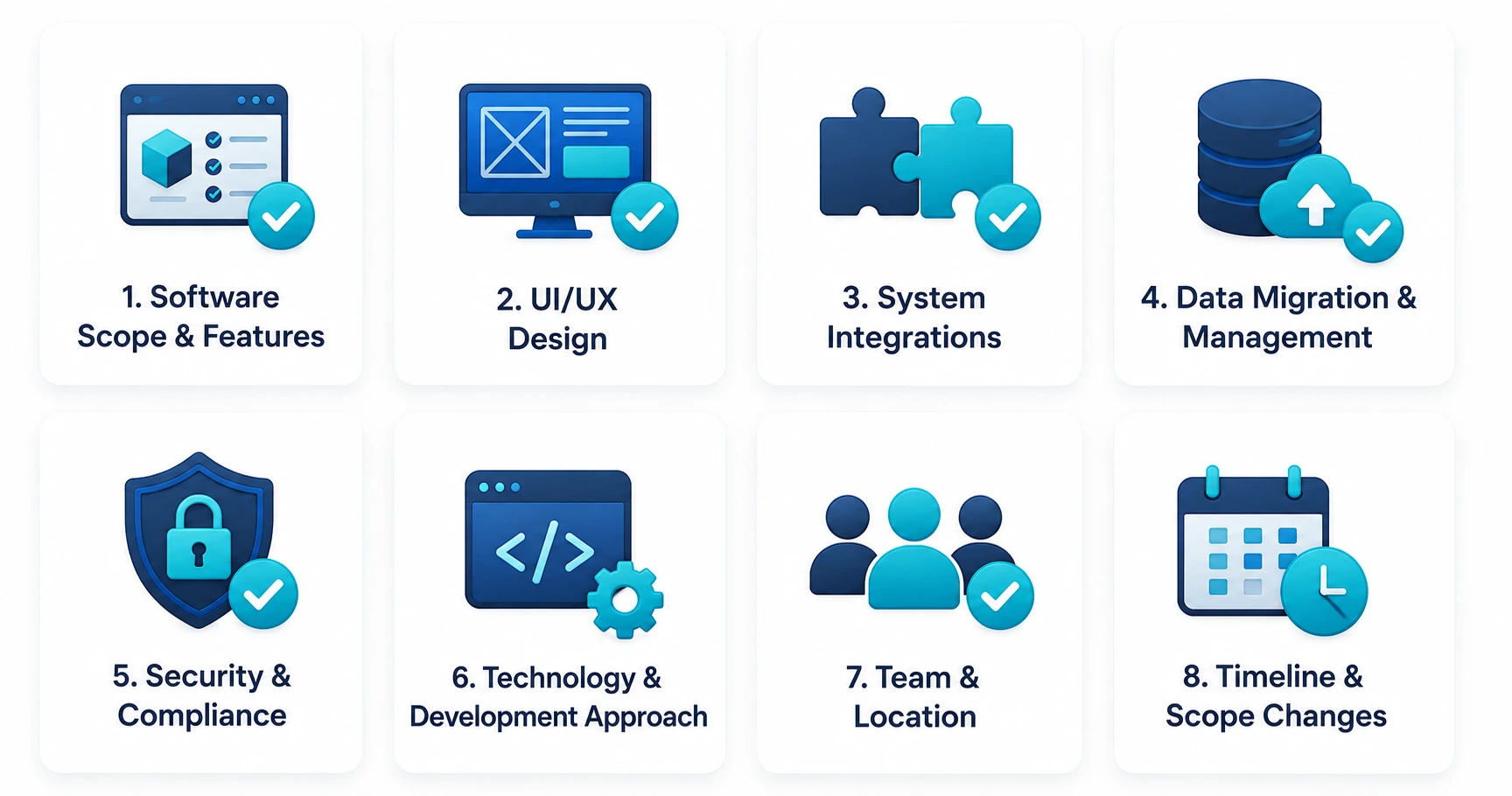
The final budget depends on the effort required to plan, build, test, launch, and maintain the software. These are the main factors to evaluate before requesting a quote.
1. Software scope and feature complexity
The number of features matters, but their complexity matters just as much. A dashboard displaying basic business metrics takes less effort than one that processes real-time data, supports custom reports, and applies different access rules to each user role.
Start by separating essential features from enhancements that can wait. If your business needs a new product but has not validated every requirement, professional MVP development services can help you focus the initial release on core functionality and expand it as you learn from users.
2. User interface and experience design
Design costs depend on the number of screens, user journeys, supported devices, accessibility requirements, and the amount of custom interaction. A straightforward internal dashboard typically needs less design effort than a customer-facing platform with onboarding, personalisation, and multiple account types.
A clear design process helps prevent expensive changes during development. If the interface is central to your product’s value, allocate enough budget for research, wireframes, prototypes, and usability testing rather than treating design as a final cosmetic step.
3. Integrations with existing systems
Software often needs to connect with payment gateways, CRMs, accounting platforms, inventory tools, identity providers, or third-party APIs. Costs rise when these systems use incompatible data formats, have limited documentation, or require complex synchronisation and error handling.
For example, ERP software development can involve connecting finance, procurement, inventory, sales, and reporting workflows. The number of modules and the complexity of data exchange can make a significant difference to the overall budget.
4. Data migration and management
Moving data from spreadsheets, older applications, or disconnected databases can require data cleaning, mapping, validation, migration scripts, and reconciliation. The effort increases when records are duplicated, formats differ, or the existing data contains gaps.
If the software needs a central source of reliable business information, custom data management software may be relevant to the wider solution. The budget should account for data quality and governance, not only the screens through which users access information.
5. Security, compliance, and reliability
Basic applications and regulated business systems do not have the same security requirements. Healthcare, financial services, and other sensitive environments can need stronger access controls, encryption, audit trails, compliance reviews, and more extensive testing.
Reliability requirements matter too. Software expected to support many users at once or operate with minimal downtime often needs additional architecture, monitoring, backup, and recovery planning. These requirements should be identified before estimating the project rather than added after development begins.
6. Technology stack and development approach
The selected programming languages, frameworks, cloud services, and third-party components influence development effort and future maintenance. Familiar, well-supported technologies can help a team work efficiently, while specialised tools or complex infrastructure might require additional expertise.
AI features also need careful evaluation. An application that calls an existing AI API has different requirements from one that needs custom model development, retrieval pipelines, evaluation systems, and ongoing monitoring. For an initial estimate, review the likely AI agent software development cost alongside the expected scope and infrastructure needs.
7. Team composition and location
The budget depends on which specialists your project needs and how long they are involved. A typical team might include a business analyst, UI/UX designer, frontend and backend developers, QA engineers, and a project manager. Complex projects might also need cloud, security, data, or AI specialists.
Hourly rates vary by location, seniority, engagement model, and expertise. However, choosing a team on price alone can lead to missed requirements, weak testing, and costly rework. Compare proposals by the responsibilities covered, estimated effort, delivery process, and quality controls rather than the headline rate alone.
8. Project timeline and changes in scope
A tight deadline can require more parallel work, additional specialists, or faster testing cycles. Frequent changes can also increase the budget because the team must revise requirements, code, design, documentation, and test cases.
A structured software development life cycle helps the team plan requirements, design, development, testing, and release in a manageable sequence. It also makes it easier to assess how a requested change will affect cost and delivery time.
Software Development Cost Breakdown by Stage
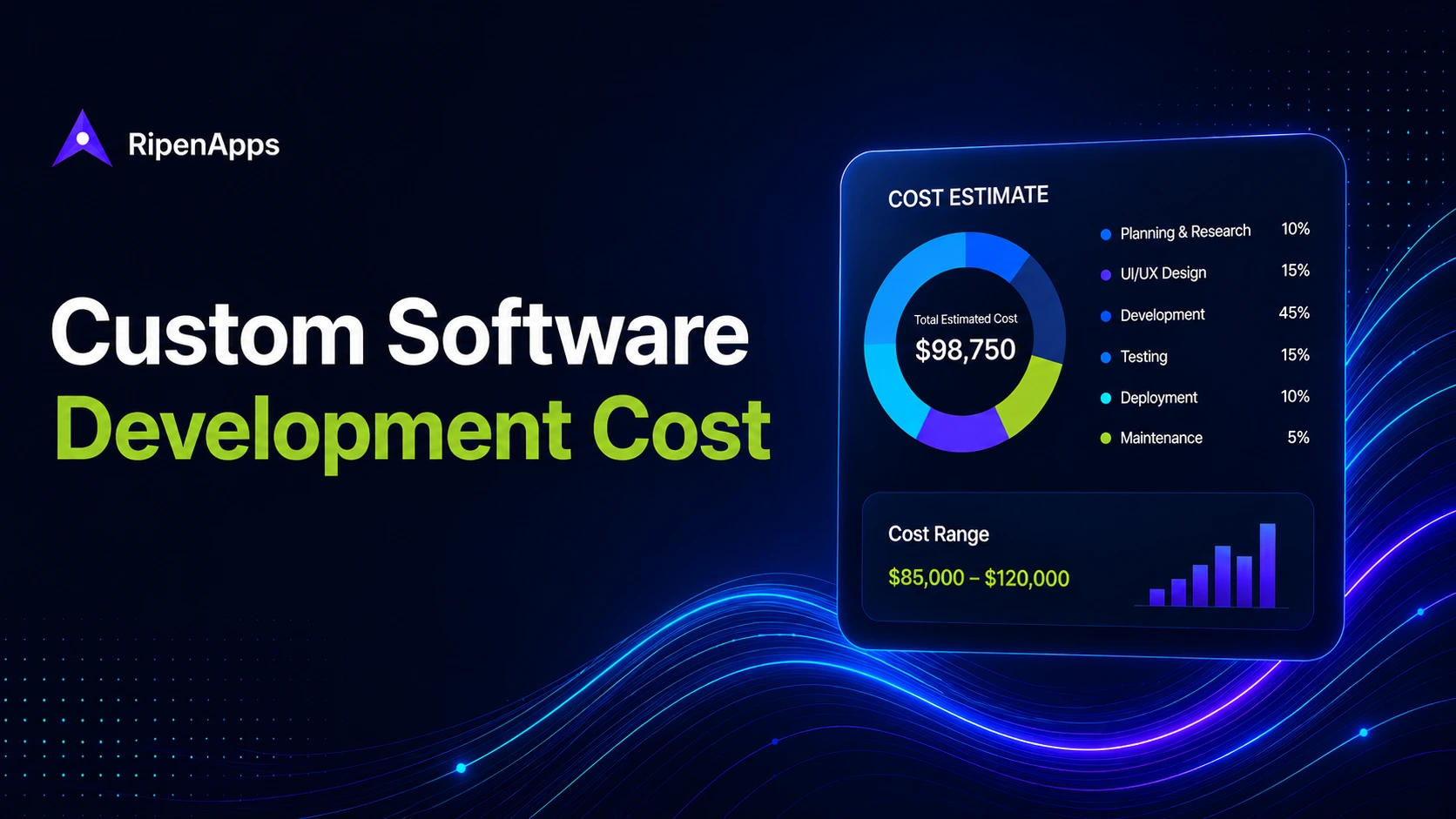
A realistic budget covers the full delivery process, not only programming. The following percentages are useful for initial planning, although the actual allocation depends on the project’s complexity and delivery model.
| Development stage | Illustrative share of initial budget | What it includes |
| Discovery and requirements | 5–10% | Business goals, user needs, scope, requirements, and feasibility |
| UI/UX design | 10–15% | User flows, wireframes, interface design, and prototypes |
| Architecture and development | 40–55% | Technical architecture, frontend, backend, features, and integrations |
| Testing and quality assurance | 15–20% | Functional, integration, usability, security, and performance testing |
| Deployment and launch | 5–10% | Release preparation, configuration, documentation, and handover |
| Project management and coordination | 5–10% | Planning, progress tracking, communication, and risk management |
These percentages are indicative planning ranges, not fixed industry rules. The categories can overlap, and some proposals include project management across each stage instead of listing it separately. Make sure the percentages in any estimate add up to the total project budget and do not double-count the same work.
For instance, a project with extensive integrations might spend more on development and testing. A product with complex user journeys could require a larger design allocation, while regulated software may need additional security and compliance work.
Discovery deserves particular attention because unclear requirements can lead to expensive changes later. A focused planning phase helps identify dependencies, agree on priorities, and produce a more defensible estimate before major development work begins.
Estimated Cost by Type of Custom Software
Software category offers another starting point for budgeting. The ranges below are broad planning estimates for custom-built solutions, not guaranteed prices. The same category can fall into a different range depending on its features, integrations, security needs, and scale.
| Software type | Illustrative initial cost | What can affect the estimate |
| Internal business tool or workflow app | $10,000–$40,000 | Number of workflows, roles, reports, and integrations |
| MVP or early-stage product | $10,000–$60,000 | Core features, validation needs, platform coverage, and design |
| CRM or HR management system | $25,000–$100,000+ | User roles, automation, employee or customer data, and reporting |
| ERP or operations platform | $50,000–$200,000+ | Business modules, cross-department workflows, and data migration |
| Data management platform | $40,000–$150,000+ | Data sources, processing, access controls, analytics, and scale |
| AI-enabled application or agent | $40,000–$200,000+ | AI model or API choice, integrations, evaluation, and monitoring |
| Healthcare or other regulated platform | $60,000–$250,000+ | Privacy, audit trails, interoperability, security, and compliance |
| Enterprise software ecosystem | $150,000–$500,000+ | Multiple systems, complex architecture, availability, and rollout needs |
These estimates can overlap. A focused MVP can cost more than a basic internal tool if it needs complex integrations, while a larger system can be delivered in phases to spread investment over time.
MVP development
An MVP is designed to validate a product idea with a limited set of essential features. It can be a practical starting point when you want to test demand before committing to a broader roadmap. The cost depends on the minimum functionality needed to test the main business assumption, not simply on the number of screens.
ERP and HR software
ERP systems connect business functions such as finance, procurement, inventory, and operations. HR platforms manage employee records, attendance, payroll, and related workflows. Costs rise as you add departments, permissions, automation, complex reporting, and integrations with existing systems. For HR-specific requirements, see the guide to HRMS software development.
AI-enabled software
AI-based systems need budget for more than the model itself. Data preparation, API usage, retrieval, security, response evaluation, and human review can all influence the initial and recurring cost. The final estimate depends on whether the solution uses existing AI services or requires more specialised model and infrastructure work.
Healthcare and data-sensitive systems
Healthcare software often requires additional safeguards for sensitive records, access permissions, auditability, and integrations with clinical systems. For projects involving healthcare information, clinical data management software offers a more specific look at the workflows and requirements involved.
How to Estimate Software Development Cost
A useful estimate starts with a defined scope and a realistic view of the work involved. Instead of relying on a single figure based on the software category, break the project into features, estimate the effort for each task, and account for supporting activities.
Step 1. Define the scope and requirements
Document the business problem, target users, core workflows, user roles, required platforms, and expected outcomes. Separate essential launch requirements from features that can be introduced later.
This step helps prevent the estimate from including assumptions that were never agreed upon. It also gives every vendor the same baseline when you compare proposals.
Step 2. Break the project into tasks
Create a work breakdown structure covering discovery, design, development, integrations, testing, deployment, and project coordination. Divide larger features into smaller tasks so the team can estimate the effort more consistently.
For a complex business application, list each module separately. For example, a system with inventory, billing, reporting, and user management may require different effort estimates for each module and its connections to the others.
Step 3. Estimate the hours required
Ask the relevant specialists to estimate the time required for each task. Include development, reviews, testing, meetings, documentation, and deployment preparation rather than counting only coding hours.
At this stage, the team can use previous project data, expert judgement, or a more detailed task-based method. The more clearly defined the requirements are, the more useful the estimate becomes.
Step 4. Apply the team’s rates
Multiply the estimated hours for each role by its agreed hourly rate, then add the results. A senior architect, designer, developer, and QA engineer can have different rates, so using one blended rate is appropriate only when its assumptions are clear.
A basic estimation formula is:
Labour Cost = Σ (Estimated Hours × Hourly Rate)
For example, if a team estimates 800 hours at a blended rate of $35 per hour, the estimated labour cost is $28,000. This is a simplified illustration, not a quote for a particular project. Design, infrastructure, licences, external services, and other expenses might need to be added separately.
Step 5. Include additional expenses
Add costs that sit outside the core development estimate, such as cloud hosting, paid APIs, software licences, data migration, security assessments, and third-party services. Clarify which expenses are included in the vendor’s quote and which your business will pay directly.
Step 6. Add a contingency allowance
Requirements can change, and technical issues can emerge during implementation. A contingency allowance of around 10–20% is a practical starting point for many projects, with the appropriate amount depending on uncertainty and complexity.
This is not a substitute for proper planning. A project with unclear requirements or major technical unknowns might need further discovery before its budget can be estimated reliably.
Step 7. Review assumptions before approving the budget
Ask the development team to explain the scope, exclusions, dependencies, timeline, payment milestones, and change-request process. Check whether the proposal includes testing, deployment, documentation, and post-launch support.
A useful software development cost estimation document should show how the total was calculated, which assumptions support it, and what could cause the estimate to change.
What is Included in a Software Development Quote?
Two proposals can show similar totals while covering different amounts of work. Review the scope behind each quote before deciding which one offers better value.
| Cost item | Questions to ask |
| Discovery and planning | Are requirements analysis and technical planning included? |
| UI/UX design | Does the quote cover research, prototypes, responsive layouts, and revisions? |
| Development | Which features, platforms, and integrations are included? |
| Quality assurance | Are functional, integration, security, and performance tests covered? |
| Deployment | Does the team handle release configuration, setup, and handover? |
| Project management | Who tracks milestones, manages risks, and communicates progress? |
| Third-party services | Are API fees, licences, and cloud expenses included or billed separately? |
| Maintenance and support | What support period is included, and what happens after it ends? |
Be cautious of quotes that look unusually low but omit testing, deployment, or key integrations. Those expenses often reappear later as change requests or additional contracts.
A clear proposal should also explain the pricing model. Fixed-price contracts can work well when the scope is stable, while time-and-materials arrangements can suit projects where requirements are expected to evolve. Either model needs transparent reporting and agreed rules for changes.
How Much Does Software Maintenance Cost After Launch?
The initial build is only one part of the investment. Once the software is live, your business needs to budget for bug fixes, security updates, compatibility changes, monitoring, infrastructure, and improvements based on user feedback.
A common early planning allowance is around 15–20% of the initial development cost per year for maintenance, but this is only a rough guide. Actual spending can be lower for a stable, small application or substantially higher for a frequently updated platform with demanding uptime, security, or support requirements.
For example, a software project that costs $50,000 to build might require a preliminary maintenance budget of $7,500–$10,000 annually using that planning allowance. Cloud usage, third-party licences, major new features, and dedicated support may sit outside this figure.
Your software maintenance cost estimation should account for at least four areas:
- Corrective maintenance to fix bugs and resolve issues.
- Security and compatibility updates to address vulnerabilities and changes in browsers, devices, operating systems, or dependencies.
- Infrastructure and monitoring to cover hosting, backups, performance tracking, and incident response.
- Enhancements to improve existing features or add functionality as business needs change.
Businesses that depend on the software for daily operations should define a support arrangement before launch. A clear maintenance plan helps avoid treating every update as an unexpected expense.
How to Reduce Software Development Costs Without Compromising Quality
Reducing the budget does not mean removing essential testing or choosing the cheapest team. The better approach is to reduce unnecessary work, make decisions earlier, and focus investment on features that deliver measurable value.
Prioritise features based on business value
Identify the features users need to complete their most important tasks. Delay lower-priority enhancements until you have evidence that they are necessary.
For new products, an incremental approach can help you validate assumptions before investing in a full roadmap. A well-scoped MVP can also give you a clearer basis for deciding what to build next.
Invest in discovery and planning
Unclear requirements often lead to rework, delayed decisions, and disagreements about what the project includes. A short, structured planning phase helps surface dependencies and technical risks before development begins.
Reuse proven components where practical
Existing frameworks, authentication services, payment integrations, and cloud-managed tools can reduce the need to build everything from scratch. Evaluate their licensing, security, customisation limits, and long-term costs before choosing them.
Avoid unnecessary customisation
Not every workflow needs a unique implementation. Where standard components meet your needs, use them. Reserve custom development for capabilities that support your competitive advantage, business rules, or user requirements.
Release in manageable phases
A phased release makes it easier to test assumptions, monitor performance, and adjust priorities before the full budget is committed. It also allows the business to align later investments with actual usage and operational results.
Plan for future changes
A solution that is difficult to maintain can become expensive even if the initial quote is low. If you are updating an older platform, expert software product modernization services can help you assess the existing architecture and plan changes around maintainability, security, and future requirements.
Compare proposals by value, not only price
Review the team’s experience, delivery approach, testing practices, communication, and post-launch support. A lower initial estimate might not be the most economical option if it excludes essential work or leaves your team responsible for unresolved technical issues.
Custom Software vs Off-the-Shelf Software
Buying ready-made software can be more affordable at the start, particularly when a standard product already meets your needs. Custom development becomes more relevant when your workflows, integrations, data requirements, or user experience need capabilities that existing products cannot provide efficiently.
| Consideration | Off-the-shelf software | Custom software |
| Initial investment | Usually lower | Usually higher |
| Time to start | Often faster | Requires planning and development |
| Feature fit | Based on available features | Tailored to agreed requirements |
| Integrations | Limited to supported options or add-ons | Can be designed around required systems |
| Scalability | Depends on vendor plans and product limits | Can be planned around your growth needs |
| Maintenance | Often managed by the vendor, with subscription fees | Your team or development partner manages upkeep |
| Long-term costs | May include subscriptions, add-ons, and usage fees | May include support, hosting, and future enhancements |
Custom software is not automatically the better financial choice. If an existing platform covers most of your requirements, adapting your processes to it might be more economical. If workarounds, manual data entry, and disconnected systems are creating ongoing problems, tailored software may offer stronger long-term value.
For smaller organisations, custom ERP software development is worth considering when standard tools cannot connect essential business processes. The decision should account for the total cost of ownership, including subscriptions, implementation, support, and the operational impact of each option.
How Software Development Costs Differ Across Business Scenarios
The same type of software can have different budgets depending on the business problem it solves. These examples show how scope changes the likely investment.
A startup validating a product idea
A startup might begin with an MVP that supports user registration, a core workflow, basic analytics, and a limited admin dashboard. Rather than building every planned feature, the team can test whether users need the solution and which capabilities deserve further investment.
The budget should reflect what needs to be learned from the first release. Businesses planning their first product can review software development for startups to understand how scope, resources, and technical choices affect early-stage delivery.
A business automating appointment bookings
A basic scheduling system may include service listings, availability, booking confirmations, and an admin view. Costs increase when the platform adds recurring appointments, multiple locations, staff calendars, payments, reminders, and integration with existing business systems.
A more detailed appointment scheduling software development plan can help identify which capabilities are essential at launch and which can be introduced later.
A warehouse improving inventory visibility
A warehouse platform might begin with stock records, item tracking, and basic reporting. If it also needs barcode scanning, order management, multiple warehouses, real-time inventory synchronisation, and links to ERP or shipping systems, the development effort increases.
For businesses assessing these requirements, a cloud-based warehouse management system can provide a more focused starting point for understanding relevant workflows and functionality.
An enterprise modernising a legacy platform
An established business might need to replace an outdated system while keeping essential operations running. Costs can include architecture assessment, data migration, integration with existing tools, security improvements, user training, and phased deployment.
The estimate should account for transition risks as well as the new software itself. A detailed software product development strategy helps align the technical roadmap with business priorities, delivery constraints, and future investment.
Common Mistakes That Lead to Budget Overruns
Even a reasonable initial estimate can become unreliable when key decisions are delayed, or project assumptions remain unclear.
- Starting without defined requirements. A vague brief makes it difficult to estimate effort and creates room for disagreements during delivery.
- Adding features without reviewing the impact. Each change should be assessed for its effect on the timeline, dependencies, testing, and total budget.
- Underestimating integrations. Connecting external systems can require additional permissions, data mapping, testing, and coordination with third-party providers.
- Cutting testing to save money. Skipping quality checks can lead to production issues, rework, and disruption after launch.
- Ignoring recurring expenses. Hosting, licences, API usage, security updates, and support can continue long after the initial build.
- Choosing a vendor based only on the quote. Compare deliverables, assumptions, team expertise, communication, and support rather than the headline price.
- Failing to set aside contingency funds. A budget with no allowance for uncertainty can leave the project underfunded when genuine technical or business changes arise.
A reliable estimate does not eliminate every risk. It makes the assumptions visible, establishes a process for managing changes, and gives stakeholders a practical way to track spending against the agreed scope.
How to Choose the Right Software Development Partner
The development partner you select affects how accurately the project is scoped, how efficiently the team works, and how well the final product meets your needs. Look beyond a low initial quote and assess the process behind it.
Ask for a transparent cost breakdown
The proposal should explain the work included in each phase, the estimated effort, the deliverables, and any exclusions. It should also identify recurring charges and third-party costs that are not part of the initial build.
Review relevant experience
Look for evidence that the team understands your software category, integrations, data requirements, and operational constraints. Similar project experience can help the team identify risks that might otherwise be missed during early estimation.
Understand the delivery and communication process
Ask how the team reports progress, reviews completed work, handles changes, and escalates risks. Regular demonstrations and clear milestones make it easier to catch issues before they become expensive.
Confirm post-launch support
Clarify who handles bugs, security updates, infrastructure issues, and future enhancements after deployment. Check whether a warranty or support period is included and how additional work will be priced.
Start with a clear discovery process
Before approving a large build, make sure the team has enough information to assess feasibility and define the scope. Structured discovery can clarify priorities, reveal technical dependencies, and help stakeholders agree on what the first release needs to deliver.
The right partner should be able to explain not only how much the project is expected to cost, but also why that budget is appropriate, what it covers, and which decisions could change it.
How to Plan a Realistic Software Development Budget
Before approving a project, prepare a budget that covers both delivery and the first stage of operation. This reduces the risk of launching the software without enough resources to maintain it or respond to early feedback.
Use this checklist to review your estimate:
- Define the business goals and essential features.
- Confirm supported platforms, user roles, and integrations.
- Include discovery, design, development, testing, and deployment.
- Review security, compliance, data migration, and infrastructure needs.
- Confirm third-party licences, API charges, and cloud expenses.
- Reserve contingency funds based on project uncertainty.
- Estimate maintenance, support, and future enhancements.
- Agree on milestones, payment terms, and change-request procedures.
For design-heavy products, review the expected effort for UI and UX design before finalising the estimate. Design decisions influence development effort, usability testing, and the amount of rework required later.
It also helps to distinguish the initial build budget from the total cost of ownership. The initial budget covers getting the software ready for use, while the total cost of ownership includes ongoing operations, support, upgrades, and future changes over an agreed period.
Conclusion
Estimating the software development cost accurately requires more than counting features or comparing hourly rates. You need to account for requirements, design, development, integrations, testing, deployment, and the ongoing work required to keep the software secure and reliable. A clear scope and transparent estimate help you plan the investment, prioritise essential functionality, and manage changes without losing sight of your business goals.
Before committing to a full build, invest time in planning and validating the requirements. Moreover, software product discovery workshops can help you clarify user needs, identify technical risks, and define a practical development roadmap. With the right planning and a clear understanding of your priorities, RipenApps can help you evaluate your options and move forward with a software solution built around your business requirements.
Frequently Asked Questions
Q1. How much does custom software development cost?
The software development cost depends on the project’s complexity and scope. A basic solution might fall between $10,000 and $25,000, while mid-complexity software can range from $25,000 to $60,000. Advanced and enterprise platforms can cost $60,000 to several hundred thousand dollars or more. A project-specific estimate is necessary for a reliable figure.
Q2. What is the average cost of custom software development?
There is no single average that applies to every project. A small internal tool, a customer-facing platform, and a multi-module enterprise system have different requirements and delivery effort. The most useful benchmark is a range for software with a similar scope, technology, integration needs, and security requirements.
Q3. How long does custom software development take?
A simple application might take a few months, while a platform with multiple workflows and integrations can take several months or longer. Enterprise systems often require phased delivery. The timeline depends on scope, team availability, decision-making, technical complexity, and testing requirements.
Q4. What is included in a software development quote?
A quote can include discovery, design, development, testing, deployment, and project management. However, coverage varies by provider. Confirm whether data migration, third-party integrations, cloud infrastructure, licences, documentation, training, and post-launch support are included or billed separately.
Q5. Is custom software more expensive than off-the-shelf software?
Custom software generally requires a higher initial investment because it is built around specific requirements. Off-the-shelf tools can cost less upfront, but subscriptions, add-ons, integration work, and process limitations can increase the long-term expense. Compare total cost of ownership and business fit before choosing.
Q6. How much should a business budget for software maintenance?
A preliminary allowance of 15–20% of the initial development cost per year can be a useful starting point. Actual costs depend on software complexity, infrastructure, update frequency, support expectations, and security requirements. Major feature additions and some third-party charges may need separate budgets.
Q7. How can I reduce software development costs?
Prioritise essential features, define requirements early, reuse proven components where appropriate, and release the software in manageable phases. Compare development proposals by scope and quality rather than price alone. Avoid cutting essential testing or security work to meet an arbitrary budget.
Q8. Can I get an accurate software development cost estimate before development starts?
You can get a useful estimate before development, but its accuracy depends on how clearly the requirements are defined. Early estimates are usually broader. A detailed scope, task breakdown, technical assessment, and agreed assumptions allow the team to prepare a more reliable project budget.
SHARE
WRITTEN BY

Ishan Gupta
CEO & Founder
Ishan Gupta is a seasoned entrepreneur and CEO with extensive 10+ years of experience in business and mobile app development landscape. He believes that the right digital product allows companies to focus on what they do best, while technology handles the rest. With deep exposure to global markets, he understands what makes an app succeed. His approach translates business needs into clear product strategies, ensuring that every feature contributes to measurable ROI.
View All Articles