



Key Takeaways
- An AI chatbot for ecommerce can support customers across product discovery, recommendations, sales, checkout, order tracking, returns, and post-purchase assistance.
- High-ROI chatbot use cases can help ecommerce businesses improve conversions, recover abandoned carts, automate repetitive support queries, and enhance customer satisfaction.
- Essential capabilities include natural language understanding, contextual conversations, product recommendations, ecommerce integrations, human handoff, and performance tracking.
- Custom AI chatbots provide greater control over product data, brand voice, business logic, integrations, security, and future scalability than generic chatbot solutions.
- The right chatbot strategy depends on the store’s customer journey, operational needs, technology ecosystem, business goals, and expected ROI.
- Chatbot performance should be measured through business outcomes such as conversion rate, average order value, cart recovery, support deflection, customer satisfaction, and cost savings.
- A successful ecommerce chatbot combines AI with reliable business data and workflows to create a faster, more personalized, and more useful shopping experience.
When you shop online, you should not have to browse dozens of product pages just to find the right answer. You may want to compare two products, check whether an item suits your needs, track an order, or understand a return policy. You expect quick, relevant help without waiting for a support agent.
This is where an AI chatbot for ecommerce can make the shopping experience easier. It can understand customer questions, help with product discovery, provide recommendations, answer purchase-related concerns, and support customers after checkout. Instead of treating every interaction as a support ticket, it can assist shoppers throughout their journey.
For businesses, the real opportunity goes beyond adding a chat window to an online store. A modern ecommerce chatbot can connect with product information, customer data, orders, and business workflows to deliver more relevant assistance. This can help reduce repetitive support requests while creating more opportunities to guide customers toward the right purchase.
However, building an effective chatbot requires more than choosing an AI tool and putting it on your website. A well-planned AI chatbot development service should align the chatbot with your products, customers, business goals, and existing systems. In this guide, we explore high-ROI use cases, must-have features, customization options, costs, challenges, and what businesses should consider before choosing an AI chatbot for ecommerce.
Table of Contents
What Is an AI Chatbot for Ecommerce?
An AI chatbot for ecommerce is an AI-powered conversational assistant that helps customers interact with an online store through natural, human-like conversations. Instead of relying on predefined menus or keyword-based responses, it understands customer intent and provides relevant answers, product suggestions, and shopping assistance in real time.
Unlike traditional chatbots that are limited to answering FAQs, modern ecommerce chatbots can connect with essential business systems such as product catalogs, inventory, customer accounts, order management platforms, CRM tools, and support databases. This allows the chatbot to deliver accurate, context-aware responses based on live business information rather than static content.
The shift toward conversational shopping is also gaining momentum. Salesforce reported that agentic search as the first step in the purchase journey grew 200% year over year in 2026, showing how increasingly shoppers are turning to AI-powered conversations to discover products and begin their buying journey.
The biggest advantage of an AI chatbot is its ability to understand context throughout the customer journey. It can recommend products based on customer preferences, provide real-time order updates, explain return or exchange policies, and guide shoppers toward the right purchase without requiring them to navigate multiple pages or contact support.
As conversational AI continues to evolve, ecommerce AI chatbot solutions are becoming an important part of the digital shopping experience. They combine customer support, product discovery, personalized recommendations, and post-purchase assistance into a single intelligent interface, helping businesses deliver faster service while creating a smoother and more engaging shopping journey.
Traditional Chatbots vs AI-Powered Ecommerce Chatbots
The difference is not simply that one uses AI and the other does not. The real difference lies in what the system can understand and accomplish.
| Capability | Traditional Chatbot | AI-Powered Ecommerce Chatbot |
| FAQ responses | Predefined answers | Context-aware answers |
| Customer intent | Limited | Natural-language understanding |
| Product discovery | Basic menus | Conversational search |
| Recommendations | Rule-based | Contextual and personalized |
| Conversation context | Limited | Can maintain context |
| Ecommerce integration | Usually limited | Can connect with business systems |
| Complex queries | Often requires escalation | Can resolve more scenarios |
| Personalization | Basic | Customer and behavior aware |
| Human handoff | Simple escalation | Contextual transfer with conversation history |
This is why chatbot ecommerce strategies are moving from simple support automation toward broader conversational commerce. The chatbot can become part of product discovery, purchase assistance, order management, and customer retention rather than operating as an isolated support widget.
Why Are Ecommerce Businesses Investing in AI Chatbots?
The strongest reason is not that AI is becoming popular. It is that ecommerce businesses face a growing gap between customer expectations and the resources available to serve them.
Shoppers expect fast responses at any hour. They also expect personalized assistance. At the same time, support teams need to handle high ticket volumes without allowing costs to grow at the same rate as orders.
These needs are also shaping AI chatbot development trends 2026, with businesses focusing more on automation, personalization, and efficient customer support. Moreover, an ecommerce AI chatbot can help address this gap by handling repetitive interactions while keeping human agents available for situations that require judgment or intervention.
1. Reduce Repetitive Support Requests
Many ecommerce questions follow predictable patterns. Customers ask about delivery times, return policies, product availability, payment options, sizing, order status, and cancellation procedures.
Answering these questions manually consumes support resources even when the underlying information is straightforward. A well-designed chatbot can handle these interactions automatically and escalate exceptions when necessary.
2. Improve Product Discovery
Large catalogs create another problem. Customers may know what they need without knowing which product to choose. A conversational interface can allow them to describe their requirements in ordinary language.
The system can then narrow the product set based on attributes such as budget, size, use case, preferences, compatibility, or availability. This creates a more guided shopping experience than forcing customers to repeatedly adjust filters.
3. Support Customers Around the Clock
Online stores operate beyond conventional business hours. Customers can browse and purchase at any time, but a support team cannot always respond immediately.
A chatbot for ecommerce can provide continuous assistance for common questions and workflows. This reduces waiting time and gives customers access to relevant information even when human agents are unavailable.
4. Help Reduce Purchase Friction
Customers often leave a product page because they cannot find an answer quickly enough.They may be unsure about product specifications. They may want to compare alternatives. They may have questions about delivery or returns. They may simply need reassurance before completing a purchase.
Conversational assistance can address these concerns within the shopping experience instead of making customers leave the website to search elsewhere.
5. Connect Sales and Customer Support
The next generation of AI chatbot solution for ecommerce is not limited to support. It can connect pre-sales conversations with post-purchase assistance.
The same system may help a shopper select a product, answer questions before checkout, provide order updates after purchase, and guide the customer through a return later. That continuity can create a more consistent customer experience while reducing the number of disconnected touchpoints.
High ROI AI Chatbot Use Cases for Ecommerce
An AI chatbot can influence far more than customer support. When connected with the right ecommerce systems, it can assist customers from their first product search through checkout and post-purchase support. The most valuable ecommerce chatbot use cases are the ones that remove friction from high-impact moments in the buying journey. Instead of treating conversational AI as another support channel, online retailers can use it to improve product discovery, increase conversions, recover potential sales, automate repetitive service requests, and create more personalized shopping experiences.
1. AI Powered Product Discovery
Large ecommerce catalogs can create decision fatigue. Customers may know what they want to achieve but may not know which product matches their needs. An AI chatbot can turn this broad requirement into a conversational product search. For example, instead of filtering through hundreds of products, a shopper could ask for a lightweight laptop for business travel within a specific budget. The chatbot can interpret the request, identify relevant product attributes, and present suitable options based on the information available in the catalog.
This makes AI ecommerce experiences more interactive because customers can describe their requirements naturally instead of adapting their questions to the structure of a website. The system can also ask follow-up questions when the initial request is too broad. For a fashion store, it could ask about size, preferred style, color, or occasion. For an electronics retailer, it could ask about compatibility, performance requirements, or budget. This conversational approach can shorten the path between product discovery and purchase.
2. Personalized Product Recommendations
Product recommendations become more useful when they are based on customer context rather than generic “customers also bought” suggestions. An AI system can combine information such as browsing activity, previous purchases, product attributes, cart contents, and the customer’s current conversation to generate more relevant recommendations. This allows ecommerce chatbots to act as shopping assistants that help customers evaluate products instead of simply displaying automated suggestions.
For example, a customer looking for a skincare product may mention that they have sensitive skin and prefer fragrance-free products. A conversational AI system can use those preferences to narrow the available catalog and explain why particular products may be suitable. The same approach can support cross-selling by identifying complementary products without making the interaction feel like an unrelated promotional message. The commercial value comes from making recommendations more relevant while helping customers make purchase decisions with greater confidence.
3. Cart Abandonment Recovery
Cart abandonment often happens because customers encounter uncertainty before completing a purchase. They may have questions about shipping, returns, product compatibility, payment options, or delivery timelines. A conversational system can respond to these concerns within the shopping journey rather than forcing the customer to search through separate support pages. This makes a chatbot ecommerce experience particularly useful at checkout, where even a small reduction in friction can influence whether a customer completes an order.
An AI chatbot can also help identify opportunities to re-engage shoppers who have left products in their carts. Depending on the retailer’s business rules, it can answer outstanding questions, highlight relevant product information, explain delivery options, or guide the customer back toward checkout. The objective should not be to send unnecessary discounts to every abandoned cart. It should be to understand why the purchase stalled and provide useful assistance that addresses the actual barrier.
4. Order Tracking and Delivery Assistance
Post-purchase questions can consume a significant amount of support-team capacity because many of them involve straightforward information. Customers want to know whether their order has shipped, where it is currently located, when it is expected to arrive, or whether a delivery issue has been reported. An ecommerce AI chatbot connected to order management and logistics systems can retrieve relevant information and provide customers with timely updates through a conversational interface.
This use case can improve both customer experience and operational efficiency. Customers receive answers without waiting for an agent, while support teams can focus on exceptions that require human intervention. The chatbot can also recognize when an issue falls outside its available information and transfer the conversation to an appropriate support representative with the existing context intact.
5. Returns, Refunds, and Exchange Assistance
Returns are another area where customers often need immediate guidance. A chatbot can explain eligibility requirements, identify the relevant policy, answer questions about exchange options, and guide customers through approved return workflows. When connected to customer and order systems, it can potentially identify the relevant purchase instead of asking the customer to repeatedly provide order information.
A well-designed chatbot for ecommerce should also know when automation should stop. A damaged product, disputed refund, unusual return request, or other exception may require human judgment. In such cases, the chatbot should make escalation simple rather than forcing customers through repeated automated responses. This balance between automation and human support is essential for creating a useful customer experience.
Read More: How To Build An Ecommerce App Like Temu? An Exclusive Guide
Real-World Ecommerce Success: Cobone’s Deals Marketplace
RipenApps built Cobone, a daily deals and coupons marketplace for the Middle East, using a cross-platform React Native architecture. The platform brings deals across activities, food, services, and staycations into one shopping experience, with geo-fenced discovery across 20+ categories. Features such as in-app purchase and redemption, account management, secure transactions, and real-time tracking help customers discover and complete deals through a streamlined digital journey.
The platform demonstrates the importance of creating a connected ecommerce experience where customers can quickly discover relevant products and complete transactions with minimal friction. Cobone has achieved 500K+ installs and a 4.0★ rating from 6.81K Google Play reviews, with the app actively maintained as of August 2026. Its scalable ecommerce foundation also provides a strong example of the type of digital experience that can be enhanced with conversational AI for smarter product discovery, recommendations, and customer assistance.

How AI Chatbots Improve Ecommerce ROI
The business value of conversational AI should be measured through outcomes, not simply the number of conversations handled. A chatbot may complete thousands of interactions and still provide little commercial value if those interactions do not improve customer experience, reduce operational effort, or contribute to revenue. The strongest chatbots for ecommerce connect specific capabilities with measurable business objectives such as conversion rate, average order value, cart recovery, support costs, and customer retention.
1. Improving Conversion Through Guided Shopping
When customers receive immediate answers to product questions, they may be more likely to continue toward checkout. Conversational product discovery can also reduce the time required to identify suitable products, particularly when the catalog is large or technically complex. Businesses can evaluate this impact by tracking metrics such as chatbot-assisted conversions, product-page engagement, assisted revenue, and conversion rates for customers who interact with the chatbot.
2. Reducing Customer Support Costs
Automating repetitive questions can reduce the number of routine interactions handled manually by support teams. A customer service chatbot can handle common requests, while human agents focus on more complex cases that require personal attention. The goal is not to eliminate human support, but to use it more efficiently. Metrics such as automated resolution rate, escalation rate, average handling time, and cost per support interaction can help determine whether the chatbot is delivering measurable operational savings.
3. Increasing Average Order Value
An AI sales chatbot can identify relevant complementary products during a conversation. For example, someone purchasing a camera may need a memory card, protective case, or compatible accessory. Recommendations should remain relevant to the customer’s stated requirements. When they are useful rather than intrusive, they can create additional purchase opportunities while helping customers complete their shopping journey.
4. Recovering Potentially Lost Revenue
Cart recovery is another area where conversational assistance can be measured directly. Businesses can compare purchase completion rates among customers who receive chatbot assistance with relevant control groups. This provides a more meaningful view of performance than simply counting chatbot conversations. Other useful metrics include recovered-cart value, assisted revenue, checkout completion rate, and revenue per chatbot-assisted session.
5. Supporting Customer Retention
The value of an AI chatbot does not end after the first purchase. It can continue assisting customers with product usage, order questions, returns, replenishment, and future purchases. A consistent conversational experience can contribute to stronger post-purchase engagement when it provides genuinely useful assistance. Businesses can evaluate this through repeat purchase rate, customer satisfaction, support resolution, and customer lifetime value.
The important point is that ROI should be established before deployment. A retailer should identify the business problem it wants to solve and define the relevant KPI before selecting the technology. This makes AI chatbots for ecommerce easier to evaluate because performance is tied to measurable business objectives rather than vague claims about AI efficiency.
Must-Have Features in an AI Chatbot for Ecommerce
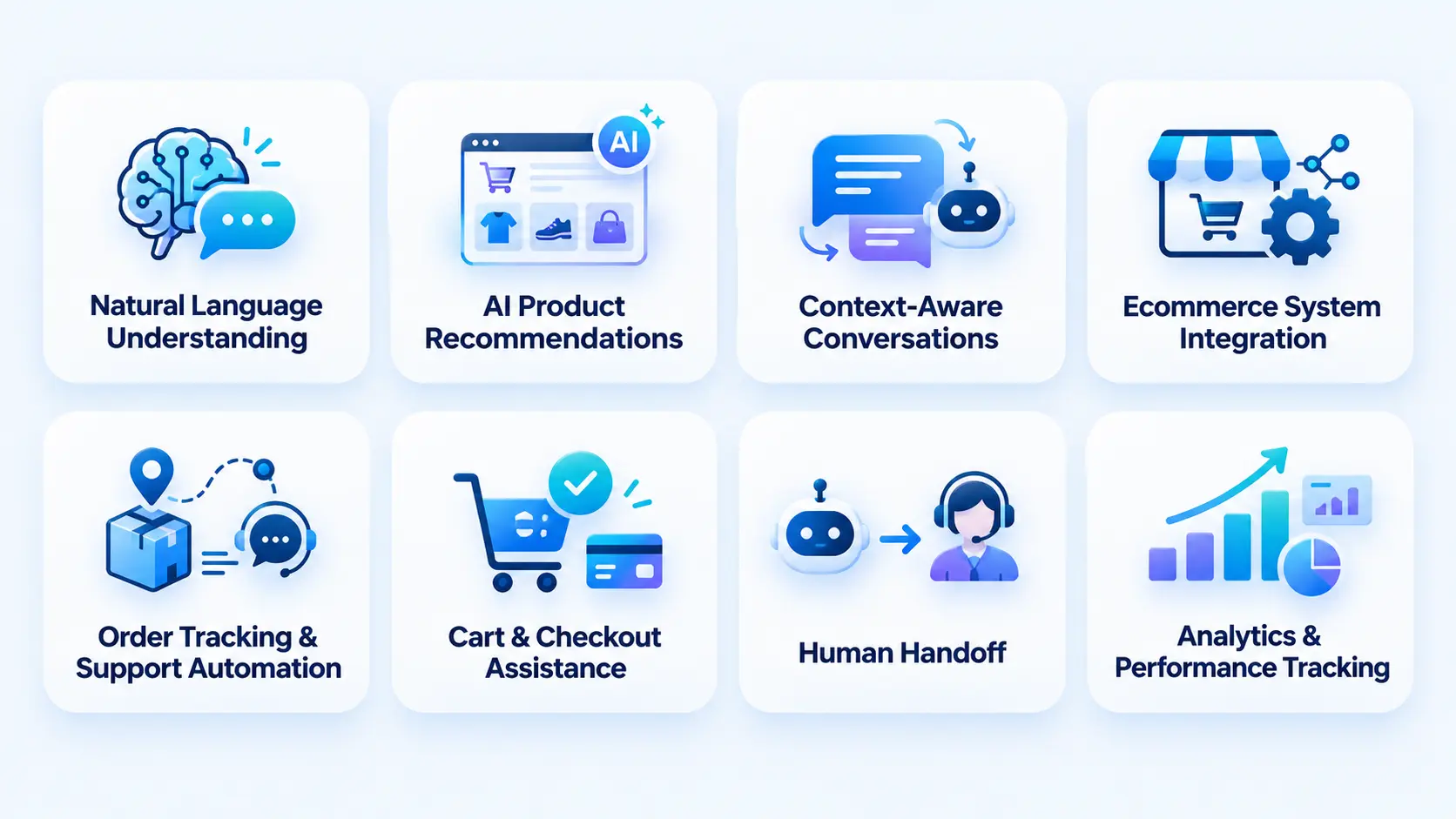
A successful ecommerce chatbot needs more than conversational capabilities. It should connect with the store’s data, understand customer intent, and support key stages of the buying journey. These capabilities should align with essential ecommerce app development features to create a smoother and more personalized shopping experience.
1. Natural Language Understanding
The chatbot should understand questions written in everyday language instead of relying on fixed commands. This allows customers to ask about products, orders, returns, and other concerns naturally.
2. AI Product Search and Recommendations
The chatbot should help shoppers discover relevant products based on their needs, preferences, budget, and previous interactions. This can make product discovery faster while creating opportunities for cross-selling and upselling.
3. Context-Aware Conversations
The system should retain relevant information throughout a conversation so customers do not need to repeat themselves. Context awareness makes ecommerce chatbots more useful for product comparisons, order queries, and multi-step shopping assistance.
4. Ecommerce System Integration
The chatbot should connect with essential systems such as product catalogs, inventory, CRM, order management, and customer accounts. These integrations allow it to provide accurate information and support real ecommerce workflows.
5. Order Tracking and Support Automation
Customers should be able to check order status, delivery updates, return eligibility, and other common requests directly through the chatbot. Automating these repetitive interactions can reduce pressure on customer support teams.
6. Cart and Checkout Assistance
The chatbot can answer questions about shipping, payment options, product availability, returns, and other purchase concerns during checkout. Removing these points of uncertainty can help customers move forward with their purchases.
7. Human Handoff
Complex complaints and sensitive requests still require human expertise. The chatbot should recognize when escalation is necessary and transfer the conversation with relevant context so customers do not have to start over.
8. Analytics and Performance Tracking
Businesses should be able to monitor conversations, resolution rates, escalations, conversions, and frequently asked questions. These insights help teams measure chatbot performance and identify opportunities to improve the overall shopping experience.
Read More: E-commerce App Development: Must-Have Features, Ready-to-Market Options & Budget Planning
What Makes a Custom Ecommerce AI Chatbot Different?
Off-the-shelf chatbots can handle basic FAQs and predefined support queries, but they may become limiting as an ecommerce business grows. AI chatbot development for ecommerce businesses allows you to build the chatbot around your products, customer journeys, business rules, and existing technology instead of adapting your operations to the limitations of a generic tool.
1. Built Around Your Ecommerce Data
A custom chatbot can connect with approved product, inventory, pricing, customer, and order data to provide more accurate and relevant responses. This allows an ecommerce AI chatbot to recommend available products, answer questions about specific orders, and provide information based on your actual store policies rather than generic responses.
2. Aligned With Your Brand and Customer Journey
Your chatbot should communicate in a way that feels consistent with your brand. Custom development allows you to define its tone, terminology, response guidelines, escalation rules, and customer interaction flow. Whether shoppers need product recommendations, pre-sales assistance, or post-purchase support, the experience can be designed around how your customers actually interact with your business.
3. Designed Around Your Business Logic
A custom solution can do more than answer questions. It can follow business-specific rules for returns, cancellations, product eligibility, discounts, order assistance, and customer support. This makes the chatbot in ecommerce a functional part of the customer journey rather than simply another communication channel.
4. Deeper Integrations With Ecommerce Systems
Custom development allows the chatbot to work with the systems your business already uses, including CRM, ERP, inventory, order management, loyalty, analytics, logistics, and customer support platforms. These integrations can also support marketplace chatbot integration when businesses operate across multiple ecommerce channels or marketplaces.
5. Greater Control Over Data and AI Behavior
Businesses can define what information the chatbot can access, how customer data is handled, when human intervention is required, and how AI-generated responses should be managed. This level of control is especially important for businesses handling sensitive customer and commercial information.
6. Built to Scale With Your Business
Your chatbot may start with customer support and later expand into product discovery, personalized recommendations, sales assistance, order management, and post-purchase engagement. A custom solution can be designed to accommodate these evolving requirements, allowing your AI chatbots for ecommerce to become a broader part of the ecommerce experience rather than a standalone support feature.
For businesses considering customization, the decision should ultimately depend on the complexity of your store, integration requirements, customer volume, and long-term goals. A custom approach is particularly valuable when you need capabilities that standard tools cannot provide or want greater control over how AI supports your customers and business operations.
Custom AI Chatbot vs Shopify Plugin vs Off-the-Shelf Bot
Not every ecommerce business needs a fully custom chatbot. Plugin-based and ready-made solutions can work well for stores with straightforward requirements. The right choice depends on how deeply the chatbot needs to interact with your products, systems, customers, and business workflows.
| Factor | Custom AI Chatbot | Shopify Plugin | Off-the-Shelf Bot |
| Customization | High | Moderate | Limited |
| Product catalog integration | Tailored integration | Usually built-in | Varies |
| Business workflow support | Advanced | Basic to moderate | Limited |
| Brand-specific responses | High control | Moderate | Limited |
| Third-party integrations | Flexible | Platform dependent | Depends on provider |
| Data and logic control | High | Moderate | Limited |
| Scalability | Designed around business needs | Depends on platform | Depends on provider |
| Best for | Complex or growing stores | Small to mid-sized stores | Basic support needs |
A chatbot for ecommerce can be effective at any of these levels, but custom development becomes more valuable when you need advanced product recommendations, personalized shopping journeys, complex integrations, or proprietary business logic.
When a Plugin May Be Enough
A plugin can be a practical option when your primary goal is to automate FAQs, provide basic product assistance, or answer common order-related questions. It can also help smaller stores validate whether conversational shopping delivers value before making a larger technology investment.
When Custom Development Makes More Sense
Custom development is worth considering when your chatbot needs to work across multiple systems, support complex customer journeys, use proprietary data, or perform actions beyond standard FAQ automation. It also gives businesses greater flexibility to add new AI capabilities as their requirements evolve.
The key is not simply choosing between a custom solution and a ready-made tool. It is about matching the technology to your business goals, operational complexity, and expected return.
Security and Privacy Considerations for Ecommerce AI Chatbots
When an AI chatbot interacts with customers, products, orders, and account information, security cannot be treated as an afterthought. A reliable AI chatbot solution for ecommerce should give businesses control over what data the chatbot can access, how that data is processed, and which customer actions require additional verification.
1. Protect Customer and Business Data
Ecommerce chatbots may handle names, order details, addresses, preferences, and conversation history. Access should be limited to the information required for each task, with appropriate authentication, encryption, and permission controls in place.
2. Keep AI Responses Grounded in Business Data
The chatbot should rely on approved product, order, and business information instead of generating unsupported claims. Connecting the AI to trusted data sources and defining clear response boundaries can reduce inaccurate answers that may affect purchasing decisions.
3. Protect Payment and Account Information
Sensitive payment credentials should not be exposed to the chatbot unless there is a specific, secure architecture designed for that purpose. Account-related actions should also use appropriate authentication so customers cannot access another person’s information.
4. Maintain Control Over AI Actions
A chatbot should not have unrestricted access to business systems. Businesses can define which actions it can perform automatically and which ones require customer confirmation or human approval. This is particularly important for refunds, cancellations, account changes, and other sensitive requests.
5. Monitor Conversations and Improve Safely
Ongoing monitoring helps identify inaccurate responses, unusual activity, repeated customer complaints, and potential security issues. It also gives businesses useful insights for improving their ecommerce chatbot without compromising customer trust.
Read More : AI in Mobile App Security: Why Every Business Should Prioritize It
How to Measure the ROI of an AI Chatbot for Ecommerce
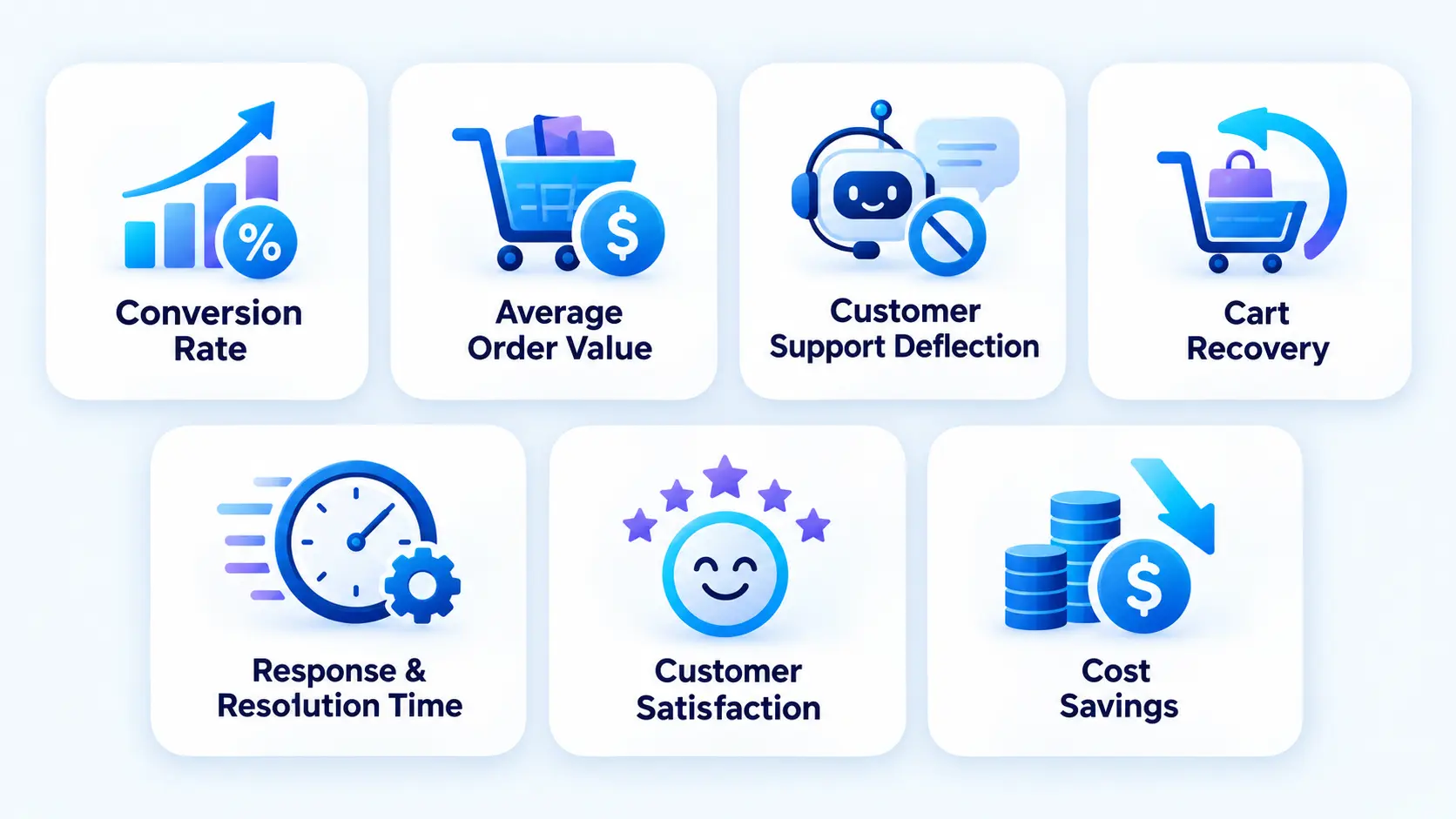
Installing a chatbot is not the same as creating business value. Ecommerce businesses should measure whether their chatbot improves customer experience, reduces operational costs, supports sales, or contributes to customer retention. The right metrics depend on the chatbot’s primary role and the problems it is designed to solve.
1. Conversion Rate
Track how often shoppers who interact with the chatbot complete a purchase. A rise in assisted conversions can indicate that the chatbot is helping customers find products, resolve concerns, or move through the buying journey.
2. Average Order Value
A chatbot that recommends complementary products or higher-value alternatives can influence basket size. Comparing average order value for chatbot-assisted and non-assisted purchases can help measure its contribution to revenue.
3. Customer Support Deflection
Measure how many customer questions are resolved without human intervention. For support-focused AI chatbots for ecommerce, this can show whether the system is reducing repetitive workloads while maintaining an acceptable resolution rate.
4. Cart Recovery
Track whether chatbot interactions encourage customers to return to abandoned carts and complete purchases. This is particularly useful when the chatbot provides product clarification, answers checkout questions, or addresses concerns about shipping and returns.
5. Response and Resolution Time
Faster answers can improve the shopping experience, particularly for order tracking, product questions, and post-purchase support. Businesses should monitor both response time and the percentage of conversations successfully resolved.
6. Customer Satisfaction
Customer feedback, satisfaction scores, repeat usage, and escalation rates provide a broader view of chatbot quality. High automation rates mean little if customers frequently leave conversations frustrated or immediately request a human agent.
7. Cost Savings
Compare the volume of conversations handled by the chatbot with the operational cost of handling the same queries through support teams. This helps businesses understand whether automation is producing measurable savings alongside revenue improvements.
The goal is not to maximize chatbot conversations. It is to maximize useful outcomes. A successful AI chatbot development for ecommerce businesses strategy should connect chatbot performance with metrics that matter to the business, such as revenue, support costs, conversions, customer satisfaction, and retention.
Common Challenges of AI Chatbots in Ecommerce
AI can improve product discovery, customer support, and sales, but the results depend on how well the chatbot is planned and implemented. Businesses should understand the common challenges before investing in chatbots for ecommerce.
1. Inaccurate or Irrelevant Responses
A chatbot can provide poor answers when it does not have access to current product, inventory, pricing, or policy information. Businesses should connect it with reliable data sources and regularly review responses to maintain accuracy.
2. Limited Understanding of Customer Intent
Shoppers rarely use the same words to describe what they need. A good chatbot should understand variations in language, follow the conversation context, and recognize when a customer is comparing products, asking for recommendations, or looking for support.
3. Poor Integration With Existing Systems
A chatbot becomes less useful when it operates separately from the ecommerce platform. Without access to relevant store and customer systems, it may answer basic questions but fail to complete useful tasks such as checking orders or providing personalized recommendations.
4. Lack of Human Escalation
Not every customer issue should be handled by AI. Complex complaints, sensitive account issues, and unusual requests may require human assistance. A proper escalation process ensures customers can reach an agent when automation is no longer appropriate.
5. Maintaining Brand Consistency
AI-generated responses should match the brand’s tone, policies, and customer service standards. Businesses need clear guidelines for how the chatbot communicates and what information it can provide.
6. Measuring Real Business Impact
Conversation volume alone does not indicate success. Businesses should connect chatbot activity with conversions, support costs, customer satisfaction, retention, and other relevant business outcomes. Tracking these metrics also helps businesses understand how top ecommerce trends are translating into measurable results.
When Should Your Ecommerce Business Build a Custom AI Chatbot?
A custom chatbot becomes worth considering when your store handles a high volume of repetitive customer queries, has a large or frequently changing product catalog, or needs more personalized shopping assistance. It can also make sense when existing chatbot tools cannot support your integrations, customer journeys, or business-specific workflows.
For growing businesses, the decision should also consider AI integration cost and long-term ROI, rather than chatbot adoption alone. If you want to improve product discovery, increase conversions, automate support, recover abandoned carts, or provide 24/7 assistance, evaluate the best ecommerce chatbots based on the business outcomes they can deliver, not just the number of features they offer.
How to Choose an AI Chatbot Development Company for Ecommerce
Choose a development partner with proven experience in AI, ecommerce workflows, and third-party integrations. The company should understand product discovery, customer support, order management, recommendations, and other ecommerce requirements rather than offering a generic chatbot solution.
Also evaluate their customization, security, scalability, and post-launch support capabilities. A reliable AI chatbot development service for ecommerce should be able to adapt the chatbot to your business processes, integrate it with your existing systems, and improve its performance as your customer and business needs evolve.
Why Choose RipenApps for Custom AI Chatbot Development?
RipenApps helps ecommerce businesses build AI-powered chatbot solutions around their specific customer journeys, products, and business requirements. Our approach combines chatbot strategy, conversational design, AI development, AI integration services, testing, and ongoing optimization, helping businesses move beyond basic FAQ automation.
With experience across AI and ecommerce application development, we focus on practical use cases such as product discovery, personalized recommendations, customer support, order assistance, and sales automation. Our custom AI chatbot development approach is designed to create scalable solutions that can evolve with your store, customer expectations, and future AI capabilities.
Wrapping Up
An AI chatbot for ecommerce is no longer limited to answering basic customer questions. When planned around real customer needs, it can help shoppers discover products, receive personalized recommendations, recover abandoned carts, track orders, resolve support queries, and move through the buying journey with less friction. The right solution should also connect with your ecommerce ecosystem, protect customer data, and deliver measurable value through better conversions, lower support costs, and stronger customer experiences.
For ecommerce businesses, the goal should not be to add AI simply because it is trending. It should be to identify where customers need help and use AI to make those interactions faster, easier, and more relevant. With custom AI chatbot development and AI integration services, RipenApps helps businesses turn these opportunities into scalable chatbot experiences built around their products, workflows, existing technology ecosystem, and growth goals.
FAQ’s
1. What is an AI chatbot for ecommerce?
An AI chatbot for ecommerce is a conversational AI solution that helps shoppers find products, get recommendations, track orders, resolve common issues, and receive assistance throughout their buying journey. Unlike basic rule-based bots, it can understand natural language and conversational context.
2. How is AI shaping the future of ecommerce businesses?
AI is shaping the future of business by helping ecommerce companies automate customer support, personalize shopping experiences, improve product discovery, and make faster data-driven decisions. As these capabilities mature, custom AI chatbots can become part of a broader strategy for improving customer experience, operational efficiency, and long-term growth.
3. How can an AI chatbot increase ecommerce sales?
An AI sales chatbot can help customers discover relevant products, answer purchase-related questions, recommend complementary items, and reduce friction during checkout. These interactions can support higher conversions and average order values when aligned with the customer’s intent.
4. What are the most common ecommerce chatbot use cases?
Common use cases include product discovery, personalized recommendations, cart recovery, order tracking, returns and refunds, customer support, pre-sales assistance, and post-purchase engagement. The right ecommerce chatbot use cases depend on the store’s goals and customer journey.
5. How much does it cost to develop an AI chatbot for ecommerce?
The cost depends on factors such as chatbot complexity, AI model selection, integrations, customization, number of platforms, features, and ongoing maintenance. Businesses can review chatbot development cost factors to understand what influences the overall investment.
6. Can an AI chatbot integrate with an ecommerce app?
Yes. A chatbot can be added to an ecommerce website or mobile application and connected with relevant product, customer, order, inventory, CRM, and support systems. This allows it to provide more useful assistance than a standalone conversational tool.
7. What is the difference between an ecommerce chatbot and an AI chatbot?
A traditional ecommerce chatbot generally follows predefined rules and workflows, while an AI chatbot can understand natural language, maintain context, and generate more flexible responses. Modern chatbot ecommerce solutions can combine both approaches to handle structured business workflows and conversational interactions.
8. How long does it take to build a custom AI chatbot?
Development time varies based on the number of features, integrations, platforms, AI capabilities, and customization requirements. A simple chatbot can be developed faster, while a fully integrated solution with advanced shopping and automation capabilities requires more planning and testing.
Discuss your project and request for proposal
SHARE
WRITTEN BY

Ishan Gupta
CEO & Founder
Ishan Gupta is a seasoned entrepreneur and CEO with extensive 10+ years of experience in business and mobile app development landscape. He believes that the right digital product allows companies to focus on what they do best, while technology handles the rest. With deep exposure to global markets, he understands what makes an app succeed. His approach translates business needs into clear product strategies, ensuring that every feature contributes to measurable ROI.
View All Articles