


Quick Summary
Planning an MVP budget in 2026 requires more than estimating development hours. This guide explains the latest MVP development cost ranges, key pricing factors, AI-assisted development, hidden post-launch expenses, and practical cost optimization strategies. Learn how to invest wisely, validate your product idea faster, and avoid expensive rebuilding later.
Key Takeaways
- MVP development costs typically range from $20,000 to $100,000, depending on product complexity, technology choices, development approach, and business requirements.
- Investing in a structured discovery phase helps validate assumptions early, reducing scope creep, technical debt, and expensive product rebuilds later.
- AI-assisted development accelerates routine coding tasks, but experienced engineers remain essential for architecture, security, quality assurance, and scalability.
- Building only core features while integrating trusted third-party services reduces development costs and shortens time to market without sacrificing quality.
- Reserve budget for post-launch maintenance, customer feedback, compliance, and continuous iteration to improve product-market fit and support sustainable growth.
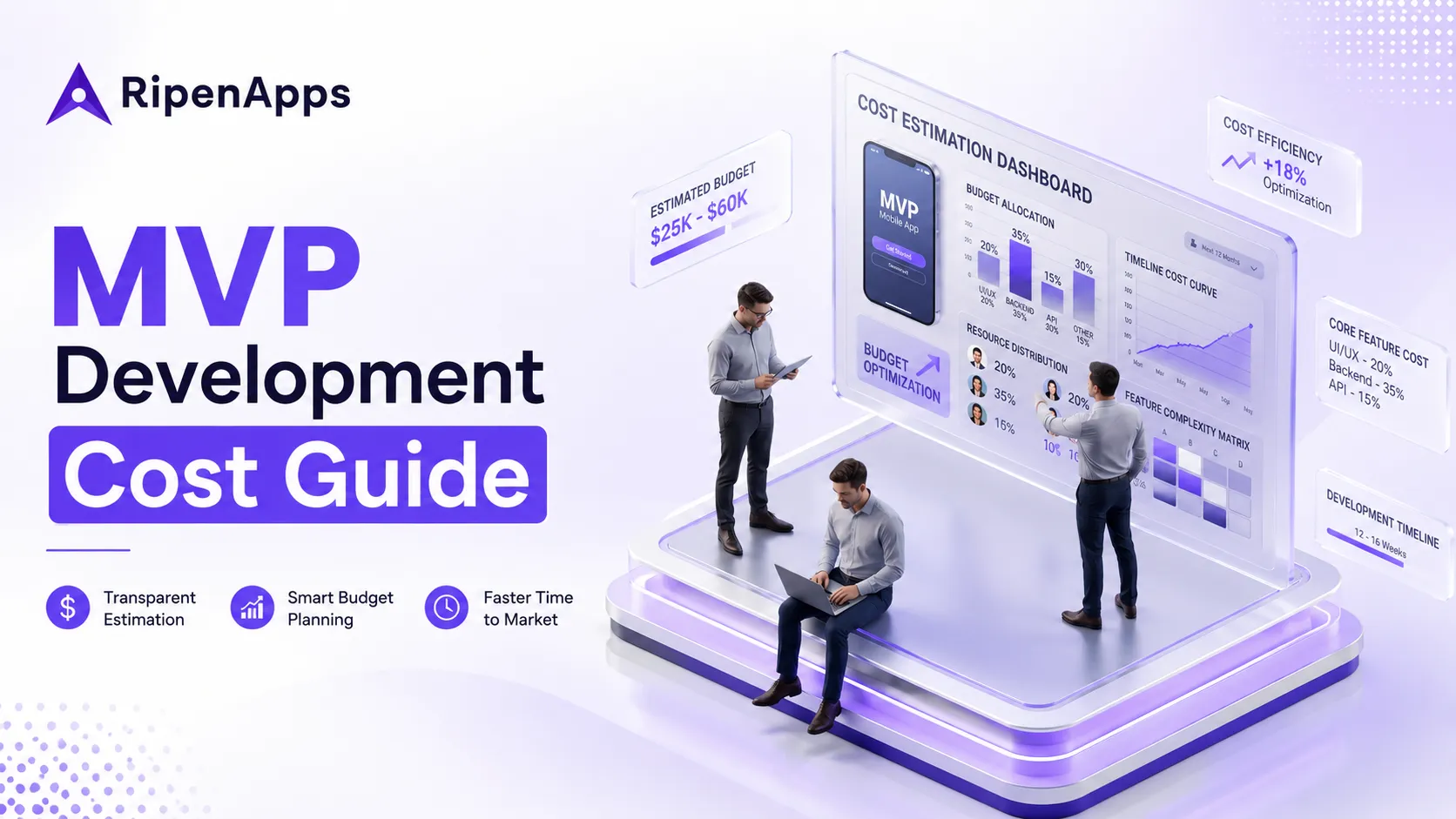
Every founder eventually asks the same question: How much does it cost to build an MVP? The short answer is that MVP development costs typically range from $20,000 to $100,000 for a custom product in 2026. A simple no-code MVP may cost as little as $2,000–$10,000, while a complex product with AI capabilities, enterprise integrations, or regulatory compliance can exceed $150,000. Most startups can expect a development timeline of 2 to 6 months, depending on the project’s complexity and scope.
However, the more important question isn’t how much an MVP costs; it’s how much it will cost if you build the wrong one. Many startups don’t exhaust their budgets because the first version of the product is too expensive. They lose valuable time and capital because they invest in features customers don’t need, choose technologies that don’t scale, or skip the strategic planning required before development begins. What initially appears to be a cost-saving decision often results in months of rework, technical debt, and delayed market entry.
Throughout this guide, we’ll introduce the Cost Per Validated Learning (CPVL) framework, a practical way to evaluate MVP investment. Instead of measuring success by the number of features delivered, CPVL measures how efficiently every dollar spent reduces business risk and validates product assumptions. This is why many startups evaluate MVP development services early, not just to estimate costs but to validate ideas, prioritize features, and reduce investment risks.
Table of Contents
MVP Development Cost at a Glance For 2026
For founders looking for a quick estimate, the table below summarizes the typical cost ranges for different types of MVPs.
| MVP Type | Typical Cost | Timeline | Best Suited For |
| No-Code / Landing Page MVP | $2,000–$10,000 | 2–4 weeks | Market validation and idea testing |
| Simple Custom MVP | $20,000–$40,000 | 8–12 weeks | Early-stage startups |
| Medium Complexity MVP | $40,000–$80,000 | 3–5 months | SaaS platforms, marketplaces |
| Complex MVP | $80,000–$150,000+ | 5–8 months | FinTech, HealthTech, AI products |
AI-assisted development has helped reduce the cost of building routine functionality in 2026, particularly for boilerplate code and repetitive engineering tasks. However, product strategy, software architecture, security, compliance, and quality assurance continue to require experienced engineering teams.
As a result, AI can accelerate development, but it doesn’t eliminate the need for thoughtful planning and technical expertise. Many founders also leverage rapid prototyping services during discovery to validate workflows and gather early user feedback before investing in full-scale development.
Why Should You Plan Your MVP Development Budget?
Many founders still think an MVP should be the cheapest possible version of a product. In reality, its purpose is to validate assumptions, not simply minimize costs.
Every digital product begins with uncertainty. Will customers use it? Will they pay for it? Can the business model scale? Is the technology stack right for future growth? Whether you’re building with an in-house team or partnering with a product development company, an MVP helps answer these questions quickly and cost-effectively before making larger investments.
This is where the Cost Per Validated Learning (CPVL) framework is valuable. Instead of measuring success by the number of features built, CPVL evaluates how effectively each dollar reduces uncertainty about customers, the market, or the product. For example, spending $15,000 to validate an idea that prevents a failed $150,000 product launch delivers far greater value than building features no one needs.
A well-planned MVP budget also aligns business, product, and engineering teams around customer learning, protects startup runway, and directs resources toward the highest-impact opportunities. The biggest financial risk in MVP development is rarely spending too much early on it’s investing in the wrong direction. That’s why successful startups treat MVP budgeting as an investment strategy, not just a cost-cutting exercise.
Validation MVP vs. Product MVP: Know What You’re Paying For
Before deciding how much to invest, founders should understand whether they need a Validation MVP or a Product MVP. Although the two terms are often used interchangeably, they serve different business objectives and require very different budgets.
A Validation MVP is designed to answer one question: Does the market actually want this solution? Its purpose is to collect evidence with minimal investment. In contrast, a Product MVP is intended for real customers and includes enough functionality to support consistent usage, onboarding, and early revenue generation. Comprehensive product design services combine usability, branding, and interaction design to create an MVP that users can navigate effortlessly.
| Validation MVP | Product MVP |
| Tests market demand | Delivers a usable product |
| Focuses on learning | Focuses on execution |
| Minimal functionality | Core workflows completed |
| Built quickly | Production-ready |
| Lower investment | Higher investment |
Consider a startup planning to build a healthcare marketplace. Instead of immediately investing $50,000 in a fully functional platform, the team could first launch a landing page, run targeted advertising campaigns, collect a waitlist of interested users, and conduct customer interviews. Within a few weeks, these experiments provide meaningful insight into whether real demand exists.
If market validation fails, the business avoids a costly product build. If demand is confirmed, founders can proceed with confidence, knowing that future development is backed by evidence rather than assumptions. Understanding this distinction is one of the simplest ways to avoid overspending during the earliest stages of product development.
Factors Driving MVP Development Costs (With Cost Estimates)
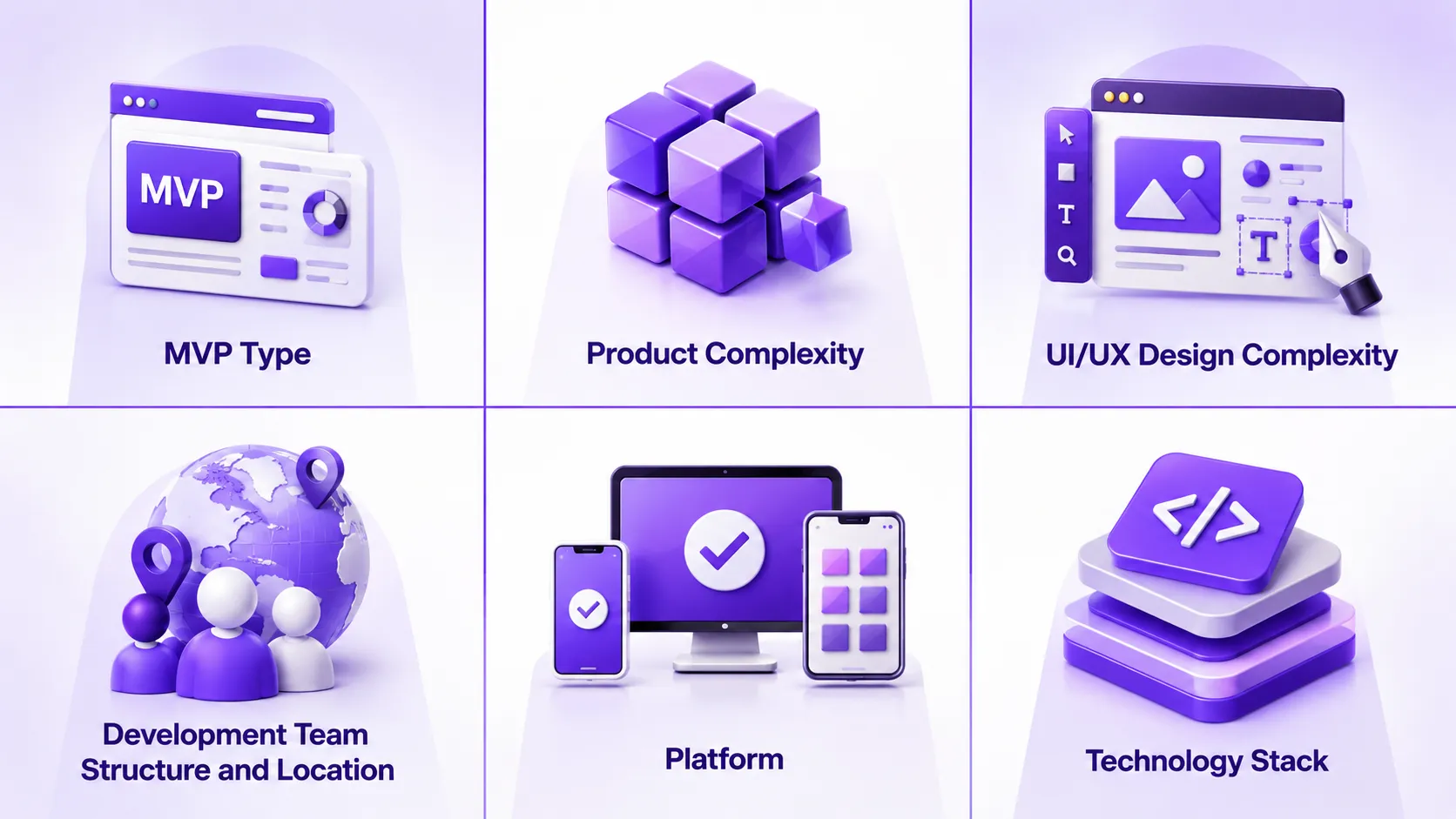
After completing the discovery phase, the next step is understanding what drives your MVP budget. Development hours alone don’t determine the final cost. Product complexity, team structure, technology choices, and architectural decisions all influence your overall investment. Understanding these factors helps you optimize costs without compromising quality or scalability.
1. MVP Type and Product Complexity
The scope of your MVP is the biggest cost driver. A landing page requires far less investment than a marketplace, fintech platform, or AI-powered SaaS product. Focus on building only the core functionality needed to validate your business idea.
| MVP Type | Typical Cost | Primary Objective |
| Landing Page MVP | $2,000–$5,000 | Validate demand |
| No-Code MVP | $5,000–$15,000 | Test business idea |
| Single-Feature MVP | $20,000–$40,000 | Validate one workflow |
| Multi-Feature MVP | $40,000–$80,000 | Test product-market fit |
| Complex Enterprise MVP | $80,000–$150,000+ | Launch scalable products |
2. UI/UX Design Complexity
A well-designed MVP generates better user feedback and improves validation. In 2026, experienced UI/UX designers typically charge $50–$100 per hour. Prioritize intuitive user flows and usability over visual perfection to keep costs under control.
Professional UI design services ensure that the MVP is visually consistent while keeping the interface simple enough for rapid validation
3. Development Team Structure and Location
Your hiring model has a major impact on both cost and delivery speed. In-house teams offer maximum control but require the highest investment. Outsourcing or offshore development provides access to experienced cross-functional teams at significantly lower costs, while nearshore teams balance collaboration with premium pricing.
| Development Model | Typical Cost |
| In-house Team | $120,000–$250,000 |
| Nearshore/Onshore Team | $170,000–$190,000 |
| Outsourced MVP Agency | $25,000–$40,000 |
| Offshore Team | $20,000–$70,000 |
Partnering with a startup app development company gives founders access to cross-functional expertise without the overhead of building an in-house engineering team. Choose a partner based on expertise, communication, and delivery capability, not just hourly rates.
4. Platform and Technology Stack
Your technology choices affect both development costs and future scalability. Cross-platform frameworks like Flutter and React Native offer the best balance of speed and cost for most startups, while Backend-as-a-Service (BaaS) platforms such as Firebase and Supabase reduce backend development effort and infrastructure costs.
Technology decisions should always support long-term business goals rather than simply reducing short-term development costs. The growing adoption of AI in MVP development is also influencing these decisions, enabling teams to automate repetitive tasks, accelerate coding and testing, and deliver products faster while keeping human oversight focused on architecture, security, and product strategy.
The Hidden Costs of AI-Assisted Development
The conversation around AI often focuses on productivity gains, but there are additional costs that many startups overlook during budgeting.
For products that integrate generative AI features, infrastructure expenses extend beyond traditional hosting. Usage-based API pricing, vector databases, prompt management, model monitoring, and inference costs become recurring operational expenses that continue long after the MVP has launched.
Equally important is code quality. AI-generated code can increase development speed, but every implementation still requires human review to ensure security, maintainability, and performance. Without proper engineering oversight, seemingly minor shortcuts can introduce technical debt that becomes expensive to resolve as the product grows.
MVP Development Cost by App Type
Not every MVP requires the same level of investment. Two products with similar screen counts can have dramatically different budgets because of integrations, compliance requirements, infrastructure complexity, or real-time functionality.
The table below provides typical cost ranges for common product categories.
| App Type | Typical MVP Cost | Primary Cost Driver |
| SaaS Platform | $30,000–$70,000 | User management, subscriptions, dashboards |
| Marketplace | $40,000–$80,000 | Buyer-seller workflows, payments, messaging |
| FinTech App | $80,000–$150,000+ | Security, compliance, financial integrations |
| HealthTech App | $80,000–$160,000+ | HIPAA compliance, patient privacy, data security |
| On-Demand Service App | $40,000–$90,000 | Real-time location tracking and notifications |
| AI-Powered Application | $60,000–$150,000+ | AI models, inference costs, data pipelines |
These figures represent broad industry benchmarks rather than fixed pricing. The final budget depends on the number of user roles, third-party integrations, reporting requirements, and technical complexity unique to each product.
For example, two marketplace applications may have similar functionality, yet one serving local businesses might cost significantly less than another supporting real-time logistics, dynamic pricing, multilingual users, and international payments.
Similarly, AI-powered products often appear simple on the surface but require additional investment in model integration, data processing, prompt engineering, monitoring, and ongoing infrastructure costs that extend well beyond initial development.
Rather than budgeting by the number of screens, founders should evaluate the complexity of the underlying business workflows and technical requirements.
Real-World MVP Cost Examples
While every product has unique requirements, examining real-world MVPs provides a practical benchmark for estimating development budgets. The examples below illustrate how product type, feature scope, and technical complexity influence the overall investment required to validate an idea and launch a market-ready MVP. The real-life examples of successful MVP development show how startups prioritize core functionality, validate demand, and optimize budgets before scaling their products.
Shubhra Ranjan: EdTech Learning Platform Developed by RipenApps
For an education platform like Shubhra Ranjan, the MVP focused on delivering a seamless digital learning experience with essential features that enabled students to access courses and monitor their progress. Advanced analytics, AI-powered recommendations, and enterprise-level reporting were intentionally deferred until after market validation, helping optimize both budget and time-to-market.
Estimated MVP Investment: $45,000–$65,000
Estimated Timeline: 3–4 months
Primary Cost Drivers: Video learning modules, student onboarding, progress tracking, and a scalable backend.
Vedic Meet: Spiritual Consultation Platform Developed by RipenApps
The initial version of Vedic Meet prioritized the core user journey—allowing users to discover experts, schedule consultations, and complete secure online sessions. By focusing on these essential workflows, the platform validated user demand before expanding into premium engagement and personalization features.
Estimated MVP Investment: $35,000–$55,000
Estimated Timeline: 3–4 months
Primary Cost Drivers: User profiles, consultation booking, secure payments, and real-time communication.
Airbnb: Marketplace MVP
If Airbnb were launched today as an MVP, the focus would be on validating interactions between hosts and guests through a streamlined booking experience. Advanced pricing algorithms, recommendation engines, and global infrastructure could be introduced later, once the business model and user demand had been validated.
Estimated MVP Investment: $60,000–$90,000
Estimated Timeline: 4–5 months
Primary Cost Drivers: Property listings, user accounts, booking workflows, messaging, and payment processing.
Uber: On-Demand Mobility MVP
An MVP for an on-demand mobility platform like Uber requires greater technical investment than many digital products because of its dependence on real-time location services and live communication. The initial version would focus on enabling riders to request trips, drivers to accept bookings, and secure payment processing while postponing advanced pricing, loyalty, and analytics capabilities.
Estimated MVP Investment: $80,000–$130,000
Estimated Timeline: 5–6 months
Primary Cost Drivers: Real-time GPS tracking, driver-rider matching, payments, and push notifications.
Key Insight
These examples demonstrate that successful MVPs don’t aim to deliver every planned feature from day one. Instead, they invest in the minimum functionality needed to validate the product’s core value proposition. By keeping the initial scope focused and iterating based on real user feedback, startups can control development costs, reduce risk, and achieve product-market fit more efficiently.
Post-Launch Costs: The Budget Most Founders Forget
Launching an MVP is not the finish line; it’s the beginning of the product validation journey. Yet many founders allocate their entire budget to development and underestimate the investment required after release.
According to the IBM Cost of a Data Breach Report 2025, organizations that extensively adopted AI and security automation saved an average of nearly $1.9 million per data breach and reduced the average breach lifecycle by approximately 80 days compared to organizations with limited automation. This highlights why allocating budget for security and compliance early is not just a risk mitigation strategy; it can significantly reduce long-term operational costs.
Once real users begin interacting with the product, you’ll need to analyze behavior, fix usability issues, improve performance, and continuously iterate based on customer feedback. In addition, infrastructure, compliance, marketing, and customer acquisition expenses become ongoing operational costs rather than one-time investments. Early UX research services help identify user pain points before design and development begin, reducing expensive revisions later.
A realistic MVP budget should therefore include a post-launch reserve alongside development costs.
| Cost Category | Typical Budget |
| Product Maintenance & Bug Fixes | Around 15–20% of development cost annually |
| Cloud Infrastructure & Hosting | Varies based on traffic and usage |
| Marketing & Customer Acquisition | $10,000+ depending on launch strategy |
| Sales & Business Development | $10,000+ for early-stage outreach |
| Security & Compliance (HIPAA, GDPR, SOC 2, etc.) | $20,000–$40,000+ where applicable |
| Product Iterations & Feature Enhancements | 20–30% of the initial MVP budget |
| Localization & International Expansion | Depends on target markets |
available budget. Successful startups reserve enough capital to learn from users and improve the product after launch.
How to Optimize MVP Development Costs
AI can significantly accelerate MVP development by generating boilerplate code, documentation, test cases, and routine workflows. However, it should support engineering teams—not replace architectural decisions, product strategy, or quality assurance.
According to the 2025 DORA Report by Google Cloud, more than 80% of developers now use AI in their daily work. However, the report also concludes that AI acts as an amplifier—it boosts productivity in teams with strong engineering practices while accelerating technical debt and quality issues in organizations with weak development workflows. This makes human oversight, code reviews, and disciplined engineering processes essential for building scalable MVPs.
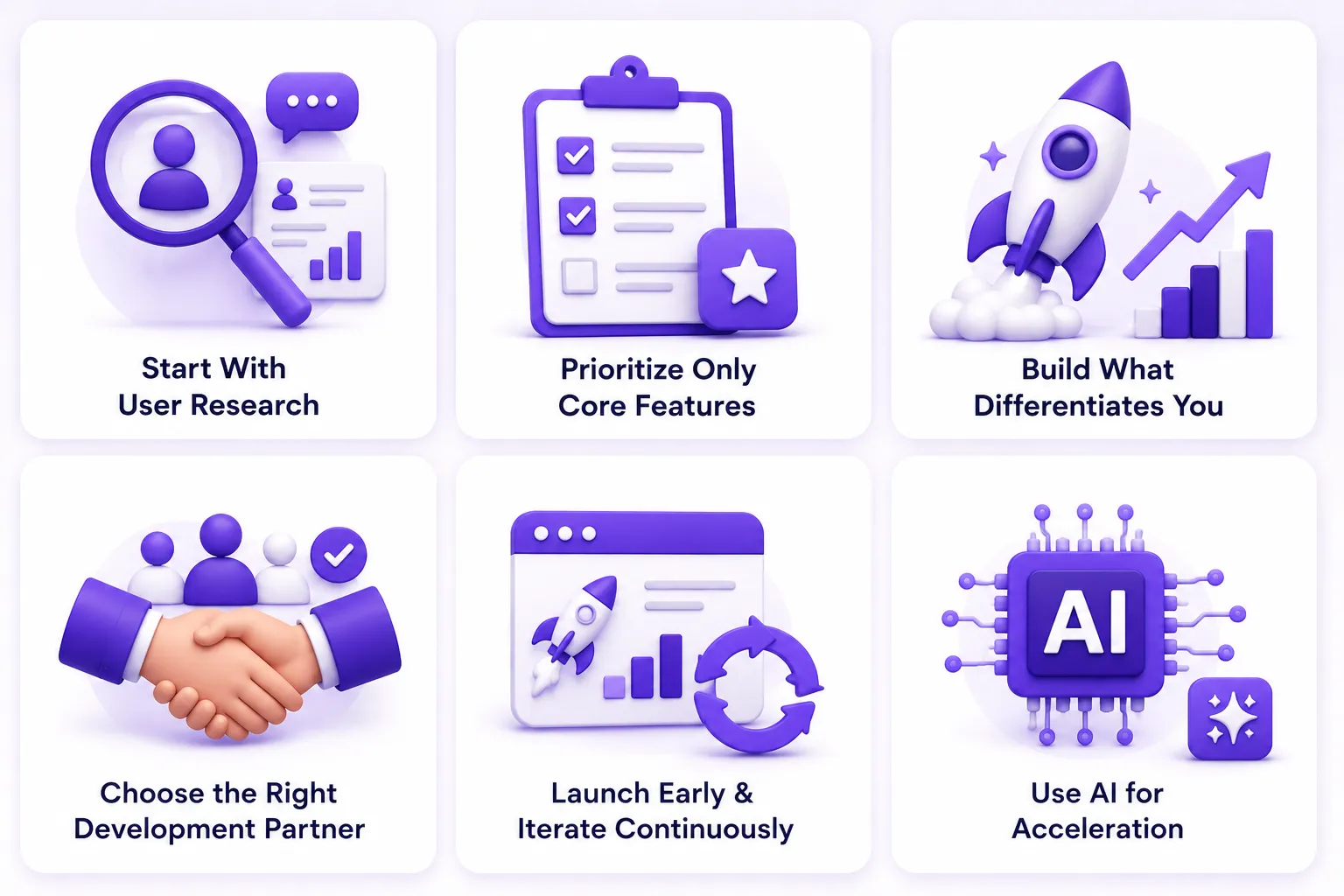
1. Start With User Research
Many expensive product decisions originate from assumptions rather than evidence. Understanding customer problems before development begins helps teams prioritize features that solve genuine user needs instead of building functionality based on internal opinions.
Interviews, surveys, competitor analysis, and usability research are relatively inexpensive activities that can prevent costly development mistakes later.
2. Prioritize Only Core Features
One of the fastest ways to exceed budget is by confusing an MVP with a finished product.
Every feature should answer a simple question: Does this help validate our business hypothesis? If the answer is no, it probably belongs in a future release rather than the initial MVP.
Launching with a smaller feature set also shortens development cycles, accelerates feedback collection, and makes future iterations easier to manage.
3. Build What Differentiates You, Integrate Everything Else
Modern software ecosystems provide reliable services for authentication, payments, notifications, analytics, cloud storage, communication, and customer support.
Building these capabilities from scratch rarely creates competitive advantage. Integrating proven third-party platforms allows engineering teams to focus their effort on the functionality that truly differentiates the product. This approach reduces development time, lowers maintenance costs, and improves overall product reliability.
4. Choose the Right Development Partner
Development cost should never be evaluated purely on hourly rates. An experienced product team can often deliver better outcomes with fewer iterations because discovery, architecture, design, engineering, and quality assurance are aligned from the beginning.
When evaluating a development partner, consider their product strategy expertise, technical capability, communication process, and experience delivering MVPs, not just their pricing.
5. Launch Early and Iterate Continuously
An MVP should be viewed as the beginning of a continuous improvement cycle rather than a one-time project. Releasing earlier allows businesses to collect real customer feedback, measure engagement, and improve the product based on actual usage rather than assumptions.
Small, iterative releases typically produce better business outcomes than waiting months to launch a feature-complete product.
6. Use AI for Acceleration, Not Decision-Making
AI can significantly improve developer productivity by automating repetitive engineering tasks, generating documentation, assisting with testing, and accelerating routine implementation. However, strategic decisions, including architecture, product design, security, and customer experience, still require experienced professionals.
The most effective teams use AI to increase engineering efficiency while relying on human expertise for the decisions that determine long-term product success. Combining AI with human oversight is also one of the best ways for MVP testing, as it helps validate functionality, identify quality issues early, and ensure the product solves real user problems before scaling.
Wrapping Up
MVP development cost is ultimately determined by the quality of your decisions rather than the number of development hours invested. Founders who focus solely on reducing upfront costs often pay far more later through technical debt, unnecessary features, delayed launches, and expensive product rebuilds. In contrast, businesses that invest in discovery, prioritize validated learning, choose scalable technologies, and iterate based on customer feedback typically achieve better outcomes with the same, or even smaller budgets.
Understanding the broader principles behind MVP planning can make these decisions even more effective, which is why it’s worth exploring a complete guide to Minimum Viable Product before moving from idea to execution.
Whether you’re validating your first startup idea or launching a new digital product within an established business, the goal isn’t to build more; it is to learn faster, make better decisions, and scale with confidence. If you’re planning an MVP and want a realistic estimate based on your business goals, technology requirements, and product complexity, start with a structured discovery process. A clear roadmap today can prevent costly rebuilding tomorrow.
FAQ
1. How much does it cost to build an MVP in 2026?
A custom MVP typically costs between $20,000 and $100,000, depending on its complexity, feature scope, technology stack, development approach, and location of the engineering team. Simpler no-code MVPs can often be built for $2,000–$10,000, while enterprise-grade products with advanced integrations or compliance requirements may exceed $150,000.
2. How much can AI-assisted development reduce MVP costs?
AI-assisted development can reduce development effort for repetitive tasks such as code generation, testing, documentation, and debugging. However, it does not eliminate the need for product strategy, software architecture, security reviews, quality assurance, or experienced engineering oversight. AI is best viewed as a productivity accelerator rather than a replacement for professional development.
3. How long does it take to develop a Minimum Viable Product?
The timeline depends on product complexity, team size, and technology choices. Startups that choose Flutter for MVP development can often reduce development time by building a single codebase for both iOS and Android, allowing many MVPs to launch within 3–6 months.
4. How long does it take to develop an MVP?
Most custom MVPs are completed within two to six months, depending on project complexity, feature scope, design requirements, and team size. No-code MVPs can often be launched within a few weeks, while highly regulated or technically complex products typically require longer development cycles.
5. What’s the difference between an MVP, a POC, and a prototype?
Understanding POC vs Prototype vs MVP helps founders select the right validation approach. A POC verifies technical feasibility, a prototype demonstrates the user experience, and an MVP is a functional product released to validate real market demand.
6. What is a realistic MVP budget for a seed-stage startup?
For most seed-funded startups, a budget of $30,000–$80,000 is sufficient to build a well-planned custom MVP that validates the core business idea. The exact investment depends on product complexity, integrations, and technology choices rather than the number of screens or features.
7. Why do most MVPs exceed their budgets?
Projects typically exceed budget because of inadequate discovery, changing requirements, poor feature prioritization, technical debt, and underestimating post-launch expenses such as maintenance, infrastructure, compliance, and customer acquisition.
8. What are the average hourly rates for MVP developers in India and the United States?
Experienced software developers in the United States generally charge $100–$180 per hour, while skilled development teams in India typically charge $25–$55 per hour. The total project cost, however, depends on delivery efficiency, product expertise, and team structure rather than hourly rates alone.
Discuss your project and request for proposal
SHARE
WRITTEN BY

Mohit Singh
Technical Content Writer
Mohit is a writer who makes technology easy to understand. He uses clear and simple words to explain technology for techy and non techy people who may not know much about tech. Mohit wants everyone to get how technology works without it being confusing. He's really good at turning complicated ideas into simple articles that anyone can read and enjoy. Mohit's goal is to help people see that tech isn't so hard to understand – it's for everyone!
View All Articles