

Do you have a mobile app concept that could acquire one million users in just 5 days after launch? And it could also bring billion-dollar investments within a few weeks?
No?
OpenAI’s ChatGPT is a revolutionary AI Chatbot. It became a global sensation overnight and created a buzz across the internet and industries since its launch in Nov 2022. What followed was unprecedented in the history of consumer technology: one million users in five days, one hundred million in two months, and a valuation that reshaped how the world thought about artificial intelligence as a business.
The incredible success of ChatGPT has shown the entire world how AI Chatbots can transform industries with their NLP and human-like conversation abilities. ChatGPT has demonstrated the transformative power of artificial intelligence and its significance in developing conversational chatbots.
Therefore, this AI-powered chatbot has become a billion-dollar app concept for businesses and entrepreneurs. The opportunity has only grown further with the rise of intelligent AI agents that can handle complex tasks, automate workflows, and deliver personalized interactions. Businesses looking to enter this space often collaborate with an AI agent development company to build next-generation chatbot applications with advanced reasoning, automation, and scalability.
However, there are many Chatbot apps and AI-based voice assistants already running in the market. But the concept of a Chatbot mobile app like ChatGPT is completely new and highly promising in the current industry.
If you are a startup or entrepreneur and want to establish your business model in the AI chatbot space, here in this guide, we will tell you how you can develop a competitive AI chatbot app in 2026, from choosing the right foundation model and tech stack, to building features users genuinely expect, to deploying and scaling responsibly. So let’s get started:
Key Takeaways
- Building ChatGPT-like apps is now API-driven, making development faster, scalable, and cost-efficient for most businesses.
- Modern chatbots go beyond conversations, enabling workflows, tool usage, memory, and multimodal interactions across platforms seamlessly.
- Agentic AI is redefining chatbot capabilities by autonomously executing multi-step tasks instead of just responding to queries.
- Development success depends heavily on choosing the right tech stack, defining use cases, and implementing robust evaluation systems.
- AI chatbot apps present a high-growth opportunity, with expanding enterprise adoption and strong ROI across multiple industries.
Table of Contents
What is a Modern Chatbot App?
A chatbot app is a web, mobile, or embedded application that utilises artificial intelligence, large language models (LLMs), and natural language processing to simulate human-like conversation and answer queries of the dedicated end-user base.
Unlike the traditional rule-based bots of the 2020s, today’s chatbot apps are driven by core foundation models. These models are capable of understanding the actual context and intent of the conversation happening between the user and the bot, thus simulating actual emotion-specific conversations.
The modern-day chatbot applications now go beyond simply answering the user’s questions; instead, they can browse the web, execute code, analyse documents and images. They also can connect users to third-party services and carry out multi-step workflows, all through natural language processing models.
These modern chatbots are meant to learn and adapt to individual users over time, thus increasingly run with persistent memory and operate across text, voice, and visual interfaces.
Key Types of Chatbots You Should Know
There are various kinds of chatbots depending on their purpose, underlying technology, and the various functionalities they deliver. A chatbot might work on a website as virtual customer assistance. Or it can be voice assistants like Siri, Alexa, or Google Assistant installed on smartphones or mobile devices.
However, most chatbots use NLP, AI, and ML models to perform actions based on the given user’s commands. So, based on their use case and functionalities, below are the most popular types of chatbot apps.
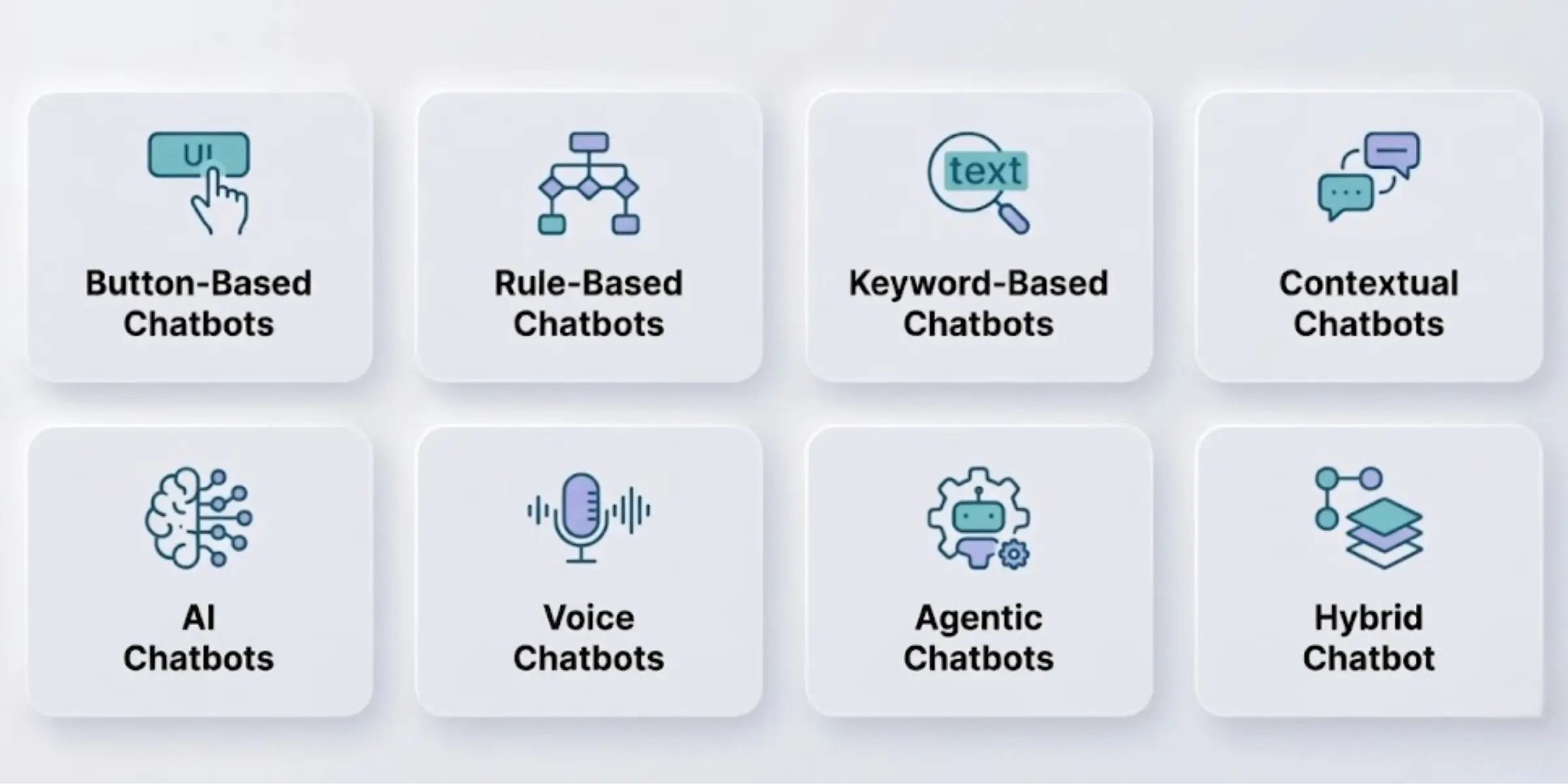
While early chatbots were largely limited to scripted interactions, the range today spans from simple button-driven menus to fully autonomous AI agents capable of completing complex yet multi-step tasks. Here are the most prominent types in 2026:
1. Button-Based Chatbots
By using the button-based chatbots to guide a user conversation, businesses can provide them with predefined clickable options. These bots don’t leverage NLP models and are fully deterministic. They are widely used for onboarding users with a sequence, simple FAQ flows, and low-complexity customer service scenarios.
2. Rule-Based Chatbots
The rule-based bot operates on an if-then logic tree. For example, if the user says X, then respond with Y. This traditional chatbot was reliable and easy to audit, but was brittle when users phrase things unexpectedly. It is now increasingly used in combination with AI models as a guardrail layer, thus ensuring compliance like HIPAA in healthcare, legal, and financial contexts within defined boundaries.
3. Keyword Recognition-Based Chatbots
Keyword recognition-based chatbots scan user input for trigger words or phrases to determine an appropriate response. This type of chatbot is more flexible than rule-based bots but prone to misinterpretation. They are now largely being replaced by intent-classification models and embedding-based semantic search, which understand meaning rather than just matching words.
4. Contextual Chatbots
By leveraging a contextual chatbot development type, your business can use machine learning (ML) and natural language processing (NLP) models to understand the user context of a real conversation across multiple turns. Now this type of chatbot is considered the baseline expectation for any consumer-facing chatbot. In 2026, contextual awareness extends to long-term memory across sessions, not just within a single conversation.
5. AI Chatbots
AI chatbots, also known as foundation model-powered chatbots, can handle open-ended queries, generate content, reason through problems, and adapt their tone and depth for the end user audiences. Driven by large language models such as GPT-4o, Claude, or Gemini, these bots are the dominant and fastest-growing category in 2026.
6. Voice Chatbots
This type of chatbot converts spoken language into text and then processes it through an AI model, and finally responds to it via synthesised speech. These voice chatbots are used in smart speakers, interactive voice response (IVR) systems, accessibility tools, and in-car assistants.
In 2026, real-time voice AI, enabled by APIs like OpenAI’s Realtime API, ElevenLabs, Deepgram, etc., has dramatically reduced latency. It results in making voice chatbots more conversational rather than transactional.
7. Agentic Chatbots
This is the defining new type of 2026. Agentic chatbots don’t just answer; they autonomously plan and execute multi-step tasks using tools, APIs, and external services. A user can instruct an agentic bot to “research competitors, draft a report, and schedule a review meeting”, and it will complete each step independently. Frameworks like LangGraph, AutoGen, and CrewAI power these systems. They represent the shift from chatbots as responders to chatbots as collaborators.
8. Hybrid Chatbots
Combine rule-based logic with AI capabilities, routing straightforward queries through deterministic paths while escalating complex or ambiguous ones to an LLM. In 2026, the most robust enterprise deployments use hybrid architectures using rules and guardrails for compliance-critical paths, and foundation models for everything that requires nuance, reasoning, or open-ended generation.
Read more : A Complete Guide to Chatbot Development
What is ChatGPT and How Has It Evolved?
Chat Generative Pre-Trained Transformer, or ChatGPT, is an AI chatbot application developed by OpenAI that interacts with users through a natural and human-like conversation. Launched in November 2022, it was built on the GPT-3.5 architecture and quickly became the fastest-growing consumer application in history.
Now, in 2026, ChatGPT has evolved into a significantly more capable platform, which is now driven by GPT-4o and o3 reasoning model series. It remains one of the most widely used AI assistants globally, with over 200 million weekly active users across its free and paid tiers.
At its core, ChatGPT is built on a transformer architecture trained on vast amounts of text data using a combination of supervised learning and reinforcement learning from human feedback (RLHF). This allows it to understand context, follow instructions, hold multi-turn conversations, and generate coherent, nuanced responses across a wide range of topics.
ChatGPT’s core capabilities now extend well beyond text, and it can process and generate images, analyse uploaded documents and spreadsheets, and execute code in a live sandbox. It can also interact with third-party tools and services through plugins and a built-in API layer. Moreover, it supports persistent memory, which means it can remember user preferences, context, and past conversations across sessions.
Why is ChatGPT Different from Other Chatbots?
Chatbots aren’t a new concept about which people are talking a lot these days. It has been running for many years in the industry. Businesses and companies have been using chatbots on their websites and software for customer service, lead generation, and basic query handling. However, these traditional chatbots had limited capabilities. They could perform only certain actions like responding to predefined queries, assisting in customer service, and writing simple content.
But ChatGPT defeated all the traditional chatbots through its advanced and extended capabilities. It is the first kind of AI chatbot in human history that has impressively demonstrated the effective use of artificial intelligence, natural language processing (NLP), machine learning, and deep learning. This chatbot offers a fast and convenient human-like chat facility for a diverse range of queries and user requests.
From the start of 2026, this gap has been widened further. While competitors like Claude, Gemini, and open-source models have raised the overall standard of AI assistants, ChatGPT continues to differentiate itself through the breadth of its capabilities. It has more intelligent features that help users from every domain to get quick and near-accurate answers or solutions to their inputs.
Here are the key features that stand out about ChatGPT from conventional chatbots in the market:
- Wide range of language inputs
- Great ability to learn and understand
- Cost-efficient and accessible for individual users
- Enhanced chatbot user experience
- Help with app development
- Designed for all industry domains
- Aids in business intelligence and decision-making
- Real-time web access and tool use
- Agentic task execution
How ChatGPT Works: Technology Behind the Intelligence
So you have got the basic and essential understanding of what features make ChatGPT unique and revolutionary. Now, let us understand how ChatGPT works. This will give you an idea of how your chatbot mobile app will work and function.
ChatGPT is built on the GPT-4o and o3 model family, a significant evolution from the GPT-3 foundation it launched on in 2022. It primarily involves a combination of supervised learning, reinforcement learning from AI feedback (RLAIF), where AI models assist in evaluating and refining outputs at scale. This underlying technology accelerates the alignment process beyond what human reviewers alone could achieve.
It is the largest NLP model ever built in the chatbot development industry that contains 175 billion parameters. Let’s break the GPT term so it will give an overview of its body.
- G (Generative) – It means an initiator or generator, producing original responses rather than retrieving pre-written answers from a database.
- P (Pre-Trained) – The model is trained on an enormous corpus of text before deployment. In 2026, these pre-trained datasets will not just include text but code, images, structured data and audio, thus enabling the multimodal capabilities users now expect.
- T (Transformer) – This is an ML model that recognises patterns, relationships, and context within language. Modern transformer implementations use significantly more efficient attention mechanisms than the original design, allowing models to process context windows of 128,000 tokens or more.
ChatGPT works on the transformer architecture. It facilitates the processing of a large volume of data and learning to operate the tasks of natural language processing (NLP) efficiently. This AI Chatbot app is pre-trained for handling a large dataset of text and answering questions from diverse subjects.
It can fetch data from user interaction. And then adapt the answers in a conversant way. Its unique ability to generate human-like responses makes it appealing and gives an improved user experience.
Step-by-Step Guide to Building a ChatGPT-like App
ChatGPT is a complex and high-end AI and ML-based chatbot software. It has an extensive and efficient ability to process large data sizes and produce desired outputs from various subjects.
However, it might appear lucrative and fascinating to have your own chatbot app like ChatGPT. But chatbot app development like ChatGPT isn’t so easy. In fact, it takes a lot of programming and intelligent use of artificial intelligence, machine learning, deep learning, and data science to build it successfully.
So when it comes to chatbot development like ChatGPT, there are two ways.
The first is to develop from scratch the way OpenAI did. But this method would cost a lot and is not even affordable to many. In 2026, this barrier is higher than ever; training a frontier model from scratch requires hundreds of millions of dollars in compute, proprietary datasets at enormous scale, and a world-class ML research team. It remains out of reach for all but a handful of organisations globally.
Hence, the second way is to use OpenAI’s ChatGPT API in your Chatbot mobile app. It is not only cost-efficient but also easy to build. In 2026, this approach has expanded considerably you are no longer limited to OpenAI alone.
Developers can now choose from a rich ecosystem of foundation model APIs, including Anthropic’s Claude, Google’s Gemini, Meta’s Llama, and Mistral, selecting the model that best fits their use case, budget, and data privacy requirements.
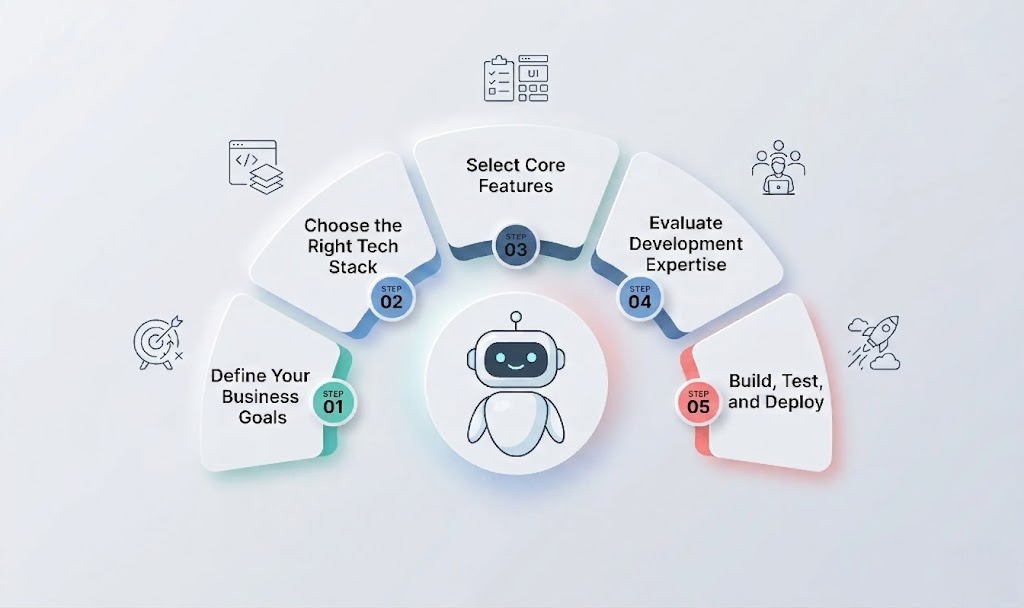
Below, we mentioned the steps on how to develop a chatbot mobile app like ChatGPT using OpenAI’s ChatGPT API:
Step 1: Define Your Business Goals
It is the first and foremost step before you dive into chatbot app development. Every chatbot serves a certain niche. It could work for online search, customer service, voice assistant, writing content, coding or academic subject matters, and much more.
There are many chatbots available in the market that are meant for particular domains. Therefore, you need to define your project scope specifically as what you expect your chatbot app to do.
Answer the following questions:
- For what purpose are you actually developing it?
- Does your chatbot need to utilise modern AI chatbot development trends or just act like executing tasks, call APIs, browse the web, or only converse with the end users?
- Do you want to develop a similar chatbot mobile app as ChatGPT?
- Do you want to use ChatGPT’s capabilities in your chatbot for some other purposes?
- What are your data privacy and regulatory requirements?
Define your business goals and deeply analyse your project requirements. This will lay down the architecture of your chatbot mobile app.
Step 2: Choose the RightTech Stack
Chatbot app development requires a definite technology stack. To build a full-fledged chatbot mobile application using ChatGPT API, you will need to integrate several technologies.
The composition of the tech stack also depends on the type of mobile app you are creating. The exact selection depends on the project requirements. If you are not a technical expert or programmer, it is advisable to consult a professional ai chatbot app development company. They will assist you in determining the right tech stack as per your project requirements.
Since we are building a chatbot mobile app using ChatGPT API, below tech stack could be used. However, this tech stack is not exclusive but indicative.
Programming Languages
- Python
- Java
- JavaScript
- TypeScript
- Clojure
- PHP
Chatbot Development Frameworks
- Google DialogFlow
- Microsoft Bot Framework
- Amazon Lex
- BotKit
- Rasa SDK
- LangChain
- CrewAI
- LangGraph
Mobile App Development Frameworks
- React Native
- Flutter
- Android Studio
- iOS SDK
- Expo
APIs
- OpenAI’s ChatGPT
- Whisper API
- Anthropic Claude API
- Google Gemini API
- Meta Llama 3
- ElevenLabs
- Dashbot
Backend Frameworks
- Botpress
- NodeJs
- FastAPI (Python)
- Vercel AI SDK
RAG and Memory Infrastructure
- Pinecone / Qdrant
- Zep
- Unstructured.io
Step 3: Select the Core Features
ChatGPT offers many attractive features, unlike conventional chatbots in the market. It can generate outputs for diverse fields, offer human-like conversations, provide assistance with coding and programming, etc.
Nevertheless, there are different variants of ChatGPT that include distinctive features also. So, determine the features for your chatbot mobile app as per your goals and target audience. Here we have listed the important features of a chatbot app like ChatGPT:
- Automation
- Personalized content
- Multi-language support
- Fine-tuning
- Interactive communication
- High scalability
- Human-like conversation
- Fast response
- Persistent memory
- Multimodal input support
- Real-time web search
Step 4: Evaluate portfolio and AI expertise
At this stage, you have all the required project details. Now, you need to find a team that will take charge of this project. For developing chatbot apps, you need to take assistance from a chatbot development company. They specialise in using artificial intelligence, machine learning, NLP, and other effective tech stacks for developing a fully functional chatbot application like ChatGPT.
While choosing the company, make sure they have a good track record in chatbot development. And also ensure their developer team possesses qualified skills in artificial intelligence and machine learning in app development.
In 2026, also verify that the team has hands-on experience with the following, as these have become essential competencies for any serious AI chatbot project:
- RAG pipeline design and vector database integration
- Prompt engineering and evaluation methodology
- Agentic workflow architecture using frameworks like LangGraph or AutoGen
- LLM observability and cost management tools, such as LangSmith or Helicone
- AI safety, output guardrails, and regulatory compliance relevant to your target industry
Step 5: Build, Test, and Deploy Your Chatbot App
Your chatbot development company will now develop the chatbot mobile app using the required tech stacks. As we mentioned, our method to develop a chatbot is to use the ChatGPT API.
So you need to ensure your chatbot app development team flawlessly integrates the ChatGPT API into your app. Once the app gets developed, put it through quality assurance tests and deploy it after validating it on all pre-defined quality parameters.
In 2026, the development and deployment process includes several additional considerations that did not exist when ChatGPT first launched:
- Evaluation before launch: Build a golden test set of representative queries and use automated LLM-as-judge scoring to measure response quality, accuracy, and safety before going live.
- Prompt versioning: Treat system prompts as code. Version-control them and test changes before deploying to production, as a prompt change can significantly alter behaviour across your entire user base.
- Observability from day one: Integrate tracing tools like LangSmith or Helicone from the start to monitor latency, token costs, failure rates, and user satisfaction in real time.
- Iterative model evaluation: Foundation models update frequently. Establish a process for re-evaluating your application against new model versions before migrating, as capability improvements can sometimes introduce unexpected behaviour changes.
How Much Does It Cost to Build an AI Chatbot App in 2026?
Building an AI chatbot app in 2026 is significantly more accessible than it was when ChatGPT first launched, but the chatbot development cost still varies enormously depending on your approach, feature set, and scale. The good news is that API pricing has dropped dramatically over the past three years, open-source models have made self-hosting viable, and a mature ecosystem of tools means development teams can move faster than ever before.
That said, building something truly competitive with RAG, memory, voice, agentic capabilities, and a polished mobile experience requires meaningful investment across several layers. Here is a realistic breakdown of what to expect in 2026.
| Chatbot Type | Estimated Cost |
| MVP chatbot app | $30,000 to $80,000 |
| Full-featured chatbot app | $80,000 to $200,000 |
| Enterprise-grade agentic chatbot platform | $200,000 to $500,000+ |
| Foundation model API costs (per 1M tokens, leading models) | $2 to $15, depending on model tier |
| Open-source self-hosted model infrastructure | $1,000 to $10,000/month, depending on traffic |
| Vector database and RAG infrastructure | $200 to $2,000/month at a moderate scale |
| Voice integration (speech-to-text + TTS) | $0.006 to $0.02 per minute of audio |
| Fine-tuning a domain-specific model (one-time) | $5,000 to $50,000 |
| LLM observability and monitoring tools | $100 to $1,500/month |
| Ongoing maintenance, evaluation, and model updates | 15 to 20% of the initial build cost annually |
For context, these figures reflect the cost of building on top of existing foundation models, which is the commercially viable path for the vast majority of businesses and startups. Training a frontier model from scratch, the way OpenAI built ChatGPT, remains a multi-hundred-million-dollar undertaking requiring world-class infrastructure and research teams.
OpenAI’s operational costs alone are estimated to run into hundreds of millions of dollars annually to keep ChatGPT running at a global scale, a figure that underscores why the API-first approach is not just the practical choice, but the smart one for virtually every builder entering this space today.
Why Chatbot Mobile App Like ChatGPT Is a Great Business Model?
ChatGPT isn’t the first chatbot people are mostly talking about. There are plenty of chatbots already available in the market. Alone on Facebook Messenger, there are more than 300,000 chatbots in operation. (Source)
From web to mobile, there are multiple types of chatbots running on both platforms, but ChatGPT stands out from all conventional chatbots, surpassing their limited capabilities. Its effective and intelligent use of NLP, AI, and ML models in a contextual chatbot has disrupted the entire industry.
According to the Precedence Research report, the global chatbot market size is valued at $1.70 Billion in 2026. It is now expected to reach $7.96 Billion by 2035 with a whopping CAGR of 18.81% between 2026 and 2035. (Source)
Not only this, if you see other chatbot app industry market statistics, you would find why chatbot development is a promising business idea for the future.
- 23% of customer service companies use chatbots
- 80% of people have interacted with a chatbot
- 68% of customers enjoy the faster chatbot answers
- Online retail stores have the highest rates of chatbot acceptance
- On average, chatbot chats have an almost 90% satisfaction rate
Thus, considering all these statistics, it is evident chatbot is certainly a lucrative business concept for startups and entrepreneurs. Businesses and consumers both are demanding this emerging chatbot model.
And interestingly, there is a huge lack of ChatGPT-like chatbots currently in the market. Especially on mobile platforms and smartphones, users are expecting the mobile app version of ChatGPT.
Top Industries Leveraging AI Chatbot Apps
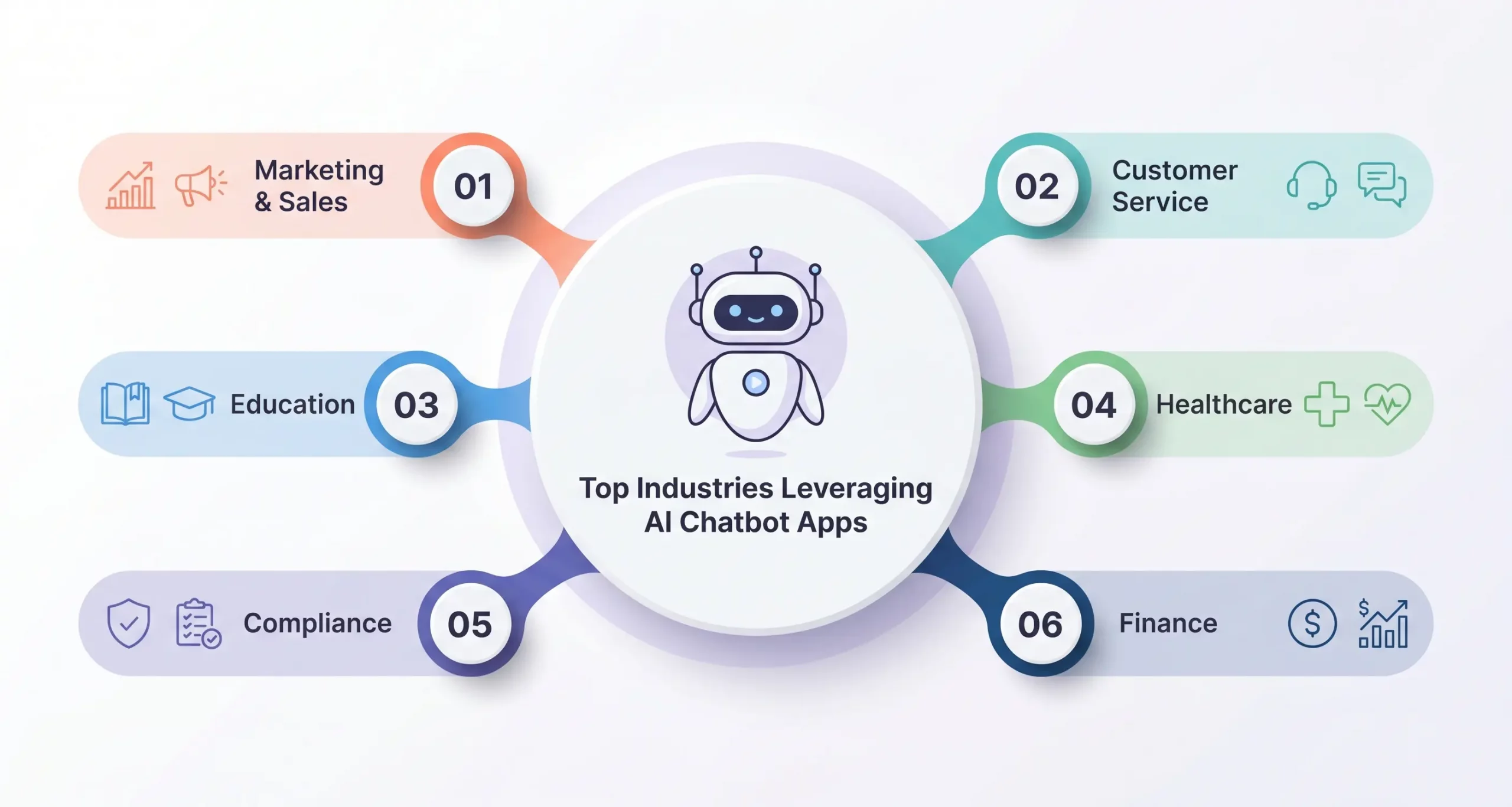
1. Marketing and Sales
Companies and business organisations can use this app for creating sales and marketing content. They can generate ideas for marketing their products and services. Since this app uses deep predictive data analytics, it can also help them in analysing their target audience and create personalised content.
AI chatbots are being used across the entire revenue funnel, from personalised outreach at scale and real-time objection handling during sales calls, to post-purchase retention campaigns that adapt dynamically to individual customer behaviour. Marketing teams using AI assistants are reporting 40 to 60% reductions in content production time.
2. Customer Service
Companies and organisations can use ChatGPT-like apps to provide fast and convenient customer service. They can use this app as an AI customer service assistant regardless of time zone, location, or language barrier. What has changed in 2026 is the depth of what AI customer service can handle.
Modern agentic chatbots can process refunds, update orders, reschedule appointments, and escalate intelligently to human agents with full context, resolving the majority of queries end-to-end without human involvement. Multilingual support now covers over 50 languages with near-native fluency, making global deployment straightforward.
3. Education and Training
One of the unique abilities of ChatGPT is to generate content in a summarised form. This is highly useful for educating and training employees. Industries can use ChatGPT-like apps for creating specialised training materials for their professionals, helping increase efficiency and productivity.
In 2026, AI tutoring assistants will go far beyond content summarisation. They can assess a learner’s current knowledge level, adapt the curriculum in real time, generate practice questions, provide detailed feedback on written work, and simulate professional scenarios for skills training. Personalised AI tutoring at scale, once a futuristic concept, is now a practical and commercially proven application.
4. Healthcare
The healthcare and medical sector can use AI chatbot apps for a deeper understanding of the human body and diseases. It could assist in providing remote medical assistance, discovering new drugs and medical solutions, and also in research and development. In 2026, healthcare AI assistants will be deployed for patient intake and triage, chronic disease management, mental health support, clinical documentation, and drug interaction checking.
Regulatory frameworks like HIPAA in the US and equivalent standards in the EU and India have matured enough that compliant deployment is now achievable, though it requires careful vendor selection and architecture decisions around data handling and model choice.
5. Legal and Compliance
Law firms, compliance teams, and legal technology companies are among the fastest-growing adopters of AI chatbot applications. Use cases include contract review and summarisation, regulatory Q&A, case research, and generating first drafts of standard legal documents.
AI assistants trained on jurisdiction-specific legal corpora and grounded with RAG over private document libraries are delivering measurable time savings for legal professionals without replacing the human judgment that remains essential for high-stakes decisions.
6. Finance and Banking
Financial institutions are deploying AI chatbots for customer onboarding, portfolio explanation, fraud detection & alert communication, loan eligibility guidance, and regulatory disclosure in plain language. The combination of real-time data access, personalised context, and 24/7 availability makes AI assistants particularly valuable in a sector where customers increasingly expect instant, accurate answers to complex financial questions.
Wrapping Up
The rapid rise of ChatGPT has unlocked new possibilities for the future of conversational AI. From enterprises to startups, businesses across industries are actively exploring intelligent chatbot solutions to enhance customer engagement, automate operations, and drive efficiency.
Given the growing demand, building a chatbot mobile app inspired by ChatGPT presents a strong high-ROI opportunity. However, developing such advanced AI solutions requires deep technical expertise, strategic planning, and the right development approach.
Partnering with an experienced development company can make all the difference. At RipenApps, a leading mobile app development company, we bring proven expertise in building scalable and innovative chatbot solutions.
With a dedicated team of AI specialists, ML engineers, data scientists, and app developers, we help businesses turn their chatbot ideas into powerful, real-world applications. If you’re planning to launch your own AI chatbot app, having the right technology partner can help you move faster, smarter, and more confidently toward success.
FAQs
1. How long does it take to build a ChatGPT-like chatbot app?
Building a ChatGPT-like app typically takes 3 to 9 months, depending on complexity, features, and integrations. An MVP can be developed faster, while enterprise-grade apps with agentic workflows, voice AI, and RAG capabilities require more time.
2. Is it better to build a chatbot from scratch or use APIs like ChatGPT?
For most businesses, using AI model APIs (like OpenAI, Claude, or Gemini) is the most practical approach. Building from scratch requires massive investment, data, and infrastructure, making APIs the cost-effective and scalable choice.
3. What are the must-have features in a ChatGPT-like app?
Key features include natural language understanding, contextual memory, real-time responses, personalisation, multimodal support (text/voice/images), and API integrations. Advanced apps also include agentic workflows and real-time web access.
4. How much does it cost to maintain an AI chatbot app?
Maintenance typically costs 15–20% of the initial development cost annually. This includes API usage, cloud infrastructure, model updates, monitoring tools, and continuous improvements to performance and accuracy.
5. Which industries benefit the most from ChatGPT-like chatbot apps?
Industries like customer service, healthcare, education, finance, and marketing benefit significantly. These chatbots help automate workflows, improve user experience, reduce operational costs, and deliver personalised interactions at scale.
Discuss your project and request for proposal
SHARE
WRITTEN BY

Ishan Gupta
CEO & Founder
Ishan Gupta is a seasoned entrepreneur and CEO with extensive 10+ years of experience in business and mobile app development landscape. He believes that the right digital product allows companies to focus on what they do best, while technology handles the rest. With deep exposure to global markets, he understands what makes an app succeed. His approach translates business needs into clear product strategies, ensuring that every feature contributes to measurable ROI.
View All Articles