
Key Takeaways
- Validate market demand before committing to a full product build.
- Keep the first release focused on essential features and clear business goals.
- Use real user feedback to improve product decisions and prioritise future features.
- Plan for maintainability, security, and future expansion without overengineering the first version.
- Define success metrics before launch so you can evaluate whether the MVP is meeting its objectives.
- Set a realistic budget that accounts for development, testing, deployment, and post-launch improvements.
- Choose a development partner who understands your product vision, target users, and validation goals.
Launching a software product without validating its core idea can waste budgets, delay releases, and result in features customers never use. Businesses need more than a promising concept to succeed. They need evidence that the product solves a real problem and offers enough value for people to use it.
A Minimum Viable Product (MVP) helps you test that assumption before committing to a complete product. It includes the essential features needed to address a specific user problem, collect feedback, and evaluate market demand. Instead of investing heavily in a full-scale build from day one, you can learn what works and refine your plans using real user insights.
With Custom MVP Software Development, you can build a product around your business model, target audience, and validation goals. A tailored MVP also gives you greater control over which features to test, how users interact with them, and how the product can evolve as your business grows.
In this blog, you’ll discover how an MVP can help you validate demand, control development costs, prioritise the right features, and prepare for future growth. You’ll also learn what to consider when working with a leading software development company to turn your idea into a product that meets user needs before committing to a full-scale launch.
Table of Contents
What Is Custom MVP Software Development?
Custom MVP Software Development is the process of building a tailored first version of a digital product with only the essential features required to test its core value proposition. It could be a web application, mobile app, SaaS platform, marketplace, or internal business tool.
Unlike a generic template, a custom MVP is designed around your target users, business workflows, and product goals. You decide which features to launch first, what user actions to measure, and which technical capabilities are necessary for future development.
For example, a business planning a food delivery platform might start with customer registration, restaurant listings, ordering, and basic payment functionality. Features such as loyalty programmes, advanced recommendations, and multi-city analytics can follow once the business understands user demand.
The objective is not to launch an incomplete product. It is to build the smallest useful version that allows you to test important assumptions, gather feedback, and decide what to build next.
Why Businesses Should Invest in a Custom MVP Before Full Product Launch
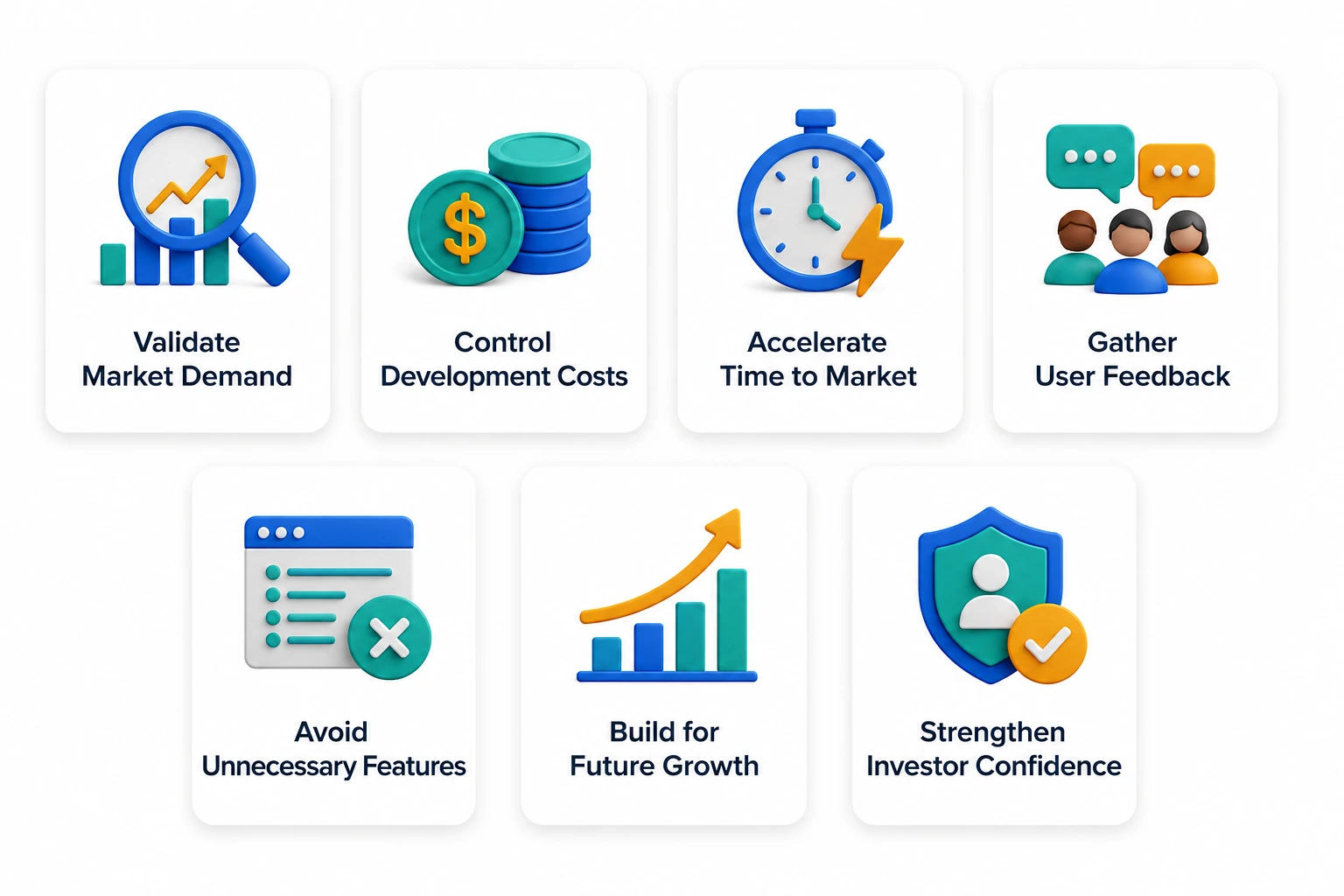
A full product launch involves significant decisions about development budgets, features, infrastructure, marketing, and ongoing support. Building everything before validating demand increases the risk of spending resources on the wrong priorities.
Custom MVP Software Development gives businesses a more controlled way to approach these decisions. Here are the key reasons to consider it before investing in a complete product.
1. Validate Market Demand Before Making a Larger Investment
A product idea might look promising during internal discussions, but that does not guarantee customers will use it or pay for it. An MVP lets you introduce the core solution to a selected group of users and observe their response.
You can assess whether users understand the product, complete its main workflows, return after their first visit, and show interest in its value proposition. This evidence helps you decide whether to continue with the current direction, adjust the concept, or explore a different opportunity.
A focused MVP also supports a stronger software product development strategy because product decisions are based on validated needs rather than assumptions alone.
2. Control Initial Development Costs
Building every planned feature before launch can increase development time, testing effort, and project expenses. Some of those features might eventually prove unnecessary, making the initial investment difficult to justify.
A custom MVP keeps the first release focused on essential functionality. You can allocate the available budget to core workflows, launch readiness, security, and user feedback instead of spending on features that have not yet demonstrated their value.
If budget planning is a priority, review the MVP development cost guide to understand the factors that influence the investment, including feature scope, platform choice, integrations, and technical complexity.
3. Bring Your Product to Market Sooner
A smaller, clearly defined product scope helps the development team concentrate on the features required for an initial release. This can shorten the path from planning to launch compared with attempting to build a complete product at once.
An earlier release also gives you more time to observe actual user behaviour while refining the roadmap for future versions. However, speed should not come at the expense of essential testing, data protection, or product reliability.
For businesses exploring software development for startups, an MVP offers a practical way to move from an early concept to a working product without committing to the full feature set immediately.
4. Gather Real User Feedback Before Scaling
Internal reviews and prototype testing help identify usability issues, but real users can reveal problems that the development team did not anticipate. They might struggle with a particular workflow, ignore a feature, or request functionality that was not part of the original plan.
A working MVP lets you collect feedback through interviews, support requests, usage analytics, and task completion data. You can then prioritise improvements according to user needs and business goals.
This feedback loop makes Custom MVP Software Development a learning process rather than a one-time delivery exercise. Each iteration helps you make better decisions about the product’s next release.
5. Reduce the Risk of Building the Wrong Features
A long feature list can make a product appear more competitive, but every additional feature requires design, engineering, testing, and maintenance. Without validation, it is difficult to know which capabilities deserve that investment.
Start by separating must-have features from enhancements that can wait. Build the workflows necessary to solve the main user problem, then use feedback and performance data to determine what to prioritise next.
This approach also makes it easier to define success metrics. Instead of judging progress by the number of features delivered, measure whether users complete key actions, return to the product, or demonstrate genuine demand.
6. Establish a Foundation for Future Growth
An MVP should be small in scope, but its technical foundation still matters. Poorly structured code, weak access controls, or tightly connected modules can make future changes expensive when the product gains traction.
Plan the architecture around the product’s current needs while leaving a practical path for new features, integrations, and higher user volumes. You do not need to build enterprise-scale infrastructure on day one, but you should understand which design decisions could limit future growth.
For products that handle substantial business information, planning for reliable data models and clear ownership of records is especially important. A relevant custom data management software approach can help teams think through how information should be structured and managed as the product evolves.
7. Make Investor and Stakeholder Discussions More Concrete
A working MVP gives investors, business partners, and internal decision-makers something more tangible than a pitch deck or product mock-up. They can explore the core experience and assess whether the product addresses a clear problem.
The MVP can also provide early evidence about user engagement, demand, and product feasibility. These signals do not guarantee funding or commercial success, but they can make discussions more specific and help stakeholders understand what the next investment would support.
For businesses preparing to scale, the strongest case comes from combining a clear product vision with credible evidence of user needs and a realistic plan for future development.
Custom MVP Software Development vs Ready-Made Solutions
Not every product idea requires a fully custom build from the beginning. Ready-made platforms, no-code tools, and existing software components can be suitable for testing standard workflows quickly. Custom development becomes more valuable when your product depends on unique business logic, specialised user journeys, or integrations that off-the-shelf solutions cannot support well.
| Consideration | Ready-made or no-code solution | Custom MVP |
| Initial setup | Often faster for standard workflows | Requires planning and tailored development |
| Feature flexibility | Limited by available tools and configurations | Features are designed around your product goals |
| User experience | Uses existing layouts and components | Supports product-specific user journeys |
| Integrations | Depends on supported connectors | Can be built around required systems and APIs |
| Technical control | Depends on the chosen platform | Greater control over architecture and code |
| Future changes | May be limited by platform capabilities | Can evolve according to product needs |
| Initial investment | Often lower for simple validation | Varies with scope and technical complexity |
How should you decide? Use an existing solution when your main goal is to test a standard idea with minimal technical investment. Consider a custom MVP when the product’s core value depends on unique functionality, specialised workflows, data control, or a technical foundation that needs to support future expansion.
Real-World Example of a Custom Software Platform
A real-world project shows how a focused software solution can address a specific business problem without requiring every possible feature at launch. The Volt Energy case study illustrates how a tailored platform can support a specialised business model through practical workflows and transparent financial planning.
Volt Energy – A Renewable Energy Platform
RipenApps developed a web-based software platform for Volt Energy to simplify commercial solar adoption through a transparent, risk-free financial model and end-to-end installation management. Delivered in three months, the platform included solar feasibility assessments, quoting, financial modelling, installation workflow management, and operational cost tracking. According to the results published in the Volt Energy case study, the business reported 300+ installations, a 60% reduction in operational costs, and 44% monthly growth, alongside 140,000 happy clients. This example highlights how focusing on the core business requirements can help create a practical solution that supports operational efficiency and future growth before expanding its capabilities.
Which Businesses Can Benefit From Custom MVP Development?
An MVP can help businesses at different stages, but the reason for building one varies according to their goals and constraints.
Startups Testing a New Idea
Founders can use startup MVP development to test whether a target audience needs their proposed solution before investing in a larger product. It also helps them identify essential features, assess technical feasibility, and plan the next development stage.
Established Businesses Launching New Digital Products
Companies introducing a new customer portal, subscription service, marketplace, or digital offering can test the concept with a smaller audience before making it available across the organisation or market.
Businesses Replacing Manual Processes
If a company wants to digitise an internal workflow, an MVP can focus on the most time-consuming process first. The team can measure whether the new software improves task completion, visibility, or operational consistency before expanding it.
Enterprises Exploring New Technologies
Larger organisations can use an enterprise MVP to validate a new digital service, integration, or AI-powered workflow within a controlled scope. The project should define data access, security, compliance, and success criteria before testing with real users.
Businesses Improving an Existing Product
A business with an underperforming application can test a redesigned workflow or a new capability with a limited user group before committing to a wider rollout. If the existing product needs deeper technical improvements, software product modernization services may also be relevant to improving its architecture or maintainability.
How to Build a Custom MVP Before Full Product Launch
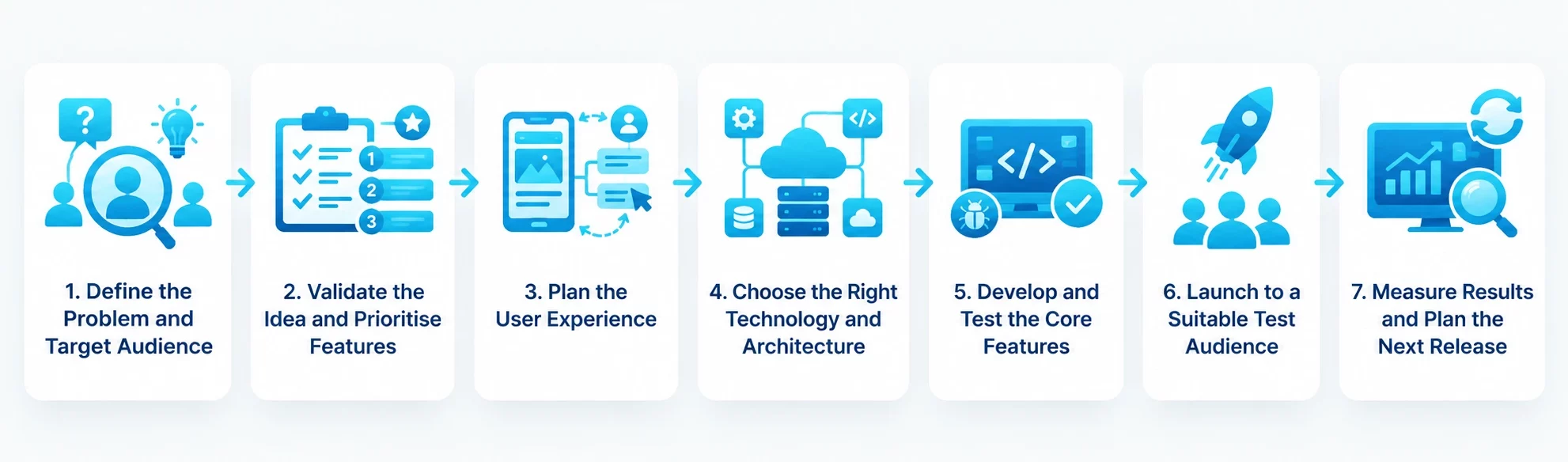
A successful MVP starts with a clear business question, not a long list of features. The development process should connect product decisions to user needs, technical requirements, and measurable outcomes.
Step 1. Define the Problem and Target Audience
Identify the specific problem your product will solve and who experiences it. Document your target users, their current alternatives, the challenges they face, and the outcome they expect from your solution.
Avoid defining the product only through features. Start with the user problem and explain why your proposed approach is useful. This creates a clearer basis for deciding what belongs in the first release.
Step 2. Validate the Idea and Prioritise Features
Use customer interviews, competitor research, surveys, or prototype testing to assess your assumptions. Identify which features are essential to testing the core value proposition and which can wait until you have stronger evidence.
Software product discovery workshops can help stakeholders agree on user journeys, feature priorities, technical requirements, and initial success metrics before development begins. This reduces ambiguity and gives the team a more focused scope to work with.
Step 3. Plan the User Experience
Map the key actions users need to complete, from registration and onboarding to the product’s main task. Keep the interface clear and remove unnecessary steps that could prevent users from reaching the product’s core value.
A qualified UI UX design agency can help translate these requirements into wireframes, prototypes, and tested user flows. Testing the experience early helps uncover usability issues before they become more expensive to fix during development.
Step 4. Choose the Right Technology and Architecture
Select technologies based on the product’s purpose, required integrations, team capabilities, security needs, budget, and likely growth. The best technology choice is the one that supports your product requirements without adding unnecessary complexity.
Plan important technical decisions early, including data structures, authentication, permissions, backups, and integration boundaries. For products with AI capabilities, assess whether the feature needs AI at all and define how its output will be evaluated before including it in the first release.
Step 5. Develop and Test the Core Features
Build the essential user workflows first and test them throughout development. Functional testing should confirm that key actions work as expected, while security and performance checks help identify issues that could affect the initial launch.
A structured software development life cycle helps teams manage requirements, design, implementation, testing, deployment, and maintenance. The process should remain flexible enough to incorporate findings without allowing uncontrolled feature expansion.
Step 6. Launch to a Suitable Test Audience
Release the MVP to a controlled group of target users or an initial market segment. Provide a way for users to report problems and share feedback, and monitor the core actions that indicate whether the product is solving the intended problem.
Before launch, confirm that critical workflows work reliably, user data is handled appropriately, and support responsibilities are clear. A limited release should still meet the quality and security standards necessary for its intended users.
Step 7. Measure Results and Plan the Next Release
Review usage data, user feedback, task completion, retention, and other metrics relevant to your product. Compare the results with the assumptions and success criteria established during planning.
Use these findings to decide whether to improve the current features, add new capabilities, change the product direction, or pause further investment. Custom MVP Software Development creates the most value when learning from one release directly informs the next product decision.
Read Also : The Complete Guide to Minimum Viable Product (MVP): Process, Benefits, and Examples
How Much Does Custom MVP Software Development Cost?
The cost of an MVP depends on the product’s scope, technical complexity, platform requirements, integrations, design needs, and testing effort. A simple web-based product with a few core workflows will generally require less investment than a multi-platform solution with complex business logic, payment processing, or AI functionality.
For planning purposes, businesses can use the following illustrative budget ranges as a starting point. These are not fixed market prices or quotations; actual costs depend on the requirements and development team’s estimates.
| MVP complexity | Illustrative cost range | Typical scope |
| Basic MVP | 10,000–25,000 | Core features, basic user accounts, and simple workflows |
| Mid-complexity MVP | 25,000–60,000 | Custom user journeys, integrations, dashboards, and more detailed business logic |
| Advanced MVP | 60,000–100,000+ | Complex integrations, specialised workflows, AI features, or demanding security requirements |
These ranges are intended for early budgeting, not as a guarantee of what a particular product will cost. A project with a narrow scope might cost less, while regulatory requirements, multiple platforms, and complex integrations can increase the investment.
For a more detailed breakdown of pricing factors and planning considerations, explore the MVP development cost guide.
Factors That Influence MVP Development Cost
- Feature scope: Every additional workflow requires design, development, and testing. Prioritising essential features helps keep the first release focused.
- Platform requirements: A web application, native mobile app, and cross-platform solution involve different development and testing needs.
- UI/UX design: Research, prototyping, accessibility, and usability testing affect the time needed to prepare the product for real users.
- Technical complexity: Custom business logic, real-time processing, advanced permissions, and AI capabilities can require additional engineering effort.
- Third-party integrations: Payment gateways, external APIs, analytics tools, and existing business systems add implementation and testing work.
- Security and compliance: Authentication, access controls, data protection, audit trails, and industry-specific requirements influence the scope.
- Testing and maintenance: Quality assurance, deployment, monitoring, bug fixes, and post-launch improvements should be included in the overall budget.
How to Keep Your MVP Budget Under Control
Start by defining the one primary problem the product needs to solve. Build only the features required to test that problem, agree on clear deliverables, and establish a process for approving changes to the scope.
Keep a separate allowance for testing, deployment, and early improvements. Avoid choosing a development approach based only on the lowest initial estimate; unclear requirements or a weak technical foundation can create additional costs after launch.
Common Mistakes to Avoid Before Launching an MVP
Even a well-funded project can struggle if the MVP is built without a clear validation goal. Avoid these common mistakes to get more value from your first release.
Building Too Many Features
Trying to launch with every planned capability increases cost and delays learning. Focus on the features needed to validate the core product idea, then use evidence to prioritise future additions.
Skipping User Research
Without understanding your target audience, you risk building a product around internal assumptions. Speak with potential users and test your key assumptions before committing to a detailed development plan.
Treating the MVP as a Throwaway Product
An MVP does not need enterprise-scale infrastructure, but it should still be maintainable and secure. Make practical architecture decisions that allow the product to evolve without unnecessary rework.
Ignoring Success Metrics
Launching the product is only one milestone. Define how you will measure whether users find value in it, such as task completion, repeat usage, conversion, or feedback on the core workflow.
Collecting Feedback Without Acting on It
User feedback has little value if it does not influence product decisions. Establish a regular review process to identify recurring issues, prioritise improvements, and explain why certain requests will or will not be addressed.
Choosing Technology Before Defining Requirements
Selecting a framework or platform too early can constrain the product unnecessarily. Define the user needs, workflows, integrations, and security requirements first, then choose technology that supports them.
How AI Can Support MVP Development
AI tools can help teams explore product ideas, summarise research, generate test cases, assist with coding, and automate selected workflows. These uses can reduce effort in specific stages, but they do not replace product validation, engineering judgement, or quality assurance.
The value depends on the problem being solved. If AI is central to the product’s core proposition, teams need to evaluate output quality, data privacy, operating costs, and failure scenarios before including it in the MVP. If AI is not essential to testing the main idea, adding it can introduce cost and complexity without improving validation.
Our guide to AI in MVP development explores how AI can support the process and where businesses should assess its suitability before committing to implementation.
The goal is to use AI where it improves the product or development process, not to add it simply because the technology is available.
Conclusion
Custom MVP Software Development helps businesses validate ideas, manage initial investment, and learn from real users before committing to a full product launch. By focusing on essential features, clear success metrics, and a reliable technical foundation, you can make better decisions about what to build next and where to invest your resources.
If you’re preparing to launch a new digital product, RipenApps can help you define the initial scope, prioritise features, and plan a practical development roadmap. Explore our MVP development services to discuss your product requirements and identify the right starting point for your business.
Frequently Asked Questions
Q1. What is custom MVP software development?
Custom MVP software development involves building a tailored first version of a digital product with the essential features needed to test its value with real users. It helps businesses validate demand before investing in a complete product.
Q2. Why should businesses build an MVP before a full product launch?
An MVP helps businesses test assumptions, gather user feedback, identify essential features, and manage initial development costs. It also provides useful insights for deciding whether to expand, improve, or change the product.
Q3. How much does custom MVP software development cost?
An MVP might cost around 10,000–25,000 for a basic product, 25,000–60,000 for a mid-complexity solution, and $60,000 or more for an advanced product. These are illustrative estimates, and the actual cost depends on scope, integrations, platforms, and technical requirements.
Q4. How long does it take to build an MVP?
A focused MVP might take several weeks to a few months, depending on its features, design requirements, integrations, and testing needs. A clearly defined scope and timely feedback help teams avoid unnecessary delays.
Q5. What features should an MVP include?
An MVP should include the features required to solve the main user problem and test the product’s core value proposition. Common elements include user registration, essential workflows, basic reporting, and relevant integrations, depending on the product.
Q6. Is a custom MVP better than a ready-made solution?
A custom MVP is useful when your product requires unique functionality, specialised workflows, or greater control over its technical foundation. Ready-made and no-code solutions can be more practical for testing standard ideas quickly and with a lower initial investment.
Q7. Can an MVP scale into a full product?
Yes. A well-planned MVP can evolve through new features, improved workflows, and infrastructure upgrades as user demand grows. The initial architecture should support likely future needs without introducing unnecessary complexity at launch.
Q8. How do businesses measure MVP success?
Businesses can track metrics such as user activation, task completion, repeat usage, conversion rates, customer feedback, and willingness to pay. The most relevant measures depend on the problem the product is designed to solve.
Discuss your project and request for proposal
SHARE
WRITTEN BY

Ishan Gupta
CEO & Founder
Ishan Gupta is a seasoned entrepreneur and CEO with extensive 10+ years of experience in business and mobile app development landscape. He believes that the right digital product allows companies to focus on what they do best, while technology handles the rest. With deep exposure to global markets, he understands what makes an app succeed. His approach translates business needs into clear product strategies, ensuring that every feature contributes to measurable ROI.
View All Articles