


Key Takeaways
- A successful software product begins with a validated problem and a clear understanding of customer needs.
- A strong product strategy connects business goals, user experience, technology, AI capabilities, and long-term growth.
- AI should be introduced where it creates measurable value rather than being added simply because the technology is available.
- Architecture, data, security, testing, cost, and scalability should be considered before an AI-driven product reaches production.
- Continuous measurement and improvement help businesses adapt as customer expectations, market conditions, and technology evolve.
Building a successful software product requires more than a good idea and a development team. Businesses need to understand the problem they are solving, the customers they want to serve, the value they want to create, and the technology required to deliver that value. This becomes even more important as artificial intelligence changes what modern software products can offer. AI can support personalization, automation, intelligent search, recommendations, predictive capabilities, content generation, and conversational experiences, but adding these capabilities without a clear purpose can increase complexity without improving the product.
A strong software product development strategy connects business objectives with product decisions and technical execution. It helps teams validate an opportunity before making a major investment, define the right product scope, determine where AI can genuinely contribute, and establish a technical foundation that can evolve as the product grows. For businesses planning a new product, custom software development services can help translate product requirements into a practical development plan while considering architecture, integrations, scalability, and long-term product goals.
The process should therefore not begin by asking which technology to use. It should begin by understanding the problem, validating the opportunity, defining the product vision, and then determining how technology and AI can turn that vision into a useful and sustainable product.
Table of Contents
What is a Software Product Development Strategy?
A software product development strategy is a structured approach to turning a product idea into a solution that addresses a genuine customer or business need. It connects the reason a product should exist with what needs to be built, how it should be built, and how it should evolve after launch.
The strategy begins with the “why.” Businesses need to understand the problem, the opportunity, the target audience, and the outcome they want to create. It then moves into the “what,” which defines the product vision, core workflows, features, user experience, and value proposition. Finally, it addresses the “how,” including technology, architecture, AI capabilities, integrations, security, development resources, testing, launch, and ongoing improvement.
Keeping these elements connected prevents product development from becoming a simple exercise in feature building. Without a clear strategy, teams can continue adding features because customers request them individually, competitors already have them, or new technology makes them possible. The product may become more complicated without becoming more valuable.
A strategy provides a framework for making those decisions. When a new feature is proposed, the team can evaluate whether it solves an important customer problem, supports the product vision, improves a measurable outcome, or provides meaningful differentiation.
This is particularly important for AI-driven products. Modern AI technologies make it possible to introduce conversational experiences, intelligent recommendations, content generation, predictive capabilities, automation, and natural-language interfaces into many types of software. The challenge is no longer simply determining what technology can do. The challenge is deciding what the product actually needs.
Why is a Strong Product Strategy Important?
Software products nowadays fail because teams cannot write code. The main problem behind this occurs when the wrong problem is selected and the product scope becomes too broad. Here, the customers’ assumptions remain untested and the technology decisions are made without considering the intended user experience.
A strong strategy reduces these risks by giving product teams a shared direction. Business stakeholders can understand what the product is expected to achieve. Designers can understand the experience they need to create. Developers can make architecture decisions based on actual requirements. AI and data teams can understand what intelligence the product requires and what information will support it.
This alignment becomes especially valuable when several teams or technologies are involved. An AI feature may require changes to the application architecture, data layer, user interface, security model, monitoring system, and operating budget. If those decisions are made independently, the resulting product can become difficult to maintain.
A strategy brings those decisions together while still leaving room for learning. Customer behavior, market conditions, competitors, technology, and AI capabilities can all change. A strong strategy should provide enough direction to keep the product focused while allowing the team to adapt when evidence changes.
Start With the Problem, Not the Technology
A successful software product starts with a clear understanding of the problem it is designed to solve. This becomes even more important when building AI-driven products, where new technologies can easily influence product decisions before the actual user need has been established.
Instead of beginning with a specific AI model, framework, or feature, teams should first identify the customer pain point, understand its business impact, and evaluate whether technology can provide a meaningful improvement. This problem-first approach helps businesses avoid unnecessary complexity and focus development efforts on features that can deliver measurable value.
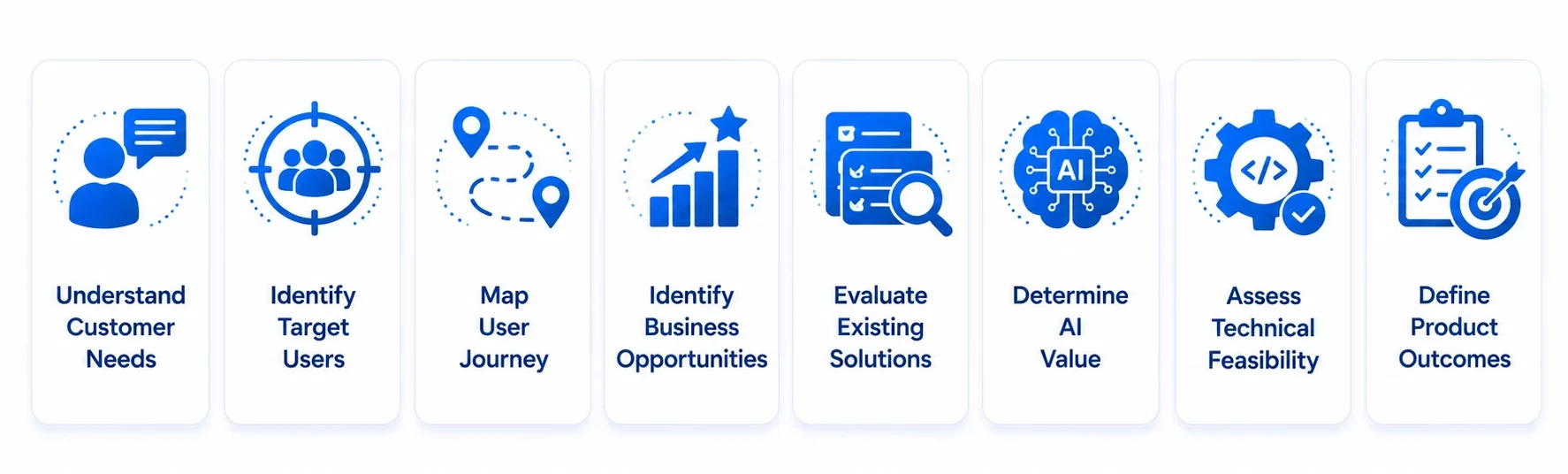
Understand the Customer Problem
One of the biggest mistakes in modern software development is starting with a technology instead of a customer problem. AI makes this particularly tempting because businesses can immediately see dozens of potential applications for generative AI, machine learning, computer vision, predictive analytics, and automation.
Teams should first understand what users are trying to accomplish, where they experience friction, what takes too much time, which processes are unnecessarily manual, and where existing solutions fail to deliver the expected outcome.
For example, a business may believe that it needs an AI chatbot because its customer-support team receives too many questions. Research could reveal that customers are actually struggling to locate accurate information. In that case, improving search and information architecture may solve the underlying problem more effectively than introducing a conversational interface.
Identify the Target Users
A clearly defined problem becomes easier to solve when teams understand who experiences it. Product teams should identify the primary user groups, their goals, workflows, technical expectations, and the circumstances in which the problem occurs.
User research, interviews, surveys, behavioral data, and competitor analysis can help reveal whether the problem is frequent and significant enough to justify building a new product or feature. Understanding different user segments can also prevent teams from designing a solution around assumptions rather than actual needs.
Map the Existing User Journey
Before introducing new functionality, teams should examine how users currently complete the task. Mapping the existing journey can reveal unnecessary steps, repetitive activities, bottlenecks, and points where users abandon the process.
This is particularly useful for AI-driven products because AI may not need to replace an entire workflow. It may be more valuable when applied to one specific stage, such as summarizing information, predicting an outcome, automating data entry, or assisting with a decision.
Identify the Business Opportunity
A customer problem also needs to connect with a meaningful business opportunity. Teams should consider whether the problem affects enough users, whether customers are willing to change their current behavior, and whether solving it can create measurable business value.
Market demand, competitive positioning, pricing potential, operational impact, and available resources all influence whether an idea is worth pursuing. A technically impressive product can still struggle if the market does not value the problem it solves.
This is why strategic planning should balance customer desirability with business viability. The strongest opportunities sit at the intersection of a meaningful user need and a sustainable business model.
Evaluate Existing Solutions
Before investing in development, businesses should understand how customers currently solve the problem. Existing competitors, internal processes, spreadsheets, manual workflows, and alternative software solutions can all provide useful insights.
The goal is not simply to build something different. The product should offer a clear improvement in usability, efficiency, accuracy, cost, speed, personalization, or another outcome that matters to the target audience.
Determine Where AI Can Add Value
Once the problem and opportunity are clear, AI can be evaluated as one possible solution. Businesses planning an AI-driven product can use the principles discussed in AI strategy for digital products to assess potential AI opportunities in relation to business objectives, user needs, data, feasibility, and expected outcomes.
AI should strengthen the solution rather than become the reason the product exists. Automation may reduce repetitive work, recommendations may improve decision-making, predictive models may help users anticipate events, and generative AI may make complex information easier to create or understand. The key is to select use cases where the expected value justifies the added complexity.
Assess Data and Technical Feasibility
An AI use case may look valuable on paper but still be difficult to implement effectively. Teams should assess whether the required data exists, whether it is reliable and accessible, and whether the organization has the technical infrastructure needed to support the proposed solution.
Other considerations include model selection, API availability, integration requirements, scalability, security, latency, maintenance, and ongoing AI-related costs. Evaluating these factors early helps teams identify technical limitations before significant development resources are committed.
Define the Expected Product Outcome
Every major product decision should connect to a measurable outcome. Instead of defining success only through features delivered, teams should determine what improvement the product is expected to create.
For an AI-driven product, this could mean reducing response times, increasing conversion rates, improving recommendation accuracy, lowering operational costs, reducing manual work, or increasing user engagement. Clear outcomes provide a foundation for prioritization and make it easier to determine whether the product is actually delivering value after launch.
Validate the Product Opportunity
Research Your Target Users
A genuine customer problem does not automatically represent a viable software opportunity. The market may be too small, customers may already have acceptable alternatives, or the problem may not be important enough to change existing behavior.
Teams should investigate who the target users are, how they currently solve the problem, what tools they already use, and where those tools fall short. Customer interviews, surveys, support conversations, product analytics, and observational research can reveal important assumptions.
The goal is not to eliminate every uncertainty. Product development will always involve assumptions. The objective is to identify the assumptions that could have the greatest impact on product success and test them as early as possible.
Analyze Existing Solutions
Competitor research helps the team understand what customers can already access. This includes direct competitors, indirect alternatives, manual processes, spreadsheets, internal tools, and emerging AI-powered solutions.
Instead of simply copying competitor features, the team should identify where existing solutions create friction. A gap may involve usability, speed, price, integration, accessibility, personalization, automation, or a specific workflow that is poorly served.
This analysis helps the product establish a meaningful reason for customers to choose it.
Test Your Product Assumptions
The product discovery phase gives teams an opportunity to test the assumptions behind the product before committing heavily to development. Discovery can clarify customer needs, evaluate solution concepts, define priorities, and identify risks.
A useful validation process should make three things increasingly clear: who the product is for, what problem it solves, and why customers would choose it over existing alternatives.
Once these questions become clearer, the product can move from an opportunity into a defined vision.
Define the Product Vision
Once the product opportunity is validated, businesses need a clear vision for what the product should achieve. The vision should connect the customer problem with the value the business wants to create and give product, design, engineering, and marketing teams a shared direction.
A strong product vision should define the value proposition, target users, and core product goals. Instead of simply describing the technology, it should explain the outcome the product intends to deliver. For example, an AI-powered customer-support product might aim to help teams resolve customer questions faster while reducing repetitive work.
Clear goals such as user adoption, retention, revenue, operational savings, task completion, or AI response quality also help teams prioritize the roadmap and measure progress. This turns the product vision into a practical framework for making development decisions.
Plan the First Product Version
Prioritize Essential Features
One of the biggest challenges in new software product development is trying to build the complete long-term product immediately. Businesses may want dashboards, multiple user roles, analytics, integrations, payments, automation, personalization, AI assistants, reporting, notifications, and administrative features from the first release.
The first version should instead focus on the smallest useful experience capable of proving the core proposition.
This approach is central to MVP development. An MVP (Minimum Viable Product) is not simply a cheaper version of the final product. It is a focused product designed to test important assumptions with real users.
Decide Whether AI Belongs in the MVP
AI should be evaluated using the same prioritization discipline as every other feature. If AI is essential to the product’s core value, it may need to be included in the first release. A document-analysis product, for example, cannot validate its central proposition without demonstrating its analysis capability.
If AI is simply an enhancement, it may be better introduced after the primary workflow has been validated. This is where AI in MVP development becomes strategically important.
The question is not how many AI capabilities can be included in the first release. It is whether AI is necessary to prove the product’s core value.
Build, Test, and Learn From the First Release
The first release should create a learning loop. Real users can reveal problems that were difficult to identify during planning, including confusing workflows, missing functionality, unexpected use cases, and performance issues.
Teams should use this evidence to decide what to improve next. A focused first version makes that learning faster and reduces the risk of spending heavily on features that customers do not need.
Where AI Fits Into Product Development
AI for Automation and Efficiency
AI can reduce repetitive work by classifying information, extracting data, generating summaries, automating routine responses, or supporting operational decisions.
The value should be measured in terms of the workflow being improved. Saving time, reducing manual errors, increasing throughput, or enabling employees to focus on higher-value work can provide a clear business case.
AI for Personalization and Recommendations
AI can help products tailor content, recommendations, offers, workflows, or experiences to individual users.
Personalization is most valuable when it improves a decision or removes friction. It should not be introduced simply because individualized experiences are technically possible.
AI for Intelligent Search and Content
Search can become more useful when systems understand intent rather than relying entirely on exact keyword matching. AI can also help users summarize information, generate drafts, organize content, or interact with large collections of documents.
These capabilities are particularly useful where users work with large volumes of unstructured information.
AI for Predictive Capabilities
Predictive functionality can help businesses identify patterns, forecast demand, detect anomalies, estimate outcomes, or prioritize actions.
The usefulness of prediction depends on data quality and the consequences of incorrect predictions. Products should communicate uncertainty appropriately and provide users with enough context to make informed decisions.
As a broader principle, AI in product development should be considered within the overall product-development process rather than as a separate technology initiative.
Design the Product Around User Needs
AI can change how users interact with software, but the product experience should remain focused on helping users complete their goals efficiently. Teams should map the core user journey to identify where AI can reduce friction and where conventional interface elements such as forms, filters, buttons, or structured workflows are more effective.
The right AI interaction model depends on the task. Chat, recommendations, intelligent search, summaries, predictions, and automated workflows can be valuable for different use cases, while predictable tasks may still be better served by traditional controls. The strongest experiences often combine AI with familiar interface patterns rather than making AI the center of every interaction.
Users should also remain in control of important outcomes. AI-generated results may require review, editing, approval, or correction before an action is completed. Businesses exploring AI integration into mobile apps should also consider factors such as screen size, performance, connectivity, touch interactions, and user context. The goal is to make AI feel like a natural part of the product rather than a separate technology demonstration.
Build a Flexible Technical Foundation
Choose the Right Application Architecture
The technical foundation should support the current product while leaving enough flexibility for future development.
This includes application architecture, databases, APIs, authentication, cloud infrastructure, integrations, third-party services, data processing, and AI systems.
The product development life cycle provides a useful framework for understanding how a product progresses from planning and design through development, testing, launch, and ongoing improvement.
Plan APIs, Databases, and Integrations
Modern products rarely operate in isolation. They may connect with payment platforms, analytics systems, communication tools, enterprise applications, identity providers, AI services, and other external systems.
Well-defined APIs and clear data boundaries make these integrations easier to maintain. The team should also understand which integrations are business-critical and which can be replaced later.
Design for Future Product Changes
Product requirements evolve. A model provider may change its pricing. A new AI model may offer better performance. A customer may request an important integration. The product may need to support a new user group.
Modular components and clear separation between business logic and external services can make these changes easier.
The architecture should support iteration rather than assume that every early decision will remain permanent.
Build vs. Integrate: Making the Right Technology Decisions
When Custom Development Makes Sense
Not every component needs to be developed from scratch. However, capabilities that directly differentiate the product may justify deeper customization.
For specialized workflows, custom software development can provide flexibility for unique business processes, integrations, and user experiences that generic products cannot easily support.
When Third-Party Services Are Better
Commodity capabilities can often be obtained through established services. Payment processing, authentication, analytics, messaging, cloud infrastructure, and many AI capabilities can be integrated rather than built internally.
Using an existing service can reduce development time and maintenance effort, allowing the team to focus resources on the product’s differentiating capabilities.
Evaluate Cost, Security, and Vendor Dependency
A third-party service may accelerate development but introduce vendor dependency. A custom implementation may provide more control but require greater engineering and maintenance effort.
Teams should compare pricing, performance, security, data handling, customization, reliability, compliance, and the difficulty of replacing the service later.
The goal is not to build everything. It is to invest engineering effort where it creates the greatest product value.
Planning AI Integration, Data, and Security
Define the AI Integration Approach
Once AI has a defined role, it needs to be integrated into the product architecture in a way that users and the business can depend on.
An AI system may involve model APIs, prompts, retrieval systems, vector databases, data pipelines, application logic, authentication, monitoring, evaluation, and user interfaces. The model should not simply operate as an isolated black box.
A structured AI integration process helps teams think through these requirements instead of treating integration as simply connecting an API.
Prepare the Data Foundation
AI performance depends heavily on the quality and availability of data. If information is incomplete, outdated, inconsistent, or poorly structured, the model may produce unreliable results.
Businesses need to understand what data the product requires, where that data comes from, how it is stored, who can access it, and how AI systems are allowed to use it.
Protect Data and User Access
AI applications can introduce risks involving sensitive information, excessive permissions, insecure integrations, prompt injection, unintended data exposure, and unreliable outputs.
Teams should establish what AI can access, what actions it can perform, which actions require human approval, and what should happen when the AI cannot produce a reliable result.
Security should therefore become part of the product architecture rather than a final pre-launch activity.
Establish AI Governance and Human Oversight
AI governance defines how intelligent capabilities are monitored and controlled. Teams should establish ownership, evaluation processes, access controls, escalation paths, and rules for high-impact decisions.
Human oversight is especially important when AI outputs can affect customers, employees, financial decisions, compliance, or other consequential outcomes.
Testing and Evaluating AI Features
Define AI Performance Criteria
Traditional software testing evaluates whether an application behaves according to predefined rules. AI requires additional evaluation because outputs can vary and may not always have one exact correct answer.
Depending on the product, evaluation may consider accuracy, relevance, completeness, consistency, latency, safety, task completion, and user satisfaction.
Test Real-World Scenarios
Testing should reflect actual operating conditions. A customer-support assistant should be tested against ambiguous questions, incomplete information, unsupported requests, and situations outside its intended knowledge base.
A document-analysis system should be evaluated against different document structures and difficult-to-read inputs. A recommendation system should be assessed for relevance and unexpected behavior.
The objective is not to prove that AI will never make a mistake. It is to understand where it performs reliably, where safeguards are required, and how the application should respond when the model cannot provide an acceptable result.
Plan for AI Failures and Edge Cases
Teams should identify what happens when a model is unavailable, produces an uncertain answer, receives malicious input, or encounters information outside its expected scope.
This is also where AI integration mistakes can provide useful guidance. Common problems include adding AI without a clear use case, underestimating data requirements, overlooking operating costs, providing excessive permissions, and launching without meaningful evaluation.
Testing should continue after launch because real users will inevitably introduce scenarios that were not represented during initial development.
Managing AI Costs and Scalability
Understand AI Development and Operating Costs
AI can introduce a different cost structure from traditional software infrastructure. Expenses may come from model usage, token consumption, embeddings, retrieval, storage, image generation, speech processing, infrastructure, monitoring, and other AI-related services.
Businesses should estimate the cost of important AI interactions before launch and compare that cost with the value those interactions create.
Optimize AI Usage
Teams can manage AI costs through appropriate model selection, efficient prompts, caching, smaller models for simpler tasks, usage limits, and continuous monitoring.
The objective is not to minimize AI spending at all costs. It is to make AI usage sustainable in relation to the value the product creates.
Prepare for Product Growth
Scalability should be considered alongside cost. A product should accommodate increases in users, data, transactions, integrations, and AI workloads without requiring a complete rebuild.
Monitoring should cover application performance, AI response times, failures, usage, and operating costs. Good scalability is not about predicting every future requirement. It is about creating enough flexibility that future growth does not make every improvement disproportionately expensive.
Launching, Measuring, and Improving the Product
Prepare for Product Launch
Launching a software product is not the end of development. It is the point at which the business begins receiving stronger evidence about how the product performs in the real world.
Before launch, teams should confirm that onboarding, analytics, support processes, monitoring, security controls, and critical workflows are ready. AI-powered functionality should also have clear fallback and escalation paths.
Track Product and AI Performance
Analytics can reveal which features users actually adopt. Customer feedback can expose usability problems. Support requests can reveal missing capabilities. AI evaluation can identify where intelligent features perform well and where they require improvement.
Product metrics may include activation, conversion, retention, engagement, recurring revenue, customer acquisition cost, task completion, operational savings, or customer satisfaction.
AI products may require additional measurements such as response quality, successful task completion, human escalation rates, latency, cost per interaction, user acceptance, and error patterns.
Use Customer Feedback to Improve the Product
A product roadmap should become a learning system. The first release may test whether customers want the product. A later release may test whether AI improves task completion. Another iteration may focus on personalization, automation, integrations, or operational efficiency.
This creates a disciplined product growth strategy because each initiative can be connected to a customer problem, business objective, or measurable assumption.
The strongest product teams do not simply collect feedback. They use it to decide what to improve, what to remove, and what should remain unchanged.
Software Product Development for Startups
Focus on the Core Product
Startups generally operate with less time, money, and engineering capacity than established organizations. A focused product that solves one important problem exceptionally well can create a stronger foundation for growth.
For businesses exploring software product development for startup, the initial strategy should concentrate on validating the product proposition, reaching a specific customer segment, and learning quickly from actual usage.
Validate Before Scaling
Startups should avoid the temptation to build the entire long-term vision before validating the first meaningful use case.
Early investment should prioritize evidence. Once the product demonstrates demand, the team can expand functionality around the capabilities that generate the strongest customer response.
Use AI Strategically
AI can provide leverage by automating tasks that would otherwise require significant human effort. However, startups still need to consider AI operating costs, reliability, data requirements, security, and vendor dependency.
A narrow AI capability that solves a clear customer problem can often be more valuable than a product filled with loosely connected intelligent features.
Enterprise Software Product Development
Plan for Complex Integrations
Enterprise products operate in a more complex environment. Large organizations may already have legacy applications, multiple departments, established workflows, security policies, regulatory requirements, and large amounts of business data.
Integration may therefore be just as important as the user-facing experience. Products may need identity integration, APIs, audit trails, approval workflows, administrative controls, reporting, and compatibility with existing enterprise systems.
Address Security and Governance
For businesses considering enterprise software product development, the strategy should account for both end-user adoption and organizational compatibility.
AI introduces additional considerations because enterprises need to understand where information is processed, which systems AI can access, what actions it can perform, and where human approval is required.
Security and governance should be designed into the product rather than treated as obstacles added at the end.
Support Enterprise Adoption
A technically capable product can still struggle if employees cannot incorporate it into their existing workflows.
Training, onboarding, permissions, documentation, support, change management, and clear accountability can all influence adoption. An enterprise application development company can help businesses align product capabilities with organizational workflows, ensuring the solution supports both technical requirements and long-term enterprise adoption.
Building a Long-Term Product Growth Strategy
Prioritize Future Product Enhancements
The first release is only the beginning of the product journey. Once the core proposition has been validated, businesses can expand the product based on customer feedback, usage data, business performance, and market changes.
Product enhancement should not mean adding features indefinitely. Sometimes the highest-value improvement is a simpler workflow, better performance, improved onboarding, stronger security, or a more reliable AI experience.
Expand AI Capabilities Gradually
An AI-driven product might initially provide intelligent search and later introduce conversational workflows, recommendations, personalization, automation, or predictive capabilities.
The sequence should be determined by customer needs and business priorities rather than by the arrival of every new AI technology.
A roadmap should separate what is essential today from what should be validated next and what may become relevant later.
Adapt to Changing Customer and Technology Needs
Customer expectations evolve. Competitors introduce new solutions. AI models improve. Infrastructure costs shift. Regulations develop. New opportunities emerge.
The product vision can remain stable while the methods used to achieve it evolve. A business may remain committed to helping customers work more efficiently while replacing an AI model, redesigning a workflow, changing an integration, or removing a feature that customers do not use.
The strongest strategies provide a clear destination while leaving enough flexibility to change the route.
Choosing the Right Development Partner
Choosing a development partner is a strategic decision, not simply a way to add more developers to a project. The right partner should combine product thinking, technical expertise, AI capabilities, and long-term support to help turn the product strategy into a scalable solution.
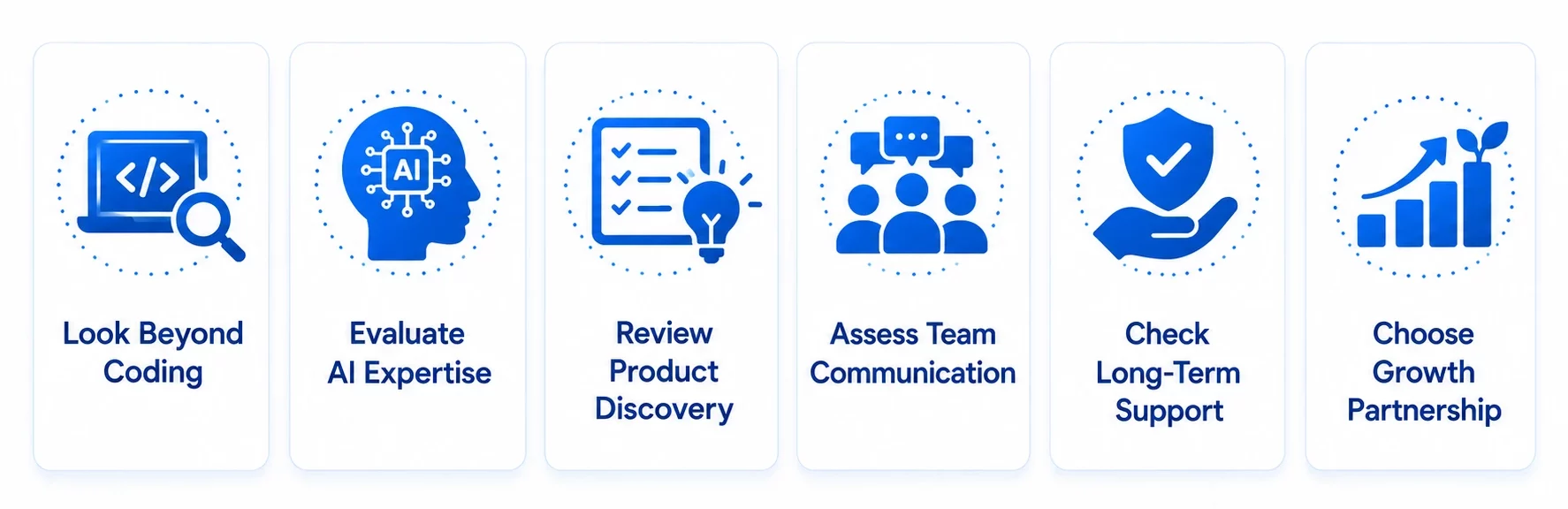
Look Beyond Development Skills
A development partner should understand more than coding capacity. Product discovery, user experience, architecture, AI integration, security, testing, scalability, and post-launch improvement all influence the outcome.
The partner should understand how these disciplines affect one another and how decisions in one area can create consequences in another. A team that can connect business goals with technical execution can help reduce costly changes later in the development process.
Evaluate AI and Product Expertise
Businesses should ask potential partners how they approach model selection, data, infrastructure, integrations, evaluation, security, operating costs, reliability, and maintainability.
The goal is not simply to find a team capable of implementing AI. It is to find a team capable of determining whether a particular AI capability makes sense for the product. Businesses evaluating potential partners can also use this AI development partner resource to understand the areas that deserve attention during partner selection.
Review Their Product Discovery Approach
A strong partner should be able to contribute before development begins. Ask how they validate requirements, research users, define product scope, prioritize features, identify technical risks, and determine what should be included in the initial release.
This helps ensure that development starts with a well-defined product direction rather than an unstructured list of features.
Assess Communication and Collaboration
Successful product development requires regular communication between the business and development team. Businesses should understand how the partner handles project updates, feedback, documentation, decision-making, timelines, and changes in requirements.
A collaborative working model makes it easier to identify issues early and keep product, design, engineering, and business objectives aligned throughout development.
Check Scalability and Post-Launch Support
The partner should be able to think beyond the initial launch. Businesses should evaluate how the team approaches application performance, infrastructure scaling, security updates, monitoring, bug fixes, AI model improvements, and future feature development.
For AI-driven products, ongoing optimization can be particularly important because models, APIs, data requirements, costs, and user expectations can change over time.
Choose a Partner for Long-Term Growth
For businesses that need support across product discovery, design, software engineering, AI architecture, and implementation, an experienced AI-powered product design and development company can help bring those activities together instead of treating them as isolated stages.
The relationship should be collaborative rather than purely execution-based. A strong partner should understand what the business is trying to achieve and help translate that objective into practical product and technology decisions. The right partner can therefore contribute not only to the initial product launch but also to its continued improvement and growth.
Conclusion
A strong software product development strategy gives businesses a structured way to turn an idea into a product that creates value today while remaining adaptable to future opportunities. The process begins with understanding a real problem, validating the opportunity, defining a clear product vision, and deciding what the first version genuinely needs.
From there, businesses can determine where AI creates meaningful value, design the product around real user needs, establish a flexible technical foundation, and plan AI integration, data, security, testing, cost, and scalability before launch. RipenApps, an experienced AI app development company, helps businesses navigate these considerations while keeping product and technology decisions aligned with their long-term goals.
The most successful AI-driven products will not necessarily be those with the greatest number of intelligent features. They will be products where technology is connected carefully to customer needs and measurable business outcomes. Businesses planning a new AI-driven product or transforming an existing platform can work with RipenApps to turn validated opportunities into scalable digital products while keeping technology aligned with long-term business goals.
FAQs
Q1. What is a software product development strategy?
A software product development strategy is a structured plan for turning a software idea into a market-ready product. It covers problem validation, product vision, user needs, feature prioritization, technology, development, testing, launch, measurement, and continuous improvement.
Q2. Why is a software product development strategy important for AI-driven products?
AI-driven products require additional decisions around data, AI use cases, model selection, integration, security, evaluation, operating costs, and scalability. A clear strategy helps businesses use AI where it creates measurable value instead of adding unnecessary complexity.
Q3. How do you decide which AI features to include in a software product?
AI features should be prioritized according to the customer problem they solve and the business outcome they can improve. Teams should consider user demand, technical feasibility, data availability, expected performance, security, implementation complexity, and ongoing AI costs.
Q4. What should be included in the first version of a software product?
The first version should include the essential functionality required to solve the product’s core problem and validate its main proposition. Additional features can be introduced later based on customer feedback, usage data, and business priorities.
Q5. How can businesses control the cost of AI-powered software development?
Businesses can manage AI costs through appropriate model selection, efficient prompts, caching, smaller models for simpler tasks, usage monitoring, and careful prioritization of AI use cases. AI infrastructure and operating costs should be considered during product planning.
Q6. How long does software product development take?
The timeline depends on product scope, complexity, platforms, integrations, AI requirements, design needs, testing requirements, and team structure. A focused MVP can generally be delivered faster than a large enterprise product with extensive integrations and advanced AI capabilities.
Q7. How can a software product remain scalable after launch?
A product can remain scalable by using modular architecture, scalable infrastructure, well-defined integrations, continuous monitoring, performance optimization, security improvements, and a roadmap based on actual customer and business needs.

SHARE
WRITTEN BY

Ishan Gupta
CEO & Founder
Ishan Gupta is a seasoned entrepreneur and CEO with extensive 8+ years of experience in business and mobile app development landscape. He believes that the right digital product allows companies to focus on what they do best, while technology handles the rest. With deep exposure to global markets, he understands what makes an app succeed. His approach translates business needs into clear product strategies, ensuring that every feature contributes to measurable ROI.
View All Articles




 India
India USA
USA Australia
 Canada
 UK
UK UAE
UAE