


Key Takeaways
- Healthcare software modernization helps organizations upgrade aging applications without necessarily replacing the entire system.
- Modernization can improve scalability, interoperability, security, performance, maintainability, and user experience.
- Healthcare organizations should assess legacy applications, dependencies, data, integrations, infrastructure, and compliance requirements before selecting a modernization strategy.
- Replatforming, refactoring, rearchitecting, rebuilding, and replacing are different approaches with different levels of cost, risk, and technical effort.
- Cloud adoption can support modernization, but moving an application to the cloud alone does not make it fully modern.
- Healthcare modernization requires special attention to patient data protection, interoperability, auditability, access controls, and regulatory requirements.
- A phased roadmap can reduce disruption by modernizing high-priority components while keeping critical healthcare workflows operational.
- The right modernization partner should understand both software engineering and healthcare-specific technology and compliance requirements.
Healthcare organizations depend on software for almost every part of their operations, from patient records and clinical workflows to billing, scheduling, diagnostics, and communication. But many of these systems were built years ago and now struggle to support modern healthcare requirements.
Outdated architecture can make integrations difficult, slow down product updates, create security concerns, and increase maintenance costs. At the same time, replacing a critical healthcare system completely is rarely practical because patient data, clinical workflows, regulatory requirements, and existing integrations cannot simply be switched off.
This is where healthcare software modernization becomes a strategic approach. Instead of abandoning a working system, organizations can gradually upgrade its architecture, technology stack, integrations, infrastructure, and user experience while protecting the functionality that still delivers value.
Working with experienced teams offering software product modernization services can help healthcare organizations create a structured roadmap that balances modernization goals with clinical continuity, security, compliance, and long-term scalability.
This guide explains what healthcare software modernization means, why legacy systems need upgrading, which modernization strategies healthcare organizations can use, how to build a roadmap, what challenges to expect, and how to choose the right modernization partner.
Table of Contents
What Is Healthcare Software Modernization?
Healthcare software modernization is the process of upgrading an existing healthcare application or software ecosystem to improve its technology foundation, performance, security, interoperability, scalability, and maintainability.
It does not always mean replacing an old application with a completely new product. In many cases, modernization involves gradually improving the existing system while preserving valuable business logic, patient data, workflows, and integrations.
For example, an organization may modernize an aging patient management system by moving parts of its infrastructure to the cloud, replacing outdated APIs, improving its database architecture, introducing modern interfaces, and connecting the platform with newer healthcare systems.
This approach is particularly important because healthcare legacy software modernization needs to balance technology improvements with operational continuity. A modernization project cannot compromise access to critical patient information or disrupt essential clinical workflows.
The goal is therefore to create a system that is easier to maintain, integrate, secure, and scale while retaining the capabilities that healthcare professionals and patients already depend on.
Why Healthcare Organizations Need to Modernize Legacy Software
Many healthcare organizations still rely on applications that were developed around older technologies, architectures, and integration methods. These systems may continue to work, but maintaining them becomes increasingly difficult as business and technology requirements evolve.
1. Rising Maintenance Costs
Older applications often require specialized knowledge and manual maintenance. Finding developers who understand outdated technologies can become difficult, increasing both maintenance effort and operational costs.
2. Difficult Integrations
Modern healthcare ecosystems depend on multiple systems, including EHRs, patient portals, telehealth platforms, medical devices, billing systems, laboratories, pharmacies, and analytics platforms. Older applications may lack modern APIs or standardized integration capabilities, making data exchange more complicated.
3. Security Risks
Legacy architectures may not support modern security controls effectively. Older dependencies, unsupported frameworks, outdated authentication mechanisms, and limited monitoring capabilities can increase security risks.
4. Poor Scalability
Healthcare organizations need software that can handle increasing patient volumes, data loads, users, and connected systems. Older architectures may struggle to scale efficiently.
5. Limited User Experience
Clinicians and administrative teams increasingly expect fast, intuitive applications. Complex interfaces and slow workflows can reduce productivity and create unnecessary friction.
6. Slower Innovation
When every new feature requires changes to tightly coupled legacy code, development teams spend more time maintaining existing functionality and less time delivering new capabilities.
These challenges make healthcare modernization an ongoing business priority rather than a purely technical exercise.
What Are Healthcare Legacy Systems and Why Are They Difficult to Replace?
Healthcare legacy systems are older software applications, platforms, databases, or infrastructure components that continue to support important healthcare operations despite being built on aging technologies or architectures.
A legacy system does not necessarily mean a bad system. Some older healthcare applications contain years of business rules, clinical workflows, historical data, and integrations that remain valuable.
The problem occurs when the technology surrounding those capabilities becomes difficult to maintain or adapt.
For example, a legacy system might still handle patient registration effectively but struggle to integrate with a modern patient mobile app. Another application may manage clinical records reliably but use an outdated architecture that makes real-time data exchange difficult.
This is why organizations need to evaluate which parts of the system should be retained, modernized, replaced, or retired instead of automatically rebuilding everything.
Signs Your Healthcare Software Needs Modernization
Healthcare organizations should consider modernization when an application starts creating more operational limitations than business value.
1. Frequent Performance Problems
Slow response times, application crashes, or unreliable system performance can indicate underlying architecture or infrastructure limitations.
2. Difficult Third-Party Integrations
If adding a new EHR connection, payment provider, medical device, analytics platform, or patient-facing application requires extensive custom work, the existing architecture may need modernization.
3. High Maintenance Dependency
If only a small number of developers understand the application’s codebase, the organization may face significant continuity risks.
4. Outdated Technology Stack
Unsupported frameworks, libraries, databases, operating systems, or infrastructure can create security and maintenance concerns.
5. Limited Mobile or Web Capabilities
Healthcare users increasingly expect access across smartphones, tablets, desktops, and web applications. Older systems may not support modern responsive or mobile experiences.
6. Increasing Security Concerns
Difficulty implementing modern authentication, authorization, encryption, monitoring, or audit controls is a strong modernization signal.
7. Inability to Support New Healthcare Workflows
If the software cannot easily support telehealth, remote monitoring, digital payments, AI capabilities, analytics, or patient self-service, its architecture may be limiting future growth.
Healthcare Software Modernization vs Software Replacement
Modernization and replacement are not the same strategy.
Software replacement involves retiring an existing system and implementing a new platform. This can provide a clean technical foundation but often involves significant migration effort, operational disruption, training, and implementation risk.
Modernization takes a more incremental approach. Organizations can retain valuable functionality while upgrading specific components over time.
| Factor | Modernization | Complete Replacement |
| Existing business logic | Can be retained | Often rebuilt |
| Data migration | Usually phased | Often extensive |
| Operational disruption | Lower with phased approach | Potentially higher |
| Initial investment | Can be distributed | Often significant |
| Time to value | Faster for targeted improvements | Longer implementation |
| Technical flexibility | High | High |
| Legacy dependencies | Reduced gradually | Removed after migration |
| Best suited for | Complex systems worth preserving | Systems no longer worth maintaining |
The right option depends on the application’s technical condition, business value, compliance requirements, data complexity, and long-term roadmap.
Healthcare Software Modernization Strategies
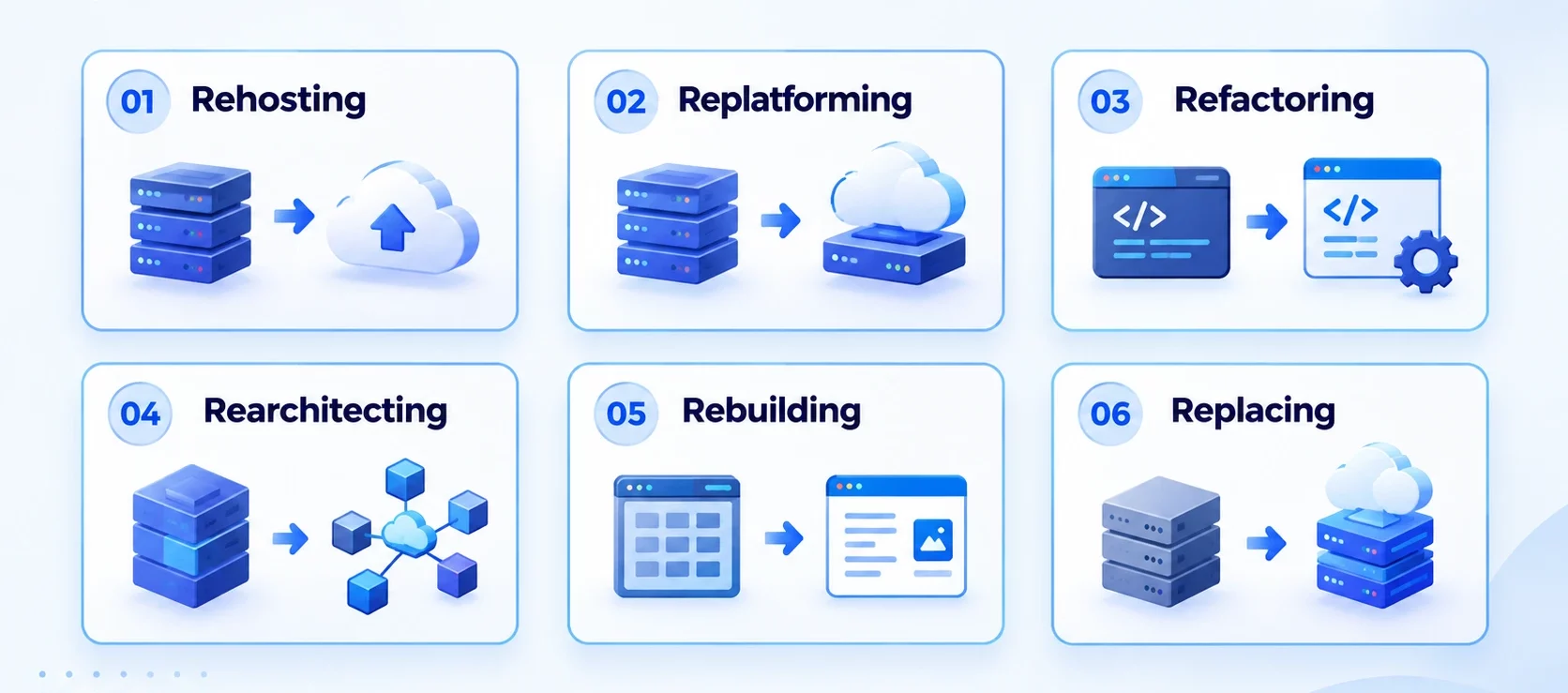
There is no single modernization approach that works for every healthcare application. The right strategy depends on the system’s condition, business value, technical debt, and future requirements. Understanding the latest application modernization trends & strategies can help healthcare organizations choose whether to rehost, replatform, refactor, rearchitect, rebuild, or replace a legacy system based on its specific needs.
1. Rehosting
Rehosting involves moving an application to a new infrastructure environment with minimal changes to its underlying code.
This approach can be useful when infrastructure modernization is the immediate priority, and the existing application remains functionally viable.
2. Replatforming
Replatforming moves an application to a newer technology environment while making limited changes to improve performance, scalability, or operational efficiency.
For example, a healthcare application might move to managed cloud databases or modern hosting infrastructure without completely changing its application architecture.
3. Refactoring
Refactoring improves the internal code structure without significantly changing the application’s external behavior.
This can reduce technical debt, improve maintainability, and prepare the application for future modernization.
4. Rearchitecting
Rearchitecting involves making bigger changes to the application’s architecture.
A tightly coupled monolithic healthcare application, for example, could be gradually reorganized into modular services or APIs that are easier to maintain and integrate.
5. Rebuilding
Rebuilding means developing a new application while retaining selected business requirements, data, and workflows from the existing system.
This approach is suitable when the legacy architecture has reached a point where further modification is no longer practical.
6. Replacing
Replacement involves retiring the legacy system and adopting a new platform or commercial solution.
This can make sense when the existing application provides limited strategic value or when modernization would cost more than replacing it.
Healthcare Software Modernization Roadmap: Step-By-Step Process
A successful modernization project should follow a structured roadmap instead of beginning with technology selection. Healthcare organizations should first assess their existing systems, workflows, data, and compliance requirements before deciding what needs to change. In some cases, custom software development can also be part of the modernization strategy when existing platforms cannot support specific clinical or operational requirements.
Step 1. Audit the Existing Software
Start by documenting the current application environment.
Review:
- Application architecture
- Programming languages and frameworks
- Databases
- Infrastructure
- APIs
- Third-party integrations
- User roles
- Authentication systems
- Data flows
- Security controls
- Compliance requirements
- Technical debt
- Business-critical workflows
This creates a baseline for deciding what needs to change.
Step 2. Identify Business-Critical Workflows
Not every feature requires the same modernization priority.
Identify workflows that directly affect:
- Patient care
- Clinical operations
- Revenue
- Patient communication
- Data exchange
- Regulatory requirements
- Staff productivity
Critical workflows should receive additional testing and migration planning.
Step 3. Map Data and Dependencies
Healthcare applications often depend on several connected systems. Before modifying an application, teams should understand how data moves between EHRs, laboratories, pharmacies, payment systems, patient portals, analytics platforms, and other services.
This dependency map helps prevent unexpected failures during modernization.
Step 4. Assess Technical Debt
Identify outdated frameworks, duplicate functionality, tightly coupled modules, unsupported dependencies, inefficient databases, and other technical limitations.
Not every technical issue needs to be fixed immediately. Prioritize problems based on risk, business impact, and modernization goals.
Step 5. Define Modernization Goals
Set measurable objectives such as:
- Faster application performance
- Improved security
- Better interoperability
- Lower maintenance effort
- Cloud readiness
- Easier feature development
- Better user experience
- Improved scalability
Clear goals make it easier to evaluate modernization success.
Step 6. Select the Right Modernization Strategy
Decide whether each application or component should be rehosted, replatformed, refactored, rearchitected, rebuilt, replaced, or retired.
A large healthcare organization may use several strategies across different applications.
Step 7. Create a Phased Implementation Plan
Avoid changing every system at once.
Start with a manageable component or workflow. Validate the approach, measure the outcome, and then expand modernization across additional systems.
Step 8. Plan Data Migration
Data migration requires special attention in healthcare because historical records can be operationally and legally important.
Define:
- Data sources
- Data formats
- Data quality issues
- Migration rules
- Validation procedures
- Backup strategy
- Access controls
- Rollback procedures
Step 9. Test Before Production Migration
Testing should cover functionality, integrations, performance, security, usability, data accuracy, and failure scenarios.
Healthcare applications also require testing against real-world workflows rather than relying solely on technical unit tests.
Step 10. Monitor and Optimize
Modernization does not end when the new system goes live.
Monitor application performance, security events, integration reliability, user feedback, infrastructure usage, and operational metrics after each modernization phase.
Read More: The Complete Legacy Application Modernization Guide
Application Modernization in Healthcare
Application modernization in healthcare focuses specifically on upgrading individual software applications that have become difficult to maintain, integrate, or scale.
For example, an organization may modernize:
- Patient management software
- EHR-connected applications
- Healthcare billing systems
- Telehealth platforms
- Patient portals
- Hospital management software
- Laboratory systems
- Pharmacy platforms
- Medical scheduling applications
- Healthcare analytics platforms
The modernization process should preserve essential workflows while improving the underlying technology.
A modular approach can be particularly useful because organizations can modernize high-value components without immediately replacing the entire application.
Cloud Modernization for Healthcare Software
Cloud adoption can provide healthcare organizations with greater infrastructure flexibility, scalability, and access to managed technology services. However, cloud migration should be treated as part of a broader modernization strategy rather than the complete solution.
Organizations should evaluate:
- Application architecture
- Data residency requirements
- Encryption
- Identity and access management
- Backup and disaster recovery
- Monitoring
- Network security
- Integration requirements
- Compliance responsibilities
- Cloud operating costs
Experienced healthcare cloud modernization service providers can help organizations determine which workloads should move to the cloud, which should remain on-premises, and which applications require architectural changes before migration.
Cloud modernization is particularly valuable when healthcare organizations need to scale digital services without continuously expanding physical infrastructure.
Modernizing Healthcare Software for Interoperability
Interoperability is one of the most important goals of healthcare modernization.
Healthcare organizations rarely operate a single software system. Patient information often moves between clinical systems, laboratories, pharmacies, insurance platforms, patient portals, medical devices, and other applications.
Modernized applications should therefore be designed around reliable data exchange and standardized interfaces.
This can involve:
- Modern APIs
- FHIR-based interoperability
- HL7 integration
- Secure data exchange
- Event-driven workflows
- Identity matching
- Data normalization
- Integration monitoring
Modern interoperability allows healthcare organizations to connect new digital services without rebuilding their core systems every time a new application is introduced.
Healthcare Software Modernization and Security
Modernization should strengthen security rather than simply update the technology stack. A healthcare application modernization strategy should evaluate access controls, data protection, system activity, vulnerabilities, recovery processes, and ongoing monitoring. These measures help organizations build stronger protection into the modernized environment instead of addressing security gaps after deployment.
Identity and Access Management
Users should receive only the access required for their role. Strong authentication and role-based permissions can help protect sensitive healthcare information. Regular access reviews can also help organizations identify unnecessary privileges and reduce the risk of unauthorized access.
Encryption
Sensitive information should be protected during transmission and storage through appropriate encryption mechanisms. Encryption helps reduce the impact of unauthorized access and supports stronger protection for patient and organizational data across connected systems.
Audit Logging
Modern systems should provide visibility into user activity, data access, administrative actions, and important system events. Detailed audit logs can help security teams investigate suspicious activity, support accountability, and maintain a clearer record of system interactions.
Vulnerability Management
Outdated dependencies and unsupported technologies should be identified and addressed during modernization. Regular vulnerability assessments and timely security updates can help reduce exposure to known threats and prevent legacy components from becoming persistent security risks.
Backup and Disaster Recovery
Critical healthcare applications need reliable backup, recovery, and continuity strategies. Organizations should define how quickly systems and data need to be restored after an outage, security incident, or infrastructure failure. Regular recovery testing also helps verify that these plans work when needed.
Continuous Monitoring
Security monitoring can help organizations identify unusual activity and respond to potential incidents more quickly. Monitoring applications, infrastructure, user activity, and integrations provides greater visibility into the modernized environment and helps teams detect emerging risks.
Modernization should therefore be aligned with broader healthcare IT security requirements rather than treated as a standalone development project. Security should be considered throughout assessment, architecture, data migration, testing, deployment, and ongoing maintenance.
Data Migration During Healthcare Software Modernization
Data migration is often one of the most complex parts of a modernization project, especially for clinical data management software that handles large volumes of sensitive healthcare information. Healthcare organizations may have years of patient records, transactions, clinical information, documents, and operational data distributed across multiple databases and systems.
A structured migration strategy should include:
- Data discovery
- Data classification
- Data quality assessment
- Data mapping
- Transformation rules
- Migration testing
- Data validation
- Security controls
- Backup and rollback planning
- Post-migration monitoring
Organizations should avoid moving unnecessary legacy data simply because it exists. Data should be assessed based on its business, clinical, regulatory, and operational value.
Where AI Fits Into Healthcare Software Modernization
AI should not be added simply because an application is being modernized. It should support a clear business or clinical use case.
Modernized healthcare platforms can create better foundations for capabilities such as:
- Clinical decision support
- Patient communication
- Intelligent search
- Healthcare chatbots
- Predictive analytics
- Document processing
- Medical workflow automation
- Personalized patient engagement
- Administrative automation
A modern architecture also makes it easier to connect AI capabilities with approved data sources while maintaining access controls and monitoring.
The priority should remain safe, useful, and measurable AI adoption rather than adding AI to every part of the application.
Benefits of Healthcare Software Modernization
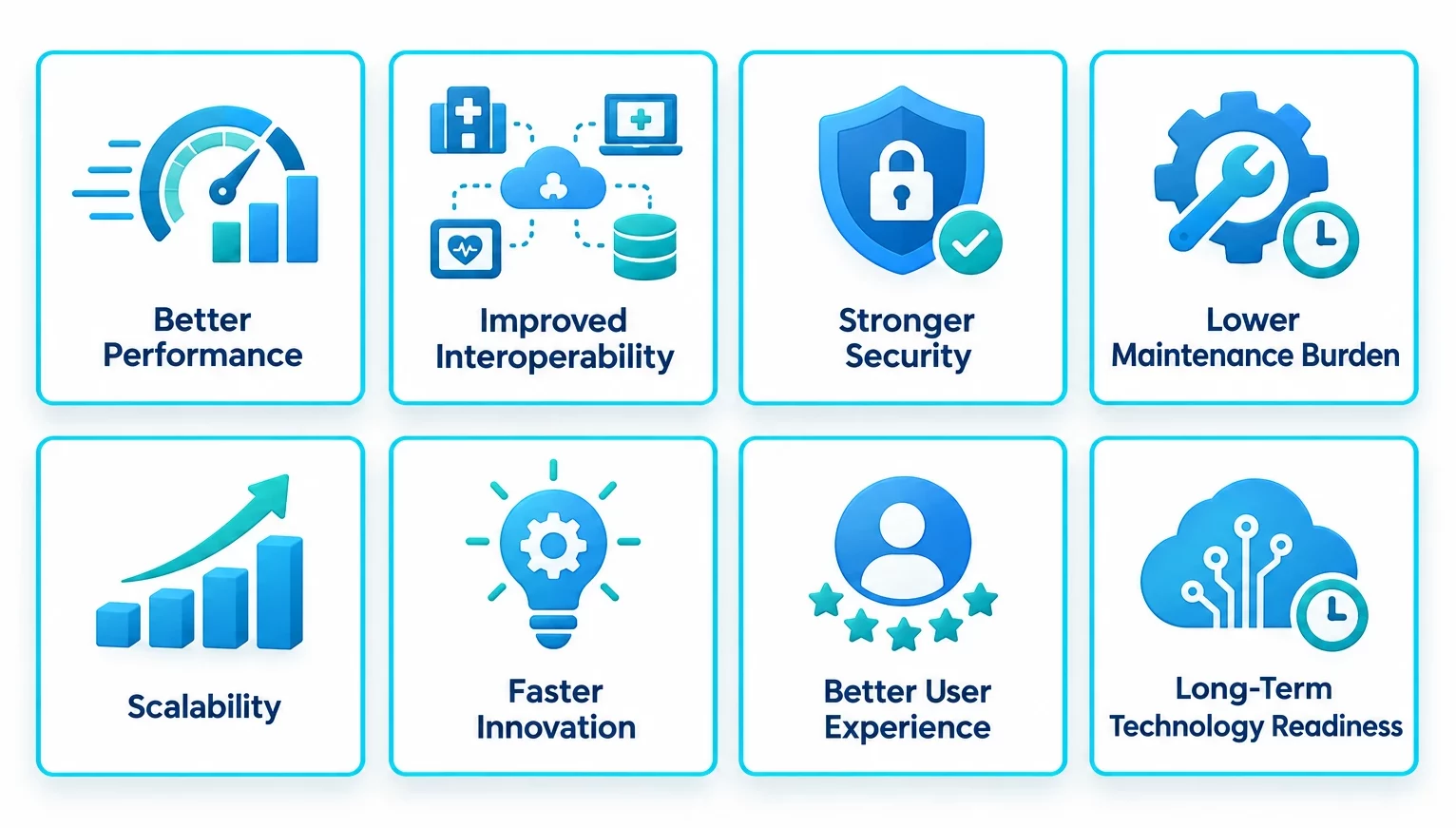
Healthcare software modernization delivers value beyond replacing outdated technology. It helps organizations create a more reliable digital foundation for clinical, administrative, and patient-facing workflows. By addressing technical debt, integration gaps, security risks, and scalability limitations, modernization makes healthcare software easier to manage today and better prepared for future requirements.
Better Performance
Modern architectures and infrastructure can improve application responsiveness, stability, and reliability. Healthcare teams can access information faster and complete routine tasks with fewer system delays. This becomes especially important for applications handling large datasets, multiple users, and time-sensitive clinical workflows.
Easier Integration
Modern APIs, modular architectures, and integration frameworks make it easier to connect healthcare applications with other platforms. Organizations can improve data exchange between EHRs, clinical systems, patient portals, billing platforms, and third-party applications. Better integration also reduces manual data entry and helps create more connected workflows.
Stronger Security
Modernization provides an opportunity to replace outdated dependencies and introduce stronger security controls. Organizations can update authentication, authorization, encryption, monitoring, and access management capabilities as part of the modernization process. This creates a stronger foundation for protecting sensitive healthcare data and managing evolving security risks.
Lower Maintenance Burden
Legacy applications often require specialized knowledge and significant effort to maintain. Modern architectures and updated technologies can simplify maintenance, troubleshooting, and future enhancements. Development teams can spend less time dealing with outdated components and more time improving features that support healthcare operations.
Better Scalability
Cloud-ready and modular architectures can support growing patient volumes, users, transactions, and data requirements. Organizations can scale infrastructure based on changing workloads instead of relying on rigid legacy environments. This also makes it easier to expand healthcare applications as services, locations, or user requirements grow.
Faster Product Development
Modern development environments give teams a stronger foundation for introducing new features and responding to changing requirements. Modular components, reusable APIs, automated testing, and modern deployment practices can shorten development cycles. Healthcare organizations can therefore improve applications without making every change dependent on complex legacy code.
Improved User Experience
Modern interfaces can reduce workflow friction for clinicians, administrative teams, and patients. Clear navigation, responsive screens, better accessibility, and streamlined workflows can make everyday interactions easier. A more intuitive experience can also reduce training requirements and improve adoption among users who depend on the software regularly.
Better Long-Term Technology Readiness
Modernized software creates a stronger foundation for future interoperability, automation, analytics, AI, and digital healthcare services. Organizations can introduce new technologies more efficiently when the underlying architecture is flexible and integration-ready. This helps healthcare software adapt to changing technology requirements without another major overhaul soon after modernization.
Common Challenges in Healthcare Software Modernization
Modernizing healthcare software involves more than upgrading technology. Organizations must work around legacy dependencies, sensitive healthcare data, complex integrations, compliance requirements, and established workflows. Identifying these challenges early helps teams build a realistic modernization plan, reduce risks, and avoid disruptions to critical healthcare operations.
- Legacy Dependencies: An old application may depend on technologies or integrations that are difficult to replace without affecting other systems.
- Data Complexity: Healthcare data can exist in multiple formats and databases, making migration and validation challenging.
- Operational Disruption: Healthcare services cannot simply stop while software is being upgraded. Modernization must be planned around operational continuity.
- Compliance Requirements: Healthcare software handles sensitive information and therefore requires careful attention to applicable privacy, security, and regulatory obligations.
- Limited Technical Documentation: Some legacy systems have poor documentation, making it difficult for new teams to understand existing business logic.
- Budget Constraints: Modernization is a long-term investment. Organizations need to prioritize projects based on business value and risk.
- Resistance to Change: Clinicians and staff who rely on established workflows may be reluctant to adopt new interfaces or processes.
- Integration Risks: Changing one application can affect several connected systems. Dependency mapping and integration testing are therefore essential.
How to Reduce Risks During Healthcare Software Modernization
A phased approach can significantly reduce modernization risk.
- Start With Assessment: Understand the existing system before making architectural decisions.
- Modernize in Small Increments: Break a large modernization program into manageable releases rather than replacing everything simultaneously.
- Preserve Critical Workflows: Identify the workflows that cannot be disrupted and give them additional testing and fallback options.
- Use Automated Testing: Automated tests can help verify that modernized components continue to deliver expected functionality.
- Maintain Parallel Operations Where Necessary: For high-risk systems, running old and modernized components in parallel for a defined period can provide additional validation.
- Create a Rollback Plan: Every migration phase should have a documented recovery strategy if unexpected problems occur.
- Monitor Post-Launch Performance: Continue tracking performance, security, integration health, and user feedback after each release.
How Much Does Healthcare Software Modernization Cost?
The cost of healthcare software modernization typically ranges from $30,000 to $250,000+, depending on the condition of the existing application, modernization scope, data migration needs, integrations, cloud infrastructure, security requirements, and compliance obligations. A focused UI, infrastructure, or component upgrade generally costs less than a complete architectural transformation or system rebuild.
Organizations should treat modernization as a phased investment rather than focusing only on the initial development cost. Assessing the existing codebase, technical debt, integrations, data, and business priorities early can help create a more realistic budget and reduce unexpected expenses during implementation.
How to Choose the Right Healthcare Software Modernization Partner
Choosing the right modernization partner is as important as selecting the technical strategy.
Look for a partner with experience in:
- Healthcare application development
- Legacy system modernization
- Cloud migration
- API development
- Healthcare interoperability
- Data migration
- Security engineering
- Healthcare compliance
- Mobile and web development
- AI and analytics integration
You should also evaluate whether the partner understands your existing architecture instead of immediately recommending a complete rebuild.
The best application modernization partners for healthcare providers should be able to explain what should be retained, what should be changed, what should be replaced, and why.
Ask About Healthcare Experience
Review previous healthcare projects and determine whether the team understands clinical workflows, patient data, healthcare integrations, and compliance requirements.
Evaluate Their Modernization Methodology
Ask how they assess legacy systems, prioritize components, manage migration, test integrations, and handle production risks.
Review Security Practices
Understand how the team manages authentication, encryption, access controls, monitoring, vulnerability management, and sensitive data.
Assess Scalability
The partner should design a solution that supports future integrations, users, products, and healthcare services.
Look Beyond the Initial Build
Modernization requires continuous maintenance and optimization. Choose a leading healthcare app development company that can support the application or software after migration.
For organizations evaluating healthcare application modernization service providers, the right partner should combine technical modernization expertise with a clear understanding of healthcare-specific operational requirements.
Healthcare Software Modernization Roadmap at a Glance
| Phase | Primary Objective | Key Activities |
| 1. Assessment | Understand current state | Architecture, dependencies, risks, technical debt |
| 2. Strategy | Define modernization direction | Rehost, replatform, refactor, rearchitect, rebuild, replace |
| 3. Planning | Build implementation roadmap | Priorities, budget, timelines, resources |
| 4. Data Preparation | Protect and organize data | Mapping, cleansing, migration planning |
| 5. Pilot | Validate approach | Modernize selected component or workflow |
| 6. Implementation | Scale modernization | Migrate and modernize additional components |
| 7. Testing | Validate quality | Security, performance, integration, usability |
| 8. Deployment | Move to production | Release, migration, monitoring |
| 9. Optimization | Improve continuously | Performance, security, user feedback, new capabilities |
This phased approach allows organizations to modernize critical technology without treating modernization as a single high-risk migration event.
Healthcare Software Modernization Services for Different Needs
Modernization requirements vary significantly between healthcare organizations.
A hospital may need to modernize a patient management or hospital information system. A digital health startup may need to rearchitect an application to support rapid growth. A healthcare provider may need to move aging infrastructure to the cloud. An established healthtech platform may need to improve interoperability across several applications.
Organizations evaluating healthcare software modernization services should therefore begin with their specific business and technical problems rather than choosing a predefined modernization package.
For example, a platform struggling with scalability may require rearchitecting, while an otherwise stable application with outdated infrastructure may benefit from replatforming.
What Does a Modern Healthcare Software Architecture Look Like?
A modern healthcare application does not have to follow one specific architecture. However, successful modernization programs often introduce characteristics such as:
- Modular application components
- API-first integration
- Cloud-ready infrastructure
- Secure identity management
- Interoperable data exchange
- Automated testing
- Centralized monitoring
- Scalable databases
- Clear separation of business logic
- Strong security controls
The objective is not to use the newest technology everywhere. It is to create an architecture that is easier to operate, secure, integrate, and evolve.
Future of Healthcare Software Modernization
Healthcare technology will continue to evolve as organizations adopt cloud platforms, AI, connected devices, digital patient services, automation, and advanced analytics.
This means modernization should not be treated as a one-time technology upgrade.
An evolving healthcare system requires software that can adapt to new integrations, changing regulations, new care models, emerging technologies, and changing patient expectations.
Organizations that build modular and interoperable foundations will be better positioned to introduce future capabilities without repeatedly rebuilding their core platforms.
The broader modernization of healthcare will therefore depend not only on adopting new technologies but also on upgrading the software foundations that allow those technologies to work together.
Why Choose RipenApps for Healthcare Software Modernization?
RipenApps helps healthcare organizations modernize legacy applications with a focus on scalability, interoperability, security, user experience, and long-term maintainability.
Our approach begins with understanding the existing software environment, business workflows, technical limitations, integrations, and modernization goals. From there, we can help define a phased strategy that reduces unnecessary disruption while creating a stronger technology foundation.
Our healthcare software development services can support application modernization, cloud migration, API development, mobile and web applications, integrations, and emerging technology adoption.
The focus is not to replace working technology simply for the sake of modernization. It is to identify where technology is limiting business or operational growth and modernize those areas strategically.
Conclusion
Healthcare Software Modernization helps organizations upgrade aging applications while improving performance, security, interoperability, scalability, and user experience. A successful approach starts with assessing legacy architecture, data, integrations, technical debt, and business priorities before choosing the right modernization strategy.
With healthcare technology evolving rapidly, organizations need software that can support cloud adoption, AI, connected systems, and digital patient experiences. RipenApps, an experienced custom software development company, helps healthcare businesses plan and execute phased modernization strategies that reduce disruption and support long-term growth.
FAQ’s
Q1. What is healthcare software modernization?
Healthcare software modernization is the process of upgrading outdated healthcare applications, architecture, infrastructure, and integrations. It improves performance, security, interoperability, scalability, and long-term maintainability.
Q2. Why is healthcare software modernization important?
Healthcare organizations often rely on legacy systems that are difficult to maintain, integrate, and scale. Modernization helps reduce technical limitations while creating a stronger foundation for connected workflows and digital healthcare services.
Q3. How does healthcare legacy software modernization improve security?
Modernization can replace outdated components, strengthen access controls, improve data protection, and support current security practices. It also helps organizations address vulnerabilities that are difficult to manage in older systems.
Q4. What are the main strategies for healthcare software modernization?
Common approaches include rehosting, replatforming, refactoring, rearchitecting, rebuilding, and replacing. The right approach depends on the application’s architecture, technical debt, business goals, compliance requirements, and modernization budget.
Q5. How long does healthcare software modernization take?
The timeline depends on system complexity, data volume, integrations, modernization scope, and the selected strategy. A phased approach often allows organizations to modernize critical components gradually while keeping essential healthcare operations running.
Q6. How can healthcare organizations modernize legacy systems without disrupting operations?
Organizations can use a phased modernization roadmap that starts with system assessment, dependency mapping, and risk identification. Incremental upgrades, controlled data migration, testing, and continuous monitoring help reduce operational disruption.

SHARE
WRITTEN BY

Ishan Gupta
CEO & Founder
Ishan Gupta is a seasoned entrepreneur and CEO with extensive 8+ years of experience in business and mobile app development landscape. He believes that the right digital product allows companies to focus on what they do best, while technology handles the rest. With deep exposure to global markets, he understands what makes an app succeed. His approach translates business needs into clear product strategies, ensuring that every feature contributes to measurable ROI.
View All Articles



 India
India USA
USA Australia
 Canada
 UK
UK UAE
UAE