


Quick Summary
Enterprise rapid prototyping enables organizations to validate ideas, reduce development risks, and accelerate digital transformation through iterative product testing. This guide explores its benefits, enterprise use cases, leading prototyping platforms, development frameworks, implementation workflow, and best practices to build scalable, user-centric software with greater confidence and efficiency.
Key Takeaways
- Enterprise rapid prototyping validates product ideas early, reducing development risks while improving stakeholder confidence and project success rates.
- Interactive prototypes help organizations gather real user feedback before investing in full-scale software development and modernization initiatives.
- Rapid prototyping in product development accelerates innovation through iterative testing, continuous validation, and collaborative decision-making across teams.
- Choosing the right platforms and frameworks ensures scalable, secure, and future-ready enterprise applications with faster time-to-market.
- Combining rapid prototyping with enterprise digital transformation strategies improves product quality, operational efficiency, and long-term business growth.
Enterprise digital transformation has become a strategic priority for organizations seeking to improve operational efficiency, enhance customer experiences, and stay competitive in a rapidly evolving market. However, launching new digital products or modernizing legacy systems without validating ideas often results in costly delays, budget overruns, and products that fail to meet user expectations.
This is where enterprise rapid prototyping plays a crucial role. Instead of investing months in full-scale software development based on assumptions, businesses create interactive prototypes to test concepts, gather stakeholder feedback, and refine solutions before development begins. As a result this iterative approach enables enterprises to minimize risks, accelerate innovation, and make informed decisions backed by real user insights.
Whether developing enterprise applications, AI-powered platforms, customer portals, or workflow automation systems, rapid prototyping helps organizations align business goals with technical execution while shortening development cycles. Companies can experiment with multiple ideas, validate product-market fit, and identify usability issues long before writing production-ready code.
Businesses looking to accelerate innovation often partner with experienced providers offering rapid prototyping services to transform ideas into interactive prototypes that validate technical feasibility, improve stakeholder alignment, and reduce development risks before full-scale implementation.
In this guide, you’ll learn what enterprise rapid prototyping is, why organizations are adopting it as a core digital transformation strategy, its key business benefits, the best tools and frameworks, industry use cases, implementation workflows, and best practices for building scalable digital products with confidence.
Table of Contents
What is Enterprise Rapid Prototyping?
Enterprise rapid prototyping is the process of quickly creating interactive software prototypes to validate product ideas before investing in full-scale development. These prototypes simulate core features, workflows, and user interactions, allowing organizations to evaluate concepts, collect feedback, and refine solutions before engineering resources are committed.
Unlike static wireframes or lengthy documentation, interactive prototypes provide stakeholders with a realistic representation of how a product will function. This enables business leaders, designers, developers, and end users to identify improvements early, resulting in better-informed product decisions.
As organizations continue investing in enterprise digital transformation, the rapid prototyping process has become an essential practice for reducing uncertainty, improving collaboration, and accelerating software innovation.
Why Enterprise Rapid Prototyping Matters in Product Development
Modern enterprise applications often integrate cloud services, AI capabilities, enterprise resource planning systems, customer relationship management platforms, APIs, analytics tools, and legacy infrastructure. Developing these complex systems without validation increases technical risks and project uncertainty.
Rapid prototyping in product development enables organizations to evaluate system architecture, business workflows, user interfaces, and technical feasibility before development begins. By testing concepts early, software teams can identify potential issues, improve product usability, and reduce engineering rework throughout the development lifecycle.
Why Do Enterprises Use Rapid Prototyping Technology?
The pace of digital innovation has made speed and adaptability essential for enterprise success. Organizations can no longer afford lengthy development cycles that rely on assumptions instead of validated insights. This is exactly why do enterprises use rapid prototyping technology to test ideas quickly, reduce uncertainty, and ensure software investments deliver measurable business value.
By building interactive prototypes before development begins, enterprises gain early visibility into user expectations, technical feasibility, and business requirements. This approach helps teams make informed decisions while avoiding expensive changes later in the product lifecycle.
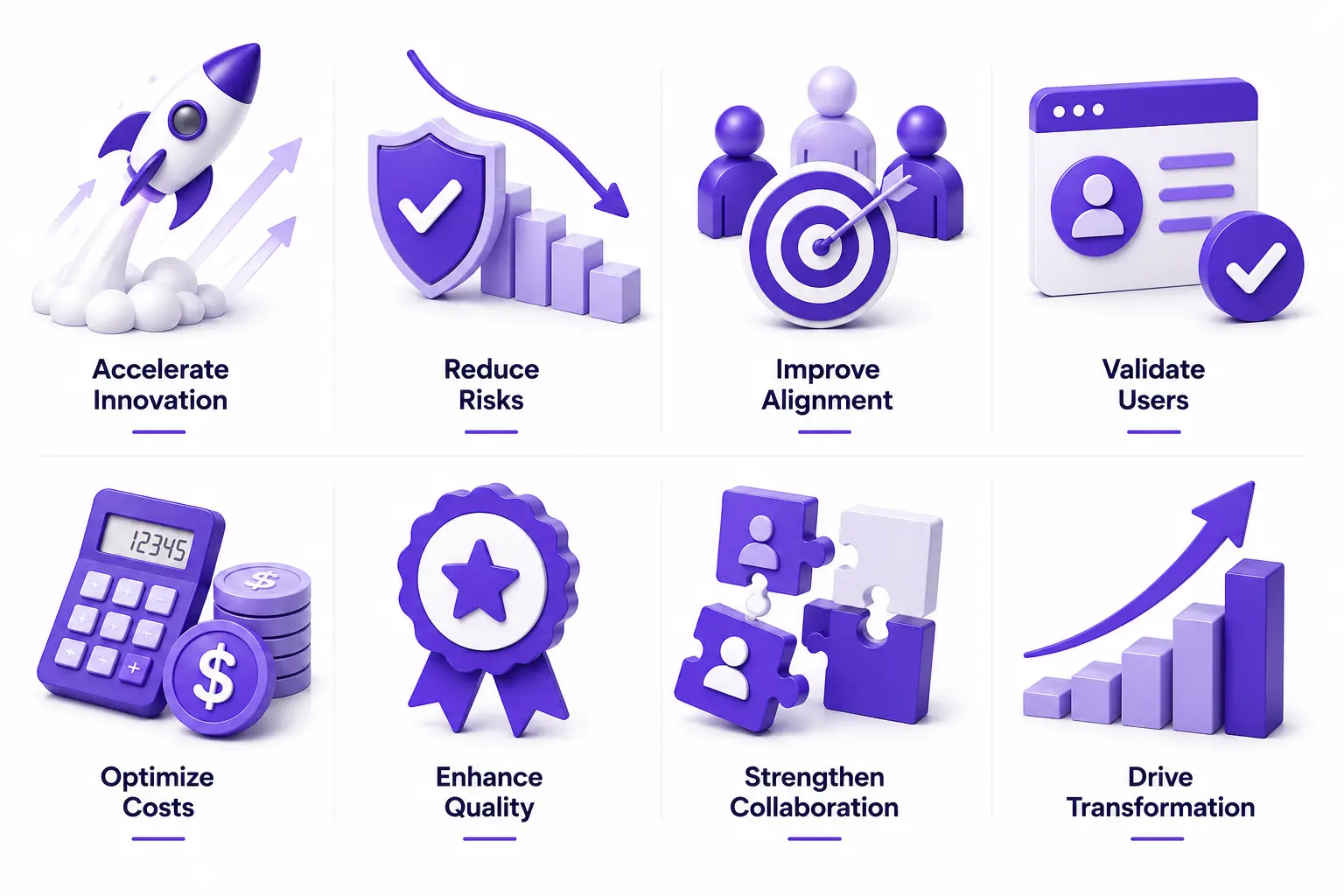
1. Accelerates Innovation
Innovation requires experimentation, and rapid prototyping provides a safe environment to explore new ideas without committing extensive development resources. Product teams can validate multiple concepts, compare alternative solutions, and identify the most promising direction before moving into production.
This enables organizations to respond faster to changing customer demands while maintaining a competitive advantage.
2. Reduces Development Risks
Building enterprise software without validation often results in scope changes, delayed releases, and increased development costs.
Rapid prototyping minimizes these risks by identifying usability issues, technical constraints, and workflow inefficiencies before engineering begins. Solving problems during the prototype stage is significantly faster and more cost-effective than making changes after development.
3. Improves Stakeholder Alignment
Enterprise software projects involve executives, product managers, designers, developers, compliance teams, and business users. Misaligned expectations can delay projects and increase costs.
Interactive prototypes create a shared understanding of the final product, enabling stakeholders to review features, suggest improvements, and approve requirements with greater confidence.
4. Enables Early User Validation
Customer feedback plays a critical role in building successful digital products.
Instead of waiting until development is complete, organizations can test prototypes with real users to understand how they interact with the product. This early validation helps prioritize features that solve genuine business problems while eliminating unnecessary functionality.
5. Optimizes Development Costs
Software changes become increasingly expensive as projects progress through the development lifecycle.
Validating concepts during the prototype stage reduces engineering rework, improves resource allocation, and prevents investments in features that may never provide business value. The result is a more efficient development process with a higher return on investment.
6. Improves Product Quality
Successful enterprise software is intuitive, efficient, and user-focused.
Continuous testing and refinement allow teams to optimize navigation, workflows, and user interactions before development starts. This leads to higher user satisfaction, improved adoption rates, and fewer post-launch improvements.
7. Encourages Cross-Functional Collaboration
Rapid prototyping encourages continuous collaboration between business teams, designers, developers, and decision-makers.
Instead of working in isolated phases, every stakeholder contributes throughout the product lifecycle. This collaborative approach improves communication, accelerates approvals, and ensures the final product aligns with both business goals and user expectations.
8. Supports Faster Enterprise Digital Transformation
Modern enterprises are continuously adopting new technologies such as artificial intelligence, automation, cloud computing, and advanced analytics. Rapid prototyping enables organizations to validate these transformation initiatives before making significant investments, reducing implementation risks while accelerating innovation.
Benefits of Enterprise Rapid Prototyping
Enterprise rapid prototyping delivers far more than faster product validation. It enables organizations to improve collaboration, optimize software investments, reduce business risks, and build digital products that better meet customer expectations. By validating ideas before development begins, enterprises can innovate with greater confidence while supporting long-term business growth.
1. Faster Product Validation
One of the biggest advantages of enterprise rapid prototyping is the ability to validate product ideas before investing in full-scale development. Interactive prototypes allow businesses to gather early feedback from stakeholders and end users, helping teams prioritize the right features, validate market needs, reduce uncertainty, and make informed product decisions with greater confidence.
2. Reduced Development Costs
Making changes during development often requires additional engineering time and budget. Rapid software prototyping reduces these expenses by identifying design and functionality issues during the validation phase. This proactive approach minimizes rework, shortens development cycles, and improves overall project efficiency.
3. Better Cross-Functional Collaboration
Enterprise software projects require close collaboration between multiple departments. Interactive prototypes provide a common reference point for executives, designers, developers, QA teams, and business stakeholders. This shared understanding improves communication, speeds up approvals, and ensures everyone works toward the same product vision.
4. Effective Risk Mitigation
Every enterprise software project carries technical, operational, and financial risks. By validating prototypes early, organizations can identify potential challenges such as integration issues, security concerns, scalability limitations, workflow bottlenecks, compliance requirements, and performance gaps before development begins. Addressing these issues early significantly reduces project risks and improves the chances of successful product delivery.
5. Faster Time-to-Market
Validated requirements reduce unnecessary revisions during development. Because teams begin engineering with greater clarity, software can be developed, tested, and deployed more efficiently. Faster delivery allows enterprises to respond quickly to market opportunities while gaining a competitive advantage.
6. Easier Product Modernization
Many organizations rely on legacy systems that struggle to support modern business requirements. As part of software modernization services, rapid prototyping allows enterprises to visualize modern interfaces, redesign workflows, and validate modernization strategies before replacing existing systems. This reduces migration risks while ensuring the new solution aligns with business objectives.
Enterprise Rapid Prototyping in Product Development
Modern enterprise applications are expected to deliver exceptional user experiences while seamlessly integrating with cloud platforms, AI models, third-party APIs, legacy systems, and enterprise software. Developing such complex solutions without validating assumptions can lead to technical challenges, budget overruns, and delayed product launches.
This is why rapid prototyping in product development has become an integral part of modern software development. By building interactive prototypes before writing production code, engineering teams can evaluate technical feasibility, validate business workflows, and identify potential issues early. The result is a more predictable development process with lower risks and higher-quality software.
Software Architecture Validation
Choosing the right architecture is one of the most important decisions in enterprise software development. A poor architectural foundation can affect scalability, performance, security, and future maintenance.
Rapid prototypes allow architects to evaluate different architectural approaches before implementation. Teams can validate system workflows, integration patterns, and infrastructure requirements while ensuring the chosen architecture aligns with long-term business goals. This early validation reduces the likelihood of costly architectural changes later in the project.
MVP Planning
Not every feature needs to be included in the first product release. Enterprise teams often struggle to determine which features deliver the highest business value. Prototypes help stakeholders prioritize functionality by focusing on essential user journeys rather than complete feature sets. This ensures development resources are invested where they create the greatest impact.
Organizations planning enterprise software frequently collaborate with an experienced MVP app development company to define an effective MVP strategy before scaling into a full-featured solution.
Agile Development
Rapid prototyping complements Agile methodologies by supporting short development cycles and continuous feedback. Instead of spending months gathering requirements, Agile teams create prototypes, validate ideas with stakeholders, incorporate feedback, and continuously improve the product throughout each sprint.
This iterative process enables organizations to adapt quickly to changing business requirements while reducing development uncertainty.
UI/UX Validation
A visually appealing interface alone does not guarantee an excellent user experience. Enterprise software must also be intuitive, efficient, and easy to navigate.
Interactive prototypes allow UX designers to evaluate navigation, workflows, accessibility, and user interactions before development begins. Real user testing helps identify friction points and improve usability, resulting in software that users can adopt more quickly.
Workflow Testing
Enterprise applications often support complex business operations involving multiple departments and approval workflows.
Rapid prototypes enable organizations to simulate real-world business scenarios and validate operational processes before implementation. This helps identify bottlenecks, eliminate unnecessary steps, and improve overall process efficiency.
DevOps Integration
Development and operations teams benefit significantly when prototypes validate deployment requirements early in the project lifecycle.
By understanding infrastructure dependencies and technical constraints during the prototyping stage, DevOps teams can prepare environments, automate deployment pipelines, and reduce implementation challenges before production development begins. This improves collaboration between development and operations while accelerating software delivery.
Best Platforms for Rapid Prototyping in Enterprise Apps
Selecting the right prototyping platform directly influences collaboration, design quality, validation speed, and development efficiency. While some tools focus on UI/UX design, others support low-code application development and enterprise workflow automation. Below are the most widely adopted platforms for enterprise rapid prototyping.
1. Figma
Figma has become the industry standard for collaborative interface design and interactive prototyping.
Best For: UI/UX design, mobile applications, SaaS platforms, enterprise software
Key Features
- Cloud-based collaboration
- Interactive prototypes
- Auto Layout
- Design systems
- Developer handoff
- Real-time commenting
Advantages
- Excellent team collaboration
- Easy stakeholder reviews
- Extensive plugin ecosystem
- Cross-platform accessibility
Limitations
- Limited backend functionality
- Requires internet connectivity for optimal collaboration
Pricing
- Free plan available
- Paid plans for professional and enterprise teams
Enterprise Suitability
Ideal for enterprises requiring collaborative design workflows across distributed teams.
2. Adobe XD
Adobe XD enables designers to create high-fidelity prototypes for web and mobile applications with seamless integration into Adobe Creative Cloud.
Best For
- Enterprise UI design
- Mobile app prototypes
- Design systems
Key Features
- Interactive prototypes
- Voice prototyping
- Auto-animation
- Component libraries
Advantages
- Smooth Adobe ecosystem integration
- High-quality design capabilities
- Easy prototype sharing
Limitations
- Smaller collaboration ecosystem compared to Figma
Pricing
Subscription-based through Adobe Creative Cloud.
Enterprise Suitability
Suitable for organizations already using Adobe products.
3. FlutterFlow
FlutterFlow combines visual development with Flutter, allowing businesses to create interactive applications quickly.
Best For
- Cross-platform mobile apps
- MVPs
- Enterprise mobile solutions
Key Features
- Drag-and-drop interface
- Firebase integration
- API connectivity
- Flutter code export
Advantages
- Faster development
- Production-ready Flutter code
- Low-code environment
Limitations
- Advanced customization may require Flutter expertise
Pricing
Free and premium plans available.
Enterprise Suitability
Excellent for organizations developing scalable cross-platform applications.
4. Bubble
Bubble enables organizations to build functional web applications without extensive coding.
Best For
- Internal enterprise tools
- Business portals
- SaaS validation
Key Features
- Visual programming
- Workflow automation
- Database management
- API integrations
Advantages
- Rapid application development
- Minimal coding required
- Strong MVP capabilities
Limitations
- Less suitable for highly complex enterprise applications
Pricing
Multiple subscription tiers.
Enterprise Suitability
Ideal for validating business ideas and internal workflows quickly.
Best Frameworks for Rapid Prototyping and Enterprise Deployment
While prototyping platforms help validate product ideas, development frameworks determine how efficiently those ideas can be transformed into scalable enterprise applications. The right framework should support rapid development, seamless integrations, long-term maintainability, and enterprise-grade performance. Below are the leading frameworks enterprises use to accelerate product development and deployment.
Flutter
Flutter has become one of the most popular frameworks for building high-performance cross-platform applications from a single codebase. It is well suited for enterprise mobile applications, MVP development, and customer-facing apps that require consistent experiences across Android, iOS, web, and desktop. Its rich widget library, excellent UI performance, faster development cycles, and strong support from Google make Flutter a preferred choice for enterprises looking to accelerate product development.
React Native
React Native enables enterprises to build native-like mobile applications using JavaScript and React while maintaining a single codebase for multiple platforms. It is widely used for enterprise mobile solutions and consumer applications because of its code reusability, extensive developer community, native module support, and seamless third-party integrations. These capabilities help organizations reduce development time without compromising performance.
Next.js
Next.js is a React framework designed for building fast, scalable web applications with excellent SEO performance. It is commonly used for enterprise portals, SaaS platforms, customer dashboards, and other business applications. Features such as server-side rendering, static site generation, and optimized performance enable organizations to deliver secure, high-performing digital experiences while improving search engine visibility.
React
React remains one of the most widely adopted JavaScript libraries for developing dynamic and interactive enterprise applications. Its component-based architecture, Virtual DOM, flexible integrations, and large ecosystem allow development teams to build scalable dashboards, SaaS products, and modern web interfaces efficiently while simplifying long-term maintenance.
Angular
Angular is a comprehensive framework developed by Google for building large-scale enterprise web applications. It offers built-in routing, dependency injection, TypeScript support, and a robust architecture that makes it ideal for complex business portals and enterprise software requiring long-term scalability, maintainability, and structured development practices.
Spring Boot
Spring Boot simplifies Java application development by providing production-ready configurations for enterprise software and backend systems. It is widely adopted for enterprise APIs, banking applications, and large-scale software because of its high scalability, microservices architecture, strong security capabilities, and extensive ecosystem, making it an excellent choice for mission-critical enterprise solutions.
Choosing the Right Framework for Enterprise Deployment
Selecting the right framework depends on your project’s goals, technical requirements, scalability needs, and existing technology stack. Before selecting a development framework, organizations should carefully evaluate their business objectives, product vision, platform requirements (whether web, mobile, or cross-platform), and compatibility with existing enterprise systems.
It’s equally important to consider long-term scalability, security and compliance requirements, as well as the available development timeline and resources to ensure the chosen framework supports both current needs and future business growth.
Working with experienced providers and leveraging software product development services helps enterprises choose the most suitable technology stack, validate architectural decisions, and ensure prototypes evolve into scalable, production-ready applications that support long-term business growth.
Enterprise Use Cases of Rapid Prototyping
Enterprise rapid prototyping is not limited to one industry. Organizations across healthcare, finance, retail, manufacturing, and other sectors use it to validate ideas, improve user experiences, and accelerate innovation before investing in full-scale software development. By testing concepts early, businesses reduce implementation risks while ensuring digital products align with operational and customer needs. Below are some of the most common enterprise applications of rapid prototyping.
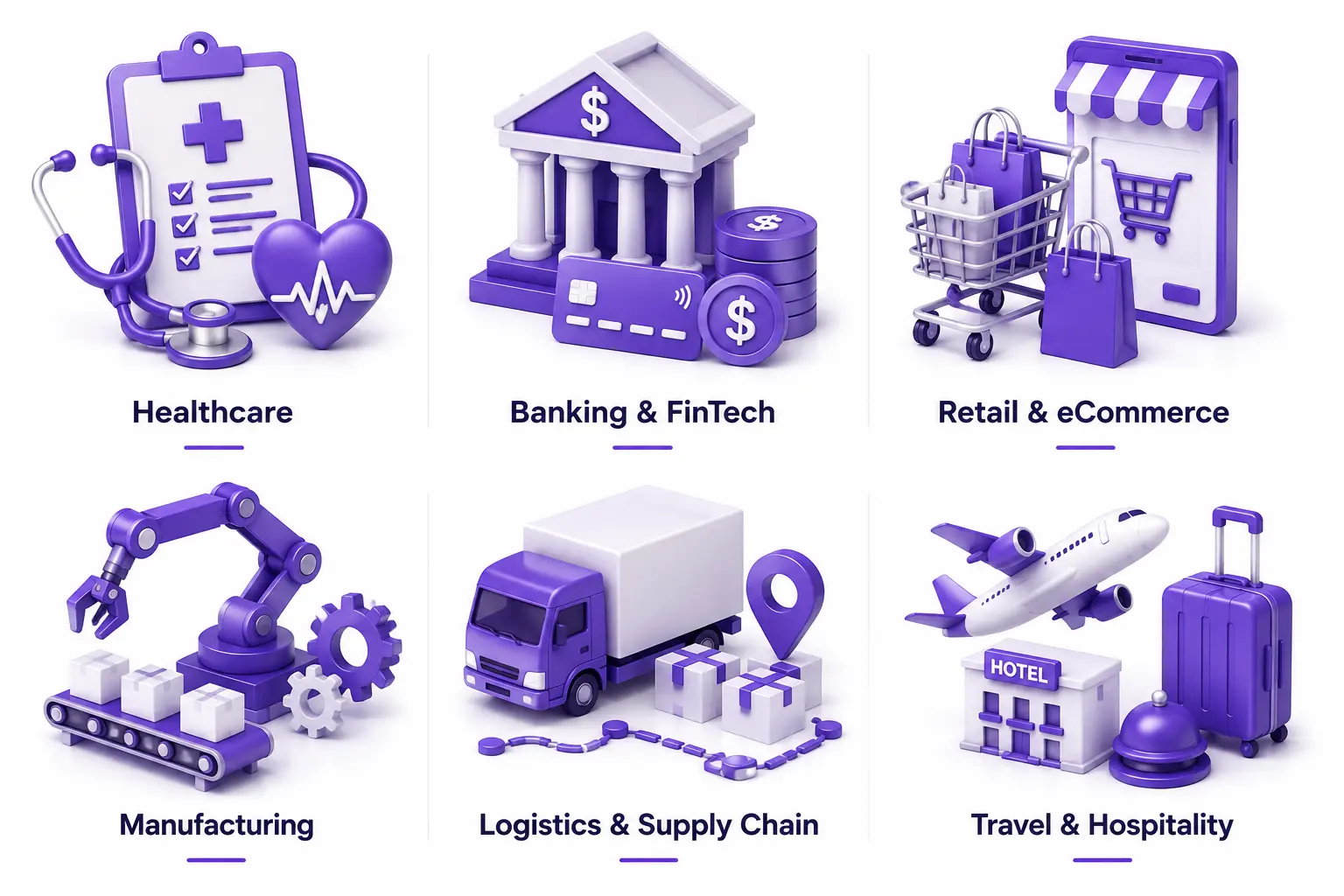
Healthcare
Healthcare organizations face increasing pressure to improve patient experiences while complying with strict regulatory requirements. Developing healthcare software without validating workflows can result in usability issues that directly affect patient care and operational efficiency.
Challenges
- Complex patient journeys
- Regulatory compliance
- Legacy hospital systems
- Data security requirements
- Multiple stakeholder involvement
Prototype Solution
Healthcare providers build interactive prototypes for patient portals, appointment booking systems, telemedicine platforms, electronic health records (EHR), and doctor dashboards. These prototypes help validate user journeys, accessibility, and workflow efficiency before development begins.
Business Outcomes
- Better patient experience
- Faster software adoption
- Reduced implementation risks
- Improved clinical workflows
- Higher stakeholder confidence
Banking & FinTech
Banks and financial institutions continuously launch new digital services while maintaining high security and regulatory standards.
Challenges
- Complex approval workflows
- Security and compliance
- Fraud prevention
- Legacy infrastructure
- Customer trust
Prototype Solution
Rapid prototypes help validate digital banking applications, loan processing systems, investment platforms, digital wallets, and onboarding journeys before implementation.
Business Outcomes
- Faster product launches
- Improved customer onboarding
- Lower compliance risks
- Better user engagement
- Reduced development costs
Retail & eCommerce
Retail businesses constantly enhance customer experiences to improve conversions and retention.
Challenges
- High cart abandonment
- Poor checkout experiences
- Personalization requirements
- Omnichannel consistency
- Inventory visibility
Prototype Solution
Interactive prototypes allow retailers to test shopping journeys, checkout flows, loyalty programs, AI recommendations, and order tracking before development.
Business Outcomes
- Higher conversion rates
- Improved customer satisfaction
- Better user engagement
- Faster feature validation
- Increased revenue opportunities
Manufacturing
Manufacturers are rapidly adopting Industry 4.0 technologies to improve operational efficiency and supply chain visibility.
Challenges
- Outdated operational systems
- Manual workflows
- Equipment monitoring
- Production delays
- Supply chain inefficiencies
Prototype Solution
Organizations prototype production dashboards, IoT monitoring platforms, inventory management systems, predictive maintenance applications, and workforce management tools.
Business Outcomes
- Improved operational efficiency
- Better production visibility
- Reduced downtime
- Faster digital adoption
- Increased productivity
Logistics & Supply Chain
Logistics companies depend on real-time visibility and operational efficiency to meet growing customer expectations.
Challenges
- Shipment tracking
- Fleet management
- Warehouse operations
- Delivery optimization
- Route planning
Prototype Solution
Rapid prototypes validate transportation management systems, warehouse dashboards, driver applications, shipment tracking portals, and customer notification systems.
Business Outcomes
- Faster delivery operations
- Improved logistics visibility
- Better customer communication
- Lower operational costs
- Increased supply chain efficiency
Travel & Hospitality
Travel businesses must deliver seamless booking experiences while managing constantly changing customer expectations.
Challenges
- Complex booking workflows
- Personalization
- Multi-platform experiences
- Customer support
Prototype Solution
Travel companies validate hotel booking systems, itinerary planners, loyalty programs, AI travel assistants, and travel management platforms before development.
Business Outcomes
- Higher booking conversions
- Better customer retention
- Improved travel experience
- Faster feature validation
- Increased operational efficiency
Rapid Prototyping for Tech Startups vs Enterprises
Although the core objective of rapid prototyping for startups remains the same:
Validating ideas before development, the implementation approach differs significantly for startups and enterprises. Factors such as budget, scalability, stakeholder involvement, compliance requirements, and technology investments influence how each organization approaches prototyping.
| Criteria | Tech Startups | Enterprises |
| Primary Goal | Validate product-market fit | Accelerate enterprise innovation and modernization |
| Budget | Limited | Higher investment capacity |
| Team Size | Small cross-functional teams | Multiple departments and stakeholders |
| Validation Focus | Customer feedback | Business, technical, and operational validation |
| Development Speed | Extremely fast iterations | Structured iterative development |
| Technology Stack | Flexible and evolving | Enterprise-grade technologies |
| Compliance | Minimal initially | High regulatory and security requirements |
| Scalability | Planned after validation | Required from the beginning |
| Decision-Making | Founder-driven | Multi-level stakeholder approvals |
| Product Lifecycle | MVP-first approach | Long-term digital transformation strategy |
While startups prioritize rapid experimentation and market validation, enterprises focus on reducing organizational risks, improving stakeholder alignment, and ensuring long-term scalability. Businesses transitioning from early-stage validation to enterprise-ready products often engage mobile app developers for startups to build scalable architectures that support future growth without sacrificing speed during the prototyping phase.
Enterprise Rapid Prototyping Workflow
A successful enterprise prototype is not created in a single step. It follows a structured workflow that transforms a business idea into a validated product concept before full-scale development begins. Each stage focuses on reducing uncertainty, improving collaboration, and ensuring the final solution aligns with business objectives and user expectations.
Following a structured workflow significantly improves project outcomes. However, even well-planned initiatives can face setbacks if teams overlook the common rapid prototyping mistakes that often lead to unnecessary rework, budget overruns, and delayed product launches.
1. Business Discovery
Every successful product starts with understanding the business problem rather than jumping directly into development. During the discovery phase, organizations define their business objectives, identify the target audience, assess market opportunities, understand existing operational challenges, establish success metrics, and align the product vision with broader digital transformation goals. This ensures the prototype addresses real business needs while creating a clear roadmap for the next stages of product development.
This stage ensures the product addresses genuine business needs instead of simply adding new technology. Many enterprises begin this phase with product discovery services to define product vision, validate business requirements, and create a clear roadmap before investing in design and development.
2. Product Research
Once the product vision is established, teams conduct market research to better understand customer needs, industry trends, and competitor offerings. This research validates the business opportunity, uncovers market gaps, and helps prioritize features that deliver the greatest value to users.
3. User Journey Mapping
User journey mapping focuses on understanding how customers will interact with the product from start to finish. By visualizing each step of the user experience, teams can identify pain points, simplify workflows, and create intuitive interactions that improve overall usability.
4. Wireframing
Wireframing provides a structural blueprint of the application by defining screen layouts, navigation, content hierarchy, and core functionality. Through professional wireframe design services, businesses can validate the product structure and user flow before investing in high-fidelity designs. Instead of focusing on visual aesthetics, this stage ensures the application’s functionality, usability, and information architecture are aligned with user expectations and business objectives.
5. Interactive Prototype Development
After the wireframes are approved, they are transformed into interactive prototypes that closely simulate the final product experience. Stakeholders can navigate screens, test workflows, and interact with key features, allowing teams to validate concepts quickly without investing in full-scale development.
6. User Testing
Interactive prototypes are then tested with real users to gather feedback on usability, navigation, and overall experience. Observing how users interact with the prototype helps identify areas for improvement and ensures the product meets customer expectations before development begins.
7. Iteration & Refinement
Rapid prototyping is an iterative process where feedback from users and stakeholders is continuously incorporated into the design. Each refinement improves usability, functionality, and business alignment, resulting in a well-validated prototype that is ready to move into development with greater confidence.
8. MVP Planning
After validating the prototype, organizations determine which features should be included in the first production release. Instead of launching every planned feature, enterprises prioritize functionality that delivers immediate business value while supporting future scalability.
Working with an experienced MVP development company helps businesses define an MVP strategy that balances customer expectations, development timelines, and long-term product goals.
9. Product Development
Once the prototype has been validated, engineering teams begin development with clearly defined requirements. Since workflows, user journeys, and functionality have already been tested, developers spend less time addressing changing requirements and more time building production-ready software. This significantly improves delivery speed and software quality.
10. Continuous Scaling & Optimization
Launching the application is only the beginning. Successful enterprises continuously improve their products by monitoring user behavior, collecting feedback, analyzing performance metrics, and introducing new features based on changing business requirements. Continuous optimization ensures software remains competitive while supporting long-term business growth.
Challenges of Enterprise Rapid Prototyping
Although enterprise rapid prototyping offers numerous business advantages, organizations often encounter challenges during implementation. Understanding these obstacles early enables businesses to develop effective strategies that maximize the value of the prototyping process.
Legacy System Integration
Many organizations still depend on legacy systems that were not designed to support modern digital experiences. Integrating new prototypes with existing infrastructure can introduce technical complexity and increase implementation time. Evaluating current systems early and validating integrations during the prototyping stage helps reduce compatibility issues later in development.
Budget Constraints
Although prototyping reduces long-term development costs, enterprises must still invest in research, design, and user testing. Limited budgets can restrict experimentation and compromise prototype quality. Prioritizing high-value features and validating core business requirements first ensures resources are used efficiently without increasing project risks.
Security and Compliance Requirements
Enterprise applications often process sensitive customer and business data, making security and regulatory compliance essential from the beginning. Ignoring these considerations during prototyping can result in costly redesigns before deployment. Incorporating security reviews and compliance requirements into the validation process helps organizations build safer and more reliable digital products.
Prototype-to-Production Gap
One of the most common misconceptions is that a prototype is nearly a finished product. In reality, prototypes are designed to validate concepts rather than meet production standards for security, scalability, and performance. A structured development process is essential to transform validated prototypes into enterprise-ready software.
Organizations often work with experienced product engineering services teams to transform validated prototypes into secure, scalable, and production-ready enterprise applications while maintaining the original product vision.
Future of Enterprise Rapid Prototyping
Enterprise rapid prototyping is evolving rapidly as emerging technologies reshape how businesses design, validate, and develop digital products. Artificial intelligence, low-code platforms, cloud-native architectures, and automation are making the prototyping process faster, smarter, and more collaborative than ever before.
As organizations continue investing in enterprise digital transformation, rapid prototyping will become a strategic capability that enables businesses to innovate continuously while reducing time-to-market and development risks. Below are the key trends shaping the future of enterprise rapid prototyping.
AI-Assisted Prototyping
Artificial intelligence is transforming product design by automating repetitive tasks and accelerating the creation of interactive prototypes. Modern AI-powered tools can generate wireframes, recommend UI layouts, suggest reusable design components, and identify usability improvements based on user behavior. This allows designers and product managers to spend less time on manual design work and more time solving complex business challenges.
Generative AI for Product Design
Generative AI is redefining how enterprise prototypes are created by converting simple text prompts into functional interface designs within minutes. Instead of manually designing every screen, businesses leveraging product design services can describe business requirements in natural language and instantly generate prototype concepts that accelerate product validation. As this technology continues to mature, enterprises will significantly reduce design cycles while increasing experimentation, innovation, and overall product development efficiency.
Growth of Low-Code and No-Code Development
Low-code and no-code platforms are making rapid prototyping more accessible across organizations. Business analysts, product managers, and innovation teams can now build functional prototypes without extensive programming expertise, enabling faster idea validation and stronger collaboration with development teams. This shift allows enterprises to accelerate innovation while reducing their dependence on traditional development resources during the early product planning stages.
Digital Twins for Enterprise Systems
Digital twins are becoming an important tool for validating enterprise solutions before deployment. By creating virtual representations of business processes, operational environments, or physical assets, organizations can simulate real-world scenarios, evaluate workflows, and identify potential issues before implementation.
Industries such as manufacturing, healthcare, logistics, and smart infrastructure are expected to benefit significantly from this technology as digital transformation initiatives continue to expand.
Cloud-Native Prototyping
Cloud-native platforms have made collaboration faster and more efficient by enabling distributed teams to design, review, and refine prototypes in real time. Features such as instant feedback, version control, and remote usability testing allow organizations to accelerate product validation regardless of geographical location. As hybrid and remote work become the norm, cloud-native prototyping will play an increasingly important role in enterprise product development.

Conclusion
In conclusion, enterprise rapid prototyping has become a strategic approach for organizations looking to accelerate innovation while minimizing development risks. By validating ideas before investing in full-scale software development, businesses can improve collaboration, make informed product decisions, and build digital solutions that align with both customer expectations and long-term business objectives.
Moreover, from healthcare and banking to retail, manufacturing, and SaaS, enterprises are leveraging rapid prototyping to shorten development cycles, modernize legacy systems, and deliver better digital experiences. As technologies like artificial intelligence, low-code platforms, and cloud-native development continue to evolve, rapid prototyping will remain a key driver of successful enterprise digital transformation.
If you’re exploring how to implement this approach effectively, our Rapid Prototyping Guide provides deeper insights into the process, best practices, and strategies for turning innovative ideas into market-ready digital products.
Finally ready to validate your next enterprise product idea and accelerate digital transformation? Connect with the experts at RipenApps to transform your vision into scalable, high-performing digital solutions with confidence.
FAQs
1. What is enterprise rapid prototyping?
Enterprise rapid prototyping is the process of creating interactive software prototypes to validate ideas, gather feedback, and refine product concepts before full-scale development begins.
2. Why is rapid prototyping important for enterprise digital transformation?
It helps organizations reduce development risks, validate business ideas early, improve collaboration, and accelerate the delivery of scalable digital solutions.
3. Which industries benefit the most from enterprise rapid prototyping?
Healthcare, banking, retail, manufacturing, logistics, SaaS, education, and other industries use rapid prototyping to improve product quality and speed up innovation.
4. What are the main benefits of enterprise rapid prototyping?
Key benefits include faster idea validation, reduced development costs, improved stakeholder collaboration, quicker time-to-market, and lower project risks.
5. How long does it take to build an enterprise prototype?
Depending on the project’s complexity, an enterprise prototype can typically be created within two to six weeks.
6. What is the difference between a prototype and an MVP?
A prototype is built to validate ideas and user experience, while an MVP is a functional product released with core features to gather real market feedback.
7. Which tools are best for enterprise rapid prototyping?
Popular tools include Figma, Adobe XD, FlutterFlow, Bubble, and other low-code platforms that support rapid design and validation.
8. Which frameworks are commonly used for enterprise application development?
Frameworks such as Flutter, React Native, React, Angular, Next.js, and Spring Boot are widely used to build scalable enterprise applications.
9. What challenges should enterprises consider during rapid prototyping?
Common challenges include integrating legacy systems, managing budgets, meeting security and compliance requirements, and bridging the gap between prototypes and production-ready applications.
10. How do I choose the right rapid prototyping partner?
Look for a partner with expertise in product strategy, UX/UI design, enterprise software development, modern technologies, and scalable product engineering to ensure successful project execution.

SHARE
WRITTEN BY

Ishan Gupta
CEO & Founder
Ishan Gupta is a seasoned entrepreneur and CEO with extensive 8+ years of experience in business and mobile app development landscape. He believes that the right digital product allows companies to focus on what they do best, while technology handles the rest. With deep exposure to global markets, he understands what makes an app succeed. His approach translates business needs into clear product strategies, ensuring that every feature contributes to measurable ROI.
View All Articles



 India
India USA
USA Australia
 Canada
 UK
UK UAE
UAE