

Key Takeaways
- Software projects face challenges related to unclear requirements, budget limits, talent shortages, and changing technologies.
- Poor planning and communication often lead to delays, rework, and rising development costs.
- Security, scalability, integration, and quality assurance need attention throughout the development lifecycle.
- Agile planning, continuous testing, clear documentation, and regular stakeholder feedback help reduce project risks.
- Businesses need a structured development strategy to build software that remains reliable, secure, and adaptable as they grow.
Software has become central to how businesses operate, serve customers, manage information, and compete in their markets. From internal business platforms to customer-facing applications, companies depend on software to improve productivity and support new opportunities. However, building and maintaining reliable software involves more than choosing a technology stack and starting development.
Projects often face unclear requirements, changing business priorities, limited budgets, talent gaps, security risks, and integration difficulties. These issues affect timelines, product quality, and the overall return on investment. As technologies and customer expectations continue to evolve, the software development industry challenges businesses face are becoming more complex. Companies must address these concerns early instead of treating them as problems that appear only during development.
Understanding these challenges helps businesses make informed decisions about planning, technology, resources, and product strategy. A structured development process, supported by the right expertise, helps reduce uncertainty and keep projects aligned with business goals. Working with a reliable custom software development company also helps organizations plan, build, and maintain solutions around their specific operational requirements.
Table of Contents
Understanding the Biggest Challenges in the Software Development Industry
Software development involves several connected activities, including requirement analysis, architecture planning, design, coding, testing, deployment, and ongoing maintenance. A problem in one stage can affect the entire project. For example, unclear requirements during planning often lead to repeated changes during development, while insufficient testing can create expensive issues after launch.
The current challenges in software development industry also reflect wider business pressures. Companies need to release products faster, protect sensitive information, integrate existing systems, and respond to changing customer needs. At the same time, they must manage budgets, technical resources, and long-term maintenance.
These challenges affect startups, growing businesses, and large enterprises differently. However, most organizations benefit from identifying potential risks early and creating a development strategy that balances speed, quality, security, and scalability.
10 Biggest Software Development Industry Challenges and Their Solutions
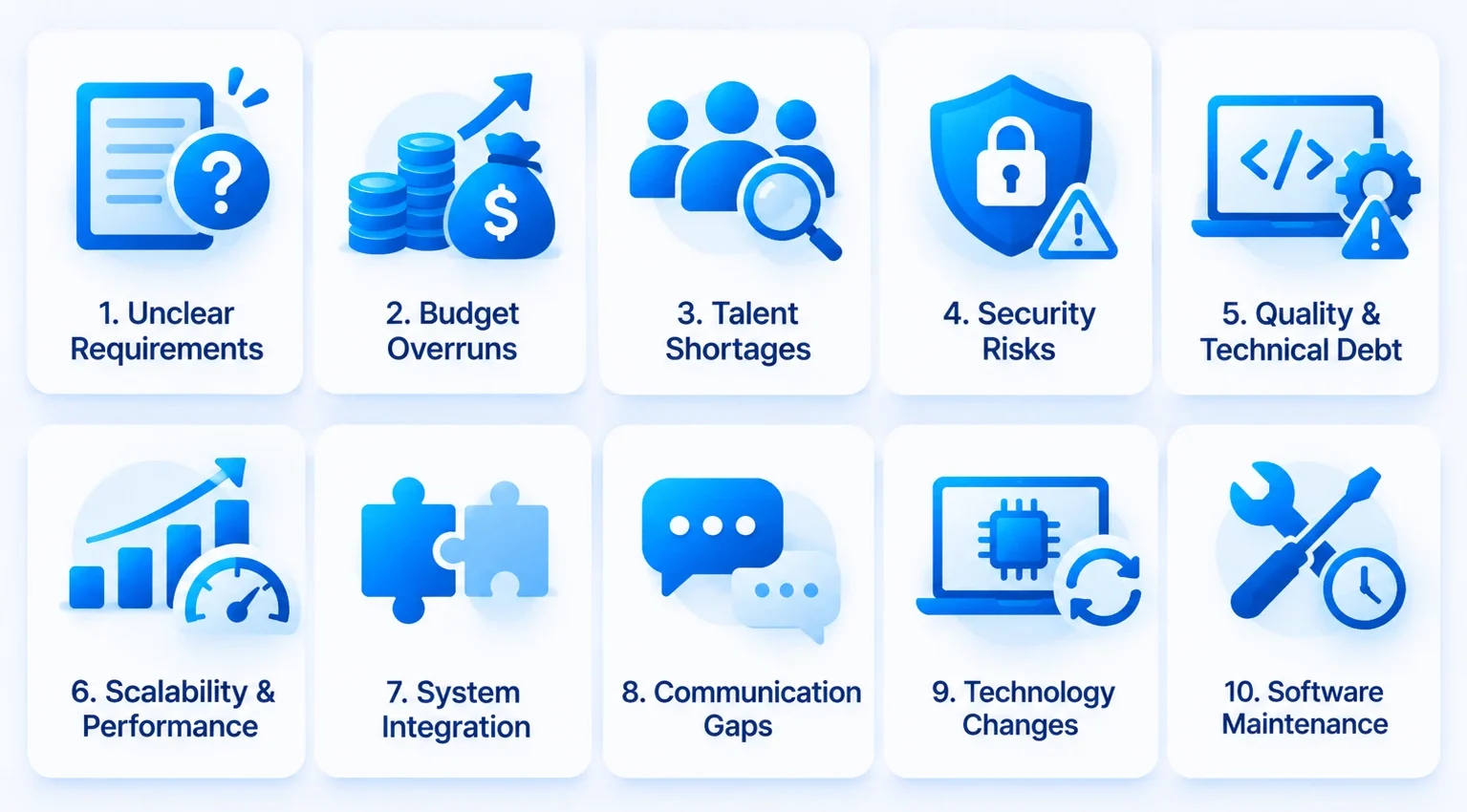
Software development projects face challenges at every stage, from initial planning and resource allocation to deployment and maintenance. Here are 10 major challenges businesses encounter and practical ways to overcome them.
1. Unclear Requirements and Changing Project Scope
One of the most common challenges in software development is translating business expectations into clear, actionable requirements. Stakeholders often begin with a broad idea but lack agreement on the product’s core features, user needs, technical limitations, and expected outcomes. This creates confusion between business teams, designers, and development teams.
The problem becomes more complicated when requirements change after development begins. New features, revised workflows, and shifting priorities increase the workload and affect delivery schedules. Without proper scope management, teams spend more time revisiting completed work than moving the product forward.
How businesses can overcome it
Businesses should begin with structured requirement gathering and stakeholder discussions. Define the target users, business objectives, essential features, technical expectations, and project boundaries before development starts. Prioritize requirements based on business value and separate essential features from future enhancements.
A clear discovery phase also helps validate assumptions before significant resources are committed. Using digital product discovery helps businesses assess user needs, define product direction, identify risks, and establish a realistic development roadmap. Teams should document approved requirements and follow a formal change-management process when priorities shift.
2. Budget Overruns and Unpredictable Development Costs
Software projects often exceed their initial budgets because the full scope of work is not clear at the planning stage. Businesses may underestimate the effort required for integrations, testing, infrastructure, security, data migration, and post-launch support. Frequent scope changes and delayed decisions add further costs.
These growing companies’ custom software development challenges become more noticeable when teams work with fixed budgets but continue adding features. Limited cost visibility also makes it difficult for decision-makers to understand where resources are being spent and which activities are affecting the project timeline.
How businesses can overcome it
Start with a detailed project estimate that considers development effort, design, testing, infrastructure, third-party services, and maintenance. Divide the project into smaller milestones and assign budgets to each stage. This gives stakeholders better visibility into spending and makes it easier to identify cost variations early.
For products with uncertain requirements, businesses should prioritize a smaller initial release instead of funding every planned feature at once. A phased roadmap while availing MVP development services in USA helps validate the product’s core value before expanding its functionality. Regular budget reviews and transparent progress reporting also help teams manage financial risks.
3. Shortage of Skilled Software Development Talent
Software development requires expertise across several areas, including programming, cloud infrastructure, cybersecurity, AI, quality assurance, and system architecture. However, finding professionals with the right technical skills and practical experience remains difficult for many businesses. This is particularly challenging when a project requires specialized knowledge or experience with emerging technologies.
Talent shortages also affect project continuity. When key team members leave, organizations may face knowledge gaps, delayed deliverables, and additional onboarding requirements. Businesses working with distributed teams also need to manage differences in time zones, communication styles, and work practices.
How businesses can overcome it
Businesses should identify the technical skills required for each project before assembling a team. Create clear responsibilities, maintain technical documentation, and encourage knowledge sharing across team members. Upskilling existing employees also helps organizations adapt to new technologies without depending entirely on external hiring.
For projects that require specialized expertise, partnering with an experienced development team provides access to a wider range of technical skills. A well-defined software development strategy for startups also helps smaller businesses plan team requirements around their product stage, available resources, and long-term goals.
4. Cybersecurity Risks and Data Privacy Concerns
Security is a major concern throughout the software development lifecycle. Applications often process personal information, financial records, business data, and other sensitive information. Weak authentication, outdated dependencies, insecure APIs, and poor access controls expose these systems to potential attacks.
Security risks also increase when businesses treat cybersecurity as a final testing activity instead of including it in the initial architecture and development plans. Data protection requirements add another layer of complexity, especially for applications operating across different regions or regulated industries.
How businesses can overcome it
Adopt a security-first development approach. Include threat assessment, secure coding practices, access controls, encryption, and vulnerability testing throughout the project. Keep third-party libraries and frameworks updated, and review API permissions before connecting external services.
Businesses should also conduct regular security audits and establish clear procedures for handling incidents. Following a structured software development life cycle helps teams include security checks at appropriate stages, from requirement planning to deployment and maintenance.
5. Maintaining Software Quality and Preventing Technical Debt
Meeting delivery deadlines while maintaining software quality is a persistent challenge. Under pressure to release products quickly, teams sometimes skip testing, use temporary fixes, or take shortcuts in code structure and documentation. These decisions might speed up initial delivery, but they often create technical debt.
As the application grows, technical debt makes updates harder and increases the risk of bugs. Small changes might affect unrelated features, while poorly maintained code becomes more difficult to test and improve. This affects user experience and increases long-term maintenance effort.
How businesses can overcome it
Establish quality standards before development begins. Use code reviews, automated testing, integration testing, and regression testing to identify issues early. Teams should also maintain coding guidelines and document important technical decisions to make future updates easier.
A balanced development roadmap should reserve time for refactoring and technical improvements. Businesses can also follow a structured software product development strategy to align product goals, engineering priorities, quality checks, and release planning.
6. Scalability and Performance Management
Software that performs well with a small number of users might struggle as traffic, data volume, and business operations increase. Slow response times, database bottlenecks, infrastructure limitations, and inefficient resource usage affect application performance. These issues become more visible when a product experiences sudden traffic growth or expands into new markets.
Scalability also involves more than supporting additional users. Businesses need systems that handle new features, larger datasets, more integrations, and changing workloads without requiring major architectural changes each time.
How businesses can overcome it
Plan for expected growth during the architecture stage. Choose technologies that support the application’s functional and performance requirements. Use load testing to understand system limits, monitor infrastructure usage, and identify bottlenecks before they affect users.
Cloud infrastructure, caching, database optimization, and modular architecture also help applications manage changing workloads. Businesses should review performance regularly and connect scalability decisions with their long-term MVP development guide when planning how an initial product will evolve into a larger platform.
7. Integration with Existing Systems and Third-Party Platforms
Businesses rarely operate through a single software application. They use different systems for customer management, payments, accounting, inventory, communication, analytics, and internal operations. Connecting these platforms is often difficult because they use different data formats, APIs, authentication methods, and technical standards.
Poor integration leads to disconnected information, repeated data entry, inconsistent records, and manual work. It can also create operational risks when an update in one system does not reflect correctly across connected applications. These software implementation challenges become more complex as organizations add new platforms or replace legacy systems.
How businesses can overcome it
Begin by mapping the systems that need to communicate and identifying the data each platform must exchange. Evaluate API availability, authentication requirements, data compatibility, and integration limitations before selecting a solution. Use standardized APIs and middleware where appropriate to manage communication between systems.
Businesses should also test integrations under realistic conditions and monitor data synchronization after deployment. A clear integration plan helps prevent isolated systems and supports smoother information exchange across departments.
8. Communication Gaps Between Stakeholders and Development Teams
Software projects involve business owners, product managers, designers, developers, testers, and end users. Each group has different priorities and ways of describing requirements. When communication is inconsistent, teams might interpret the same feature differently, overlook important feedback, or make decisions without understanding their wider impact.
Distributed teams add further complexity. Different time zones, delayed responses, unclear ownership, and scattered project updates can slow down decision-making. These issues often result in duplicated work, missed expectations, and avoidable project delays.
How businesses can overcome it
Set clear communication channels and define who is responsible for approvals, feedback, and project decisions. Maintain shared project documentation so every team member has access to the latest requirements, timelines, and updates. Regular sprint reviews and stakeholder meetings also help identify misunderstandings before they affect delivery.
Businesses should encourage early feedback rather than waiting until a feature is complete. A collaborative process supported by clear milestones and a defined software development framework for startups helps teams maintain alignment as the project progresses.
9. Keeping Up with Rapidly Changing Technologies
The software development industry continues to evolve through advancements in AI, cloud computing, automation, low-code platforms, and new development frameworks. While these technologies create opportunities, they also make technology decisions more difficult. Businesses must determine which innovations support their goals and which introduce unnecessary complexity.
Adopting every new tool or framework is not a sustainable strategy. An unsuitable technology choice can increase licensing costs, create compatibility issues, and make future maintenance harder. At the same time, relying on outdated systems can limit performance, security, and the ability to introduce new features.
How businesses can overcome it
Evaluate new technologies based on business requirements, technical maturity, security, integration capabilities, and long-term support. Run small proof-of-concept projects before introducing unfamiliar tools into critical systems. Teams should also invest in continuous learning to understand relevant changes without disrupting ongoing work.
AI, for example, should be adopted where it solves a clear product or operational problem. Businesses exploring this area can review AI in MVP development to understand how AI capabilities fit into early product planning and validation.
10. Software Maintenance and Legacy System Modernization
Software development does not end when an application goes live. Applications require regular updates, bug fixes, security patches, performance improvements, and compatibility checks. Without a planned maintenance process, software gradually becomes harder to manage and less aligned with changing business requirements.
Legacy systems create additional difficulties. Older applications might rely on outdated technologies, limited documentation, unsupported dependencies, or tightly connected components. Replacing them without understanding existing workflows and data dependencies can disrupt business operations.
How businesses can overcome it
Create a maintenance plan that covers monitoring, updates, backups, security reviews, and performance checks. Track technical issues and prioritize fixes based on their impact on users and business operations. Keep documentation updated so teams can maintain the application without depending on individual employees who originally built it.
For legacy platforms, assess the existing architecture, dependencies, data structure, and business-critical workflows before making changes. A phased modernization plan helps organizations update systems while reducing disruption. Businesses should also evaluate whether individual components need replacement or whether the entire application requires a broader transformation.
How Businesses Can Build a Stronger Software Development Strategy
Addressing individual problems is important, but businesses also need a consistent strategy to prevent recurring issues. A structured approach connects product goals with technical planning, team responsibilities, quality standards, and long-term maintenance.
The following practices help organizations manage the software development industry challenges more effectively:
1. Define Clear Business and Product Goals
Start by identifying the problem the software needs to solve. Set measurable objectives, define target users, and establish success criteria before selecting technologies or planning features.
2. Prioritize Features Based on Business Value
Separate essential features from enhancements that can be introduced later. This keeps the initial scope manageable and helps teams focus on functionality that delivers measurable value.
3. Follow an Agile and Iterative Development Process
Break large projects into smaller development cycles. Review progress regularly, collect stakeholder feedback, and adjust priorities when business requirements change.
4. Invest in UX Research and Usability Testing
Software must work well for the people who use it. An experienced ux design agency can help businesses understand user behavior, simplify workflows, and create interfaces that support adoption. Usability testing also helps identify friction before release.
5. Establish Quality and Security Standards
Include code reviews, automated testing, vulnerability checks, and performance validation throughout development. Consistent standards reduce defects and make software easier to maintain.
6. Plan for Scalability and Future Enhancements
Choose an architecture that supports expected business growth. Consider user demand, data volume, integrations, and future functionality during the initial planning stage.
7. Monitor Performance After Launch
Track application performance, user feedback, errors, and usage patterns. Use these insights to prioritize improvements and keep the software aligned with changing business needs.
Real-World Example of Overcoming Software Development Challenges
Volt Energy, a CleanTech platform focused on commercial solar adoption, faced the challenge of simplifying complex financial processes and managing solar installation workflows. Businesses needed a transparent way to assess solar feasibility, understand financial models, and manage installations without facing unnecessary operational complexity. RipenApps developed a software platform in three months, bringing solar feasibility assessments, quoting, zero-risk financial modelling, installation workflow management, and operational cost tracking into one solution.
By connecting these processes, the platform helped address fragmented workflows and improve operational visibility. Volt Energy achieved 140,000 happy clients, 300+ installations, a 60% reduction in operational costs, and 44% monthly growth. Therefore, the project demonstrates how purpose-built software can address industry-specific challenges through streamlined workflows and transparent business processes.

Emerging Software Development Trends and Challenges Businesses Should Watch
New technologies are changing how software is planned, built, tested, and maintained. They also introduce new considerations around cost, security, governance, and technical skills. Businesses should understand these developments before incorporating them into their software strategy.
AI-Assisted Software Development
AI tools are increasingly used for code assistance, test generation, documentation, and debugging. They help teams automate selected tasks, but generated code still requires review for accuracy, security, and maintainability. Businesses need clear guidelines for responsible AI use and human validation.
Cloud-Native Development
Cloud-native architectures help applications scale and support distributed workloads. However, managing cloud costs, infrastructure security, service dependencies, and operational complexity requires careful planning.
DevSecOps and Continuous Security
Security is becoming more closely connected with development and operations. DevSecOps practices integrate automated security checks into development pipelines, helping teams identify vulnerabilities earlier and reduce risks before deployment.
Low-Code and No-Code Platforms
Low-code and no-code tools help businesses create workflows and applications with less traditional coding. However, organizations still need to evaluate customization limits, data security, integration capabilities, and vendor dependency before adopting them.
Greater Focus on Accessibility and User Experience
Businesses increasingly recognize that software quality includes usability and accessibility. Applications need intuitive navigation, consistent interfaces, and support for different user needs. Working with an experienced ux design agency can help teams incorporate these considerations into product planning and interface design.
How to Choose the Right Software Development Partner
Choosing a development partner is an important decision, especially when a project involves complex requirements, multiple integrations, or long-term maintenance. The right team should understand the business problem, recommend suitable technologies, and communicate project progress clearly.
Before selecting a partner, businesses should evaluate the following factors:
- Relevant project experience: Review experience with similar applications, industries, technologies, and business requirements.
- Technical expertise: Check capabilities across architecture, development, cloud infrastructure, integrations, testing, and security.
- Discovery and planning process: Understand how the team gathers requirements, estimates project scope, identifies risks, and defines milestones.
- Communication and transparency: Confirm how progress, challenges, feedback, and changes will be shared throughout the engagement.
- Quality assurance practices: Ask about code reviews, automated testing, security checks, and release validation.
- Post-launch support: Review the team’s approach to maintenance, performance monitoring, updates, and future enhancements.
A reliable partner should offer more than development resources. It should help businesses make informed technical decisions, manage project risks, and build software that supports long-term business objectives.
Conclusion
The software development industry challenges businesses face range from unclear requirements and budget constraints to security risks, talent shortages, scalability issues, and ongoing maintenance. These challenges affect project timelines, software quality, and business outcomes. Organizations that identify risks early, follow structured development practices, and prioritize user and operational needs are better prepared to manage complexity.
Building reliable software also requires a long-term view. Businesses need the right technical expertise, consistent quality standards, and a plan for future improvements. RipenApps helps organizations build and evolve digital solutions through its software development expertise, including software modernization services that support legacy system improvements and changing business requirements.
FAQs
Q1. What are the biggest challenges in the software development industry?
The major challenges include unclear requirements, budget overruns, talent shortages, cybersecurity risks, quality assurance, scalability, system integration, communication gaps, changing technologies, and software maintenance.
Q2. Why do software development projects often fail?
Projects often struggle because of unclear goals, unrealistic budgets, poor communication, changing requirements, insufficient testing, and a lack of technical planning. Weak stakeholder involvement and inadequate risk management also contribute to delays and poor outcomes.
Q3. How can businesses reduce software development costs?
Businesses can control costs by defining requirements early, prioritizing essential features, choosing suitable technologies, and dividing development into manageable milestones. Regular budget reviews and early testing also help reduce rework and unexpected expenses.
Q4. How does Agile development help overcome software development challenges?
Agile development divides work into smaller iterations. Teams review progress frequently, collect feedback, and adjust priorities as requirements change. This improves visibility, supports collaboration, and helps businesses identify problems earlier.
Q5. How can businesses improve software security during development?
Businesses should include security requirements from the planning stage. Secure coding, encryption, access controls, dependency updates, vulnerability testing, and regular security audits help reduce risks throughout the software lifecycle.
Q6. Why is scalability important in software development?
Scalability allows software to handle increasing users, data, transactions, and business operations without major performance issues. Planning for scalability early helps businesses support growth and avoid expensive architectural changes later.
Q7. How can businesses manage changing software development requirements?
Businesses should document requirements, prioritize features, involve stakeholders, and establish a formal change-management process. Agile development and regular reviews help teams adapt to new needs while keeping the project scope under control.
Q8. What should businesses look for in a software development partner?
Businesses should evaluate technical expertise, relevant project experience, communication practices, development methodology, quality assurance, security standards, and post-launch support. The partner should understand business goals and provide a clear project plan.
Discuss your project and request for proposal
SHARE
WRITTEN BY

Ishan Gupta
CEO & Founder
Ishan Gupta is a seasoned entrepreneur and CEO with extensive 10+ years of experience in business and mobile app development landscape. He believes that the right digital product allows companies to focus on what they do best, while technology handles the rest. With deep exposure to global markets, he understands what makes an app succeed. His approach translates business needs into clear product strategies, ensuring that every feature contributes to measurable ROI.
View All Articles